
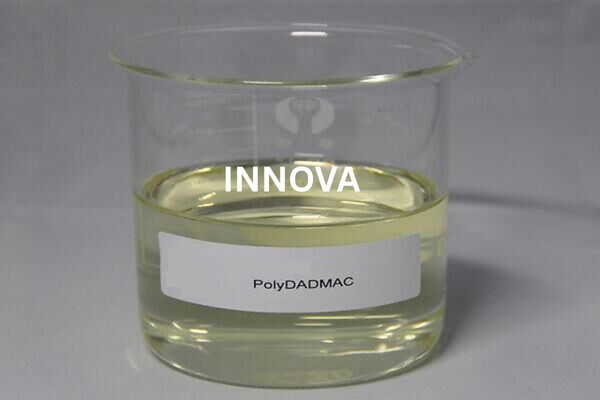
Innovacorp India manufactures and supplies Polydadmac for sugar mills in Chennai and Tamil Nadu — a high-charge cationic polymer used for juice decolorization and colour body removal ahead of evaporation and crystallization. The range covers low, medium, and high charge density grades in liquid form, supplied for continuous dosing at the clarifier. We work with mill process teams across Tamil Nadu's sugar belt — the Cauvery delta districts and the mills that ship through Chennai port — to match the Polydadmac grade and dose to the actual juice condition, not just the product name.
Anyone who has worked a crushing season in a Tamil Nadu sugar mill knows what colour bodies do to the boiling house — juice that looks clear in the clarifier carries colour precursors through evaporation, and the colour ends up locked in the crystal. By the time the sugar reaches the centrifuge, the colour is already set. Polydadmac works at the clarifier stage, where it can still make a difference — the high cationic charge neutralises the negatively charged colour bodies (melanoidins, caramels, phenolics), so they come together and settle with the mud instead of carrying through to the evaporator. In the Cauvery delta belt, juice condition changes through the season — cane maturity, delta soil, and monsoon timing all shift the colloidal load and the charge demand. The Polydadmac grade and dose that worked in week one may need adjustment by week ten. Our technical team works with mills through those adjustments, using jar tests on the actual juice, not lab samples.
The range is organised by charge density and molecular weight. The final grade for your mill is confirmed after a jar test on your actual juice — the colloidal load and charge demand determine the choice.
Typical ranges for standard grades. The TDS for the specific product is the final reference for charge density, solid content, viscosity, and dosage.
| Parameter | Typical Range |
|---|---|
| Appearance | Clear to pale yellow viscous liquid |
| Solid Content | 20% – 40% (grade dependent) |
| Charge Density | Low / Medium / High (grade dependent) — stated on TDS |
| pH (as supplied) | 4 – 7 (grade dependent) |
| Viscosity (25°C) | 500 – 5000 cP (grade dependent) |
| Residual Monomer | Stated on TDS for each grade |
| Shelf Life | 12 – 24 months in unopened original packing |
| Storage | Cool, dry, ventilated area away from direct sunlight and freezing |
Dosage depends on the colloidal load, the charge demand, and the clarifier design. The ranges below are typical starting points — the final dose is confirmed after a jar test on your actual juice.
Polydadmac works best when dosed as a properly diluted solution — under-dilution or over-dilution both reduce performance. Dilution ratio and ageing time are stated on the TDS for each grade.
Polydadmac only works if it is matched to the juice, the colloidal load, and the clarifier design. Our technical team supports Tamil Nadu sugar mills with jar-test-based grade selection, dilution and ageing guidance for the dilute solution, dose adjustment through the crushing season, compatibility checks with the anionic flocculant used in the clarifier, storage and handling guidance, and TDS/MSDS documentation. If a batch underperforms against the approved specification, we investigate with your mill team before the next dispatch. Share your juice pH, colloidal load, current Polydadmac grade, and clarifier design and we will suggest a grade and starting dose for a jar test.
Polydadmac is a high-charge cationic polymer that neutralises negatively charged colour bodies such as melanoidins, caramels, and phenolics in sugar juice. This helps remove colour precursors before crystallisation and supports better colour in the final sugar. The specific grade and dose depend on the juice condition and the mill's process — confirmed after a jar test on your juice.
In industrial wastewater treatment, Polydadmac acts as a primary coagulant — it neutralises the negative charge on colloidal particles, so they come together and settle as floc. This is particularly useful where the colloidal load is high and the charge is strongly negative. It is often used alongside an inorganic coagulant such as alum or PAC rather than as a replacement, depending on the wastewater and the treatment target.
Polydadmac is supplied in multiple grades with charge density stated on the TDS for each grade. Charge density, solid content, and viscosity are the key specification parameters — customers should confirm these against their application before ordering.
Technical Data Sheets (TDS) and Material Safety Data Sheets (MSDS) are provided on request for all supplied Polydadmac grades, so mill engineers and plant operators can verify charge density, solid content, viscosity, and handling requirements before ordering.
Share your juice pH, colloidal load, current Polydadmac grade, clarifier design, and estimated monthly quantity. We will confirm the grade, charge density, dosing rate, packing format, price range, and dispatch timeline — usually within one working day. Call +91-9312871070 or email info@sugarchemicalsindia.com with your requirement.
© 2026 Innovacorp India Pvt Ltd. All Rights Reserved. Managed & Developed by Innova Corporate India
 Chat with Us