
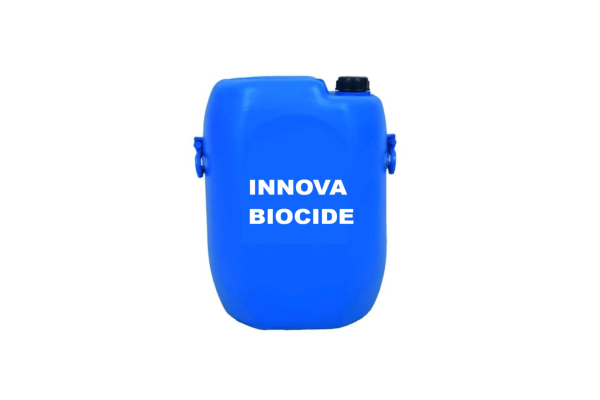
In Germany, the biocide question in a cooling tower is not only about microbial control—it is also about compliance. The 42nd BImSchV requires operators of evaporative cooling systems and cooling towers to monitor Legionella and report exceedances to the authorities. VDI 2047 goes further, specifying that only biocides approved under the Biocidal Products Regulation may be used, and that efficacy against Legionella must be demonstrated by test. For plants running cooling towers or RO systems, this means the biocide has to work and it has to fit the regulatory framework. Innovacorp manufactures and supplies oxidizing and non-oxidizing biocides for industrial water systems, with formulations suitable for cooling circuits and membrane systems where biofilm and microbial growth need to be managed.
A planktonic bacteria count can look acceptable while a biofilm is quietly doing damage on the tube surface. Even a thin biofilm layer reduces heat transfer, increases energy consumption and can cause microbiologically influenced corrosion. It also protects pathogens from biocide contact and narrows pipework over time. This is why biocide programs that only target free-floating bacteria often underperform. The treatment needs to reach the sessile organisms attached to surfaces, and that requires the right active, the right concentration and the right contact time.
German regulations add a layer of complexity that buyers in other markets may not face. Under the Abwasserverordnung, continuous treatment of open cooling circuits is restricted to hydrogen peroxide or ozone. Other biocides are limited to shock treatment. For non-oxidizing biocides, the VDI guideline requires quarterly rotation of the active substance. These rules mean a biocide program that works in another country cannot simply be copied into a German plant. The product and the dosing strategy both have to be adapted to the local regulatory context. Buyers in Deutschland should confirm with their regulatory team that the selected product and treatment mode are permitted for their specific system type.
Oxidizing biocides act quickly and can be monitored continuously in some cases, but they are consumed by organic matter and can be incompatible with certain membrane materials. Non-oxidizing biocides provide sustained activity against biofilm but require rotation and careful dose control. In a cooling tower, a shock dose of a non-oxidizing product may be used alongside a continuous oxidizing program, depending on the system and the regulatory allowance. In an RO system, the compatibility question is even more critical—some biocides can degrade membranes, so the product choice has to be made with the membrane manufacturer's constraints in mind.
| Property | Typical Range |
|---|---|
| Appearance | Liquid, clear to pale yellow |
| Active content | Confirm on TDS |
| pH (as supplied) | Confirm on TDS |
| Density at 25°C | Confirm on TDS |
| Shelf life | Confirm on TDS |
Specific values depend on the grade selected. TDS is available on request.
Cooling water biocide dosing typically falls in the range of 50–200 ppm for shock treatment and 5–20 ppm for continuous dosing, but the actual figure depends on system volume, water quality and microbial load. For RO systems, the dose is usually lower and must be confirmed against membrane compatibility. Dosing should be adjusted based on monitoring results rather than held fixed. Final dosage recommendations are confirmed after a system survey and, where required, a plant trial.
Standard industrial packing. Specific pack sizes can be discussed based on handling and storage requirements.
If biofilm persists despite biocide dosing, the first thing to check is whether the product is reaching the surface where the biofilm is established. Poor distribution in a cooling tower basin or dead legs in a recirculating loop can leave biofilm untouched even with a correct dose. Second, confirm the regulatory status of the product for the specific application—a biocide permitted for shock treatment may not be permitted for continuous dosing. Third, if Legionella is the concern, the monitoring method matters; a negative dipslide does not rule out the presence of the organism. Finally, for RO systems, never select a biocide without checking membrane compatibility, as the cost of a damaged membrane far exceeds the cost of the biocide.
What types of biocides are used in German cooling water systems?
Both oxidizing and non-oxidizing biocides are used. Under German regulations, cooling water biocides must be approved under the Biocidal Products Regulation, and non-oxidizing actives typically need to be rotated quarterly. Continuous treatment of open cooling circuits is restricted to hydrogen peroxide or ozone; other biocides are used as shock treatment.
How does biofilm affect cooling tower efficiency?
Even a thin biofilm layer reduces heat transfer, increases energy consumption and can cause microbiologically influenced corrosion. It also protects pathogens and narrows pipework. Regular biocide treatment helps keep biofilm under control.
What is the typical dosage range for cooling water biocides?
Typical ranges are 50–200 ppm for shock treatment and 5–20 ppm for continuous dosing, but the actual dose depends on water quality, system volume and microbial load. Dosing should be adjusted based on monitoring results. Final recommendations are confirmed after a system survey.
Can the same biocide be used for RO systems and cooling towers?
Not necessarily. RO systems have different compatibility requirements, and some biocides can damage membranes. The choice depends on the membrane type, feed water quality and the specific organisms causing the problem. A separate product recommendation is usually needed for RO versus cooling tower applications.
Call +91-9312871070 to discuss your cooling water or RO biocide requirements and request a TDS.
© 2026 Innovacorp India Pvt Ltd. All Rights Reserved. Managed & Developed by Innova Corporate India
 Chat with Us