A pool manager in Goa tests the water every morning. Free chlorine, pH,
total alkalinity, sometimes calcium hardness. The numbers tell a story — and if they
drift, guests notice before the logbook does. Innovacorp manufactures,
exports and supplies swimming pool chemicals for Goa's hotels, resorts, villas and
commercial pools. The range covers TCCA 90, SDIC 56, algaecides, pH balancers, alkalinity
adjusters and clarifiers, and the working conversation starts with your pool's test
report, not a fixed dosing chart.
The Three Numbers a Pool Manager Checks Every Morning
Goa's tropical conditions put pool water under a specific kind of stress. High ambient
temperature, strong UV exposure, heavy bather load during peak season, and frequent
top-up from source water that varies in hardness — all of this pushes the chemistry
around faster than in a temperate climate. The three numbers that matter most:
- Free residual chlorine: The active sanitizer. If it drops below 1 ppm, pathogens have a window. If it climbs above 3 ppm, bathers feel it in their eyes and skin.
- pH: Chlorine's effectiveness depends on pH. At pH 7.2–7.6, hypochlorous acid (the active form) is at its most effective. Above pH 8, most of the chlorine is present but not doing much.
- LSI (Langelier Saturation Index): A calculated value from pH, calcium hardness, total alkalinity and temperature. If LSI is negative, water is corrosive to tiles and equipment. If positive, it scales. Near zero is balanced.
Most pool problems in Goa trace back to one of these three drifting out of range for a
few days. The chemicals below are the tools to bring them back.
Pool Chemicals We Manufacture, Export & Supply to Goa
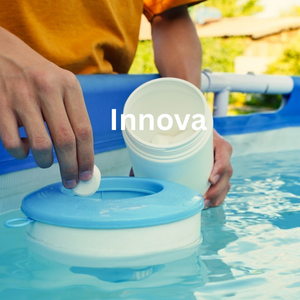
- TCCA 90 (Trichloroisocyanuric acid): Stabilised chlorine in tablet and granular form. The cyanuric acid in TCCA slows chlorine loss under UV, which is why it is commonly used in outdoor pools in tropical climates.
- SDIC 56 (Sodium dichloroisocyanurate): Fast-dissolving stabilised chlorine granules, typically used for shock dosing and daily sanitisation in smaller pools.
- pH Plus (Sodium carbonate) and pH Minus (Sodium bisulphate or hydrochloric acid): For raising or lowering pH when test results drift.
- Total Alkalinity Adjuster (Sodium bicarbonate): For stabilising pH against sudden swings — especially relevant in high-evaporation conditions.
- Calcium Hardness Raiser (Calcium chloride): For low-hardness source water, where LSI tends to go negative.
- Algaecides (quaternary ammonium and copper-based): For prevention and treatment of green, black and mustard algae.
- Clarifiers and flocculants: For binding fine suspended particles so the filter can catch them.
- Pool shock (Calcium hypochlorite or unstabilised chlorine): For breakpoint chlorination when combined chlorine (chloramines) builds up.
Specifications
| Product |
Active Content |
pH (1% solution) |
Form |
| TCCA 90 | 90% available chlorine | 2.7 – 3.2 | Tablet / granular |
| SDIC 56 | 56% available chlorine | 5.5 – 7.0 | Granular |
| Calcium Hypochlorite | 65 – 70% available chlorine | 11 – 12 | Granular / briquette |
| pH Plus (Sodium Carbonate) | ≥ 99% | 11 – 12 | Powder |
| pH Minus (Sodium Bisulphate) | ≥ 93% | 1 – 2 | Granular |
| Alkalinity Adjuster | ≥ 99% | 8 – 9 | Powder |
| Calcium Hardness Raiser | ≥ 77% | 8 – 10 | Granular |
Final specification is confirmed against the product TDS for each grade.
Dosing — Free Chlorine ppm and gm/m³
Pool dosing is set on volume and current test values, not on a fixed calendar. As a
working reference:
- Routine chlorination (TCCA 90): 1 tablet (200 g) per 10 m³ of pool volume per week, adjusted to maintain 1–3 ppm free chlorine.
- Shock dosing (SDIC 56 or calcium hypochlorite): 10–15 g/m³ of pool volume, applied at dusk, with the pool closed for 4–6 hours.
- pH adjustment: pH Plus or Minus dosed in 100 g increments per 10 m³, with re-test 4 hours later. Do not overshoot — adjust in small steps.
- Total alkalinity: 150–200 g of sodium bicarbonate per 10 m³ to raise TA by 10 ppm.
- Calcium hardness: 150 g of calcium chloride per 10 m³ to raise CH by 10 ppm.
- Algaecide: 5–10 ml/m³ as a weekly maintenance dose; higher for active algae treatment.
These are starting ranges. Final dosing depends on your pool's volume, bather load,
source water and current test results. If you do not have a recent test report, we can
suggest what to test before choosing a product.
Packing
- TCCA 90: 1 kg, 5 kg, 25 kg packs (tablets or granules)
- SDIC 56: 1 kg, 5 kg, 25 kg packs
- Liquid chemicals (pH Minus, algaecides): 5 L, 20 L, 200 L cans
- Powders (pH Plus, alkalinity, calcium hardness): 5 kg, 25 kg packs
What Pool Managers Usually Ask
A few questions that come up in almost every technical discussion:
- "Why does my pool smell like chlorine even after dosing?" — That smell is usually chloramines (combined chlorine), not free chlorine. It builds up when free chlorine is not high enough to break down bather waste. A shock dose at dusk is the usual starting point.
- "How do I stop algae coming back every monsoon?" — Algae prevention is mostly about holding free chlorine steady and brushing the pool walls weekly. Algaecide helps, but it is not a substitute for consistent chlorination.
- "Is TCCA 90 safe for my vinyl-liner pool?" — TCCA is acidic and should not be added directly to a vinyl liner without pre-dissolving. For vinyl pools, SDIC 56 or calcium hypochlorite are usually easier to work with. Final suitability depends on your liner and current water chemistry.
- "Can we use the same chemicals across multiple properties?" — Yes, but dosing differs by pool volume and bather load. We work with multi-property teams on a shared grade list and per-property dosing cards.
Technical Support for Goa Pool Teams
We do not sell drums and walk away. For Goa hotels, resorts and villas, we review your
pool test report, walk through LSI calculation with your team, and recommend the grade
mix and dosing plan. If a pool is turning green mid-season or chloramine levels are
building, call us — we will look at the test data with you. TDS and MSDS are shared on
request.
Frequently Asked Questions
What swimming pool chemicals does Innovacorp manufacture and supply in Goa?
Innovacorp manufactures, exports and supplies TCCA 90 tablets and granules, SDIC 56
granules, algaecides, pH balancers (pH Plus and pH Minus), alkalinity adjusters, calcium
hardness raisers and pool clarifiers. The right combination depends on your pool's
current water test results.
How should Goa commercial pools maintain free chlorine levels?
For high-traffic Goa resorts, free residual chlorine is typically maintained between 1.0
and 3.0 ppm, with pH held between 7.2 and 7.8. TCCA 90 is stabilised chlorine — it holds
up better under the tropical sun than unstabilised hypochlorite, which breaks down
faster in UV exposure.
Why is LSI balance important for swimming pools in Goa?
LSI (Langelier Saturation Index) balance indicates whether pool water is corrosive,
scale-forming or balanced. In Goa's tropical conditions, where evaporation and refill
cycles are frequent, LSI tends to drift. pH, calcium hardness and total alkalinity are
adjusted together to keep LSI near zero, which helps protect tiles, grout and pump
internals.
Do you supply swimming pool chemicals in bulk to Goa hotels and resorts?
Yes. We supply TCCA 90 in 1 kg, 5 kg and 25 kg packs, and liquid chemicals in 5 L, 20 L
and 200 L cans. For Goa hotels and resorts, we coordinate on monthly or seasonal supply
schedules and share TDS and MSDS on request.
Share Your Pool Test Report
Tell us your pool volume, current free chlorine, pH and LSI values, and the bather load
you handle in peak season. We will suggest the grade mix and the working dosing range
for your pool — and if you manage multiple properties, we can map the requirement across
them. Call +91-9312871070.

 Chat with Us