
A die-casting plant in IMT Manesar checks its boiler water every shift and finds the pH drifting down to 9.8. A commercial tower in Cyber City notices corrosion product building up in its cooling water return line. A food processing unit in Udyog Vihar keeps adding caustic soda, but the alkalinity swings between shifts because the feedwater hardness changes with the municipal supply. These are pH control problems, and pH control is the first line of defence against corrosion in any steam or cooling system. Innovacorp India supplies alkalinity builders to industrial and commercial facilities across Gurugram, with grades selected for the system — boiler or cooling — and the water chemistry that actually exists here.
Gurugram's industrial belt draws water from a mix of municipal supply and groundwater, and the quality varies across zones. Hardness, TDS, and natural alkalinity fluctuate. In a boiler, that variability shows up as pH drift. Feedwater with low alkalinity and dissolved CO2 produces carbonic acid in the condensate return, which attacks steel. Feedwater with high hardness and inconsistent pH makes precipitation programmes less predictable. An alkalinity builder does not replace a full treatment programme, but it stabilises the pH window that every other treatment chemical depends on. Without stable pH, corrosion inhibitors and scale control chemicals cannot perform reliably.
In boiler systems, the alkalinity builder is dosed to the feedwater or boiler water to maintain the pH range that keeps the protective magnetite layer intact. In cooling water systems, the builder adjusts pH to keep the Langelier Saturation Index within a range where neither scale nor corrosion dominates. The application is different, and the product grade is different. A boiler alkalinity builder is designed for high-temperature, low-oxygen environments. A cooling water builder works at ambient temperature with higher dissolved oxygen. Using the wrong grade in the wrong system wastes chemical and may not solve the problem.
Boiler water pH control is about corrosion prevention in steel at high temperature and pressure. The target pH is usually alkaline, and the builder must not contribute to carryover or foaming. Cooling water pH control is about scale and corrosion balance at the heat exchanger surfaces. The target pH depends on the cycles of concentration and the calcium hardness of the make-up water. Gurugram plants often run both systems, and the chemical programme for each should be reviewed separately. A single product used for both is a compromise that rarely performs well in either.
Indicative values. Final specification is confirmed against your system and water analysis.
| Parameter | Typical Range |
|---|---|
| Appearance | Clear to slightly hazy liquid |
| pH (as supplied, 1% solution) | 10.5 – 12.5 |
| Specific Gravity | 1.05 – 1.20 |
| Active Alkalinity | Confirmed on TDS |
| Shelf Life | 12 months in sealed container |
Boiler water alkalinity builder dose is calculated from the feedwater alkalinity, the target boiler water pH, and the blowdown rate. Cooling water dose depends on the make-up water alkalinity, the cycles of concentration, and the target pH. There is no universal ppm figure that works across systems. A plant in Manesar with high-hardness groundwater will need a different dose from a commercial tower in Cyber City on municipal supply. The starting point is a water analysis, not a guess.
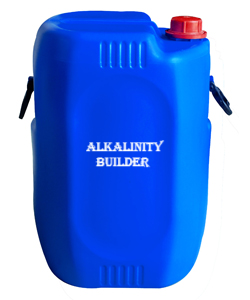
Standard industrial packing is 200 L HDPE drums for liquid products and 50 kg HDPE bags for powder grades. Store in a cool, dry place away from acids. Alkalinity builders are alkaline materials — follow standard PPE and handling procedures for alkaline chemicals.
Caustic soda raises pH, but it is not a formulated alkalinity builder. It can cause caustic embrittlement in boilers if overfed, and it does not provide the buffering that a blended alkalinity builder offers. In cooling systems, caustic soda without scale inhibitor can precipitate hardness as hydroxide sludge. The cheaper chemical often costs more in corrosion repairs and downtime.
We work with plants across Gurugram's industrial areas — Udyog Vihar, IMT Manesar, Sector 37 (Pace City), and the commercial cooling tower operators in Cyber City and Golf Course Road. For the wider NCR industrial belt, we also support requirements in Faridabad, Bawal, and Sonipat (Kundli), where similar boiler and cooling water systems face comparable pH control challenges.
We help interpret water analysis reports and recommend the alkalinity builder grade and dose range for your system. Lab trials can be arranged on your water sample before a plant-scale order. We do not claim on-site visits unless separately confirmed.
What alkalinity range should boiler water be maintained at in Gurugram plants?
For most industrial boilers, boiler water alkalinity is typically maintained in the range that keeps pH between 10.5 and 11.5. The exact target depends on boiler pressure, feedwater quality, and the treatment programme. Gurugram's groundwater hardness varies, so the alkalinity builder dose is set after checking your feedwater analysis.
How does an alkalinity builder prevent corrosion in Gurugram's boiler systems?
Acidic conditions in boiler water cause hydrogen embrittlement and general corrosion. An alkalinity builder raises pH and maintains the protective magnetite layer on steel surfaces. In Gurugram plants using hard groundwater, pH control also helps precipitation-based scale control work more predictably.
Can the same alkalinity builder be used for cooling towers in Gurugram?
Cooling water systems have different chemistry from boilers. A cooling water alkalinity builder adjusts pH to keep scale and corrosion in balance at the cycles of concentration the tower runs at. The product grade and dose differ from boiler treatment. Confirm the application before selecting a grade.
What packing is available for alkalinity builder supply to Gurugram?
Standard industrial packing is 200 L HDPE drums for liquid products and 50 kg bags for powder grades. Pack sizes are confirmed at the time of order.
Call +91-9312871070 to discuss your Gurugram plant's alkalinity control requirement.
© 2026 Innovacorp India Pvt Ltd. All Rights Reserved. Managed & Developed by Innova Corporate India
 Chat with Us