
A refinery operator looking at melt liquor that still carries colour after clarification. A process engineer trying to extend the life of an activated carbon bed by removing more colour upstream. A plant manager evaluating whether a cationic polymer can improve floc formation before filtration. These are the colour problems that decolourizing agents address in a sugar refinery. Innovacorp supplies cationic polymer decolourizing agents for refinery process streams. This page explains what the chemistry does and where it fits. Note for Kohima buyers: Nagaland does not have an operating sugar refinery. The technical content here applies to refinery operations elsewhere; if you operate a refinery outside Nagaland and are evaluating suppliers, the chemistry is relevant.
Activated carbon and ion exchange resins are adsorbents. They remove colour by trapping colour bodies on a surface or within a pore structure. They are effective, but they have a capacity limit: once the bed is saturated, it must be regenerated or replaced. The colour load reaching the bed determines how long that takes.
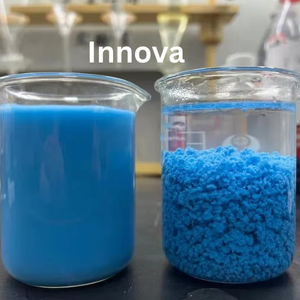
A decolourizing agent works differently. It is a cationic polymer that binds to dissolved colour bodies in the liquor, neutralises their charge, and forms an insoluble floc. The floc is removed by filtration or flotation before the liquor reaches the adsorbent. The result is a lower colour load on the carbon or resin, which extends the time between regeneration or replacement.
The two are complementary, not competing. A decolourizing agent reduces the load; the adsorbent polishes the remaining colour. Using one without the other leaves performance on the table.
Colour bodies in sugar process streams—melanoidins, caramels, and polyphenol-derived compounds—carry a negative charge in solution. That charge keeps them dispersed. A cationic polymer binds to these negative sites, reducing the electrostatic repulsion and allowing the colour bodies to aggregate.
Contact time matters. The polymer needs a few minutes to interact with the colour bodies before the floc is formed. Dose matters too: too little and the charge is not fully neutralised; too much and the polymer can re-stabilise the particles or carry over downstream. The correct dose is established by bench trial.
A typical refinery melt treatment sequence is: affination → melting → clarification (phosphatation or carbonatation) → decolourizing agent addition → filtration → adsorbent decolourization (carbon or resin) → crystallization. The decolourizing agent sits after clarification and before filtration, so the floc it forms is removed before the liquor reaches the adsorbent bed.
This placement matters. If the agent is added before clarification, it competes with the clarification chemistry. If it is added after filtration, there is no downstream separation step to remove the floc. The correct injection point is determined by the refinery's actual equipment layout and process flow.
Decolourizing agent dose is expressed in ppm relative to process liquor volume or solids. Published refinery trial data describes dose ranges in the hundreds of ppm, with contact times of a few minutes before floc separation. There is no universal dose. The correct dose depends on:
A bench trial on your actual liquor is the only reliable way to set the dose. TDS on request covers recommended dose ranges for specific product grades.
| Parameter | Typical Range / Note |
|---|---|
| Appearance | Clear to slightly hazy liquid; confirm on TDS |
| Active content | Cationic polymer; confirm on TDS |
| pH (as supplied) | Confirm on TDS |
| Viscosity | Low viscosity, suitable for metering pump dosing; confirm on TDS |
| Shelf life | Confirm on TDS; store sealed, away from direct sunlight and freezing |
Standard industrial packing applies; pack sizes on request. Store containers sealed and under cover, away from direct sunlight and freezing temperatures. Kohima's heavy monsoon rainfall means storage area humidity can be high; keep containers off the floor and away from moisture ingress. Check the TDS for specific storage limits and shelf life. Opened containers should be resealed to prevent contamination. Do not store near incompatible chemicals.
Activated carbon removes colour by adsorption onto a porous surface. A decolourizing agent is a cationic polymer that binds to dissolved colour bodies, neutralises their charge, and forms a floc that can be separated by filtration or flotation. They are complementary: the decolourizing agent reduces the colour load reaching the carbon bed, extending carbon life. Neither replaces the other; they work at different stages of the refinery train.
It is dosed by metering pump into the process stream, typically after clarification and before filtration or adsorbent treatment. Dose is expressed in ppm relative to the process liquor volume or solids. The correct dose depends on the colour load and the separation equipment available. A bench trial on the actual liquor determines the starting point; there is no universal dose.
The same cationic polymer chemistry is used in some wastewater decolourization applications, but the product grade and dose differ from sugar refinery use. For effluent treatment, the starting point is a jar test on the actual effluent: pH, colour body type, and suspended solids determine whether a cationic decolourant is effective. Do not assume a sugar-grade product will work on a different effluent without testing.
Store containers sealed and under cover, away from direct sunlight and freezing temperatures. Check the TDS for specific storage limits and shelf life. Opened containers should be resealed to prevent contamination. In humid climates, keep containers off the floor and away from moisture ingress.
Call +91-9312871070 to discuss decolourizing agent selection for your refinery.
© 2026 Innovacorp India Pvt Ltd. All Rights Reserved. Managed & Developed by Innova Corporate India
 Chat with Us