
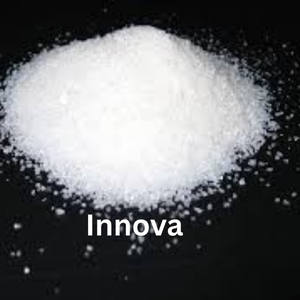
Lucknow's farming belt has a specific water problem. The Gomti belt and the surrounding UP plains get monsoon rain in bursts, but the soil does not always hold it. Loam and clay soils in the region lose a significant portion of irrigation water to percolation and evaporation between cycles, which is why the gap between two irrigations matters so much. Innovacorp manufactures, exports and supplies super absorbent polymers (SAP) for agriculture, horticulture and industrial water retention in Lucknow. The range covers potassium polyacrylate and sodium polyacrylate grades, and the working conversation starts with your soil type and crop, not a generic product chart.
Most of Lucknow's farmland is loam or clay loam. Loam holds water better than sand but still loses a significant portion to deep percolation between irrigations. Clay holds water well but shrinks and cracks on drying, which breaks root contact and causes stress. In both cases, the crop goes into stress between irrigations — even when the farmer has irrigated on schedule. SAP addresses this by holding water in the root zone for longer. The polymer absorbs water when it is available and releases it slowly as the soil dries, which bridges the gap between irrigations. It is not a substitute for irrigation — it is a way to make the same irrigation go further. Placement matters: SAP works best when mixed into the root zone at sowing, not broadcast on the surface later.
Grades are grouped by chemistry and application, because that is how selection actually works:
Grade selection depends on your soil type, crop cycle, and whether the application is agriculture or industrial. We do not recommend a fixed grade for every field.
SAP works through a cross-linked molecular network. When water contacts the granule, the network opens and absorbs water into the spaces between the polymer chains. The cross-links stop the network from dissolving, so the water is held inside the granule. As the surrounding soil dries, the water potential outside the granule drops below the water potential inside, and the water moves out into the soil solution — where the roots can take it up. A few practical points:
These numbers vary by grade. The specific values for each product are in the TDS.
| Property | Typical Value |
|---|---|
| Chemistry | Potassium polyacrylate / Sodium polyacrylate (grade-dependent) |
| Appearance | White to off-white granules |
| Absorption Capacity (distilled water) | 200 – 400 g/g (grade-dependent) |
| Absorption Capacity (0.9% saline) | 50 – 100 g/g (grade-dependent) |
| pH (1% suspension) | 6.0 – 8.0 |
| Bulk Density | 0.6 – 0.8 g/cm³ |
| Particle Size | 0.3 – 2.0 mm (grade-dependent) |
| Shelf Life | 24 months from date of manufacture (unopened, dry storage) |
Final specification is confirmed against the product TDS for each grade.
SAP dosing is set on root zone volume, not on field area alone. As a working reference for Lucknow conditions:
These are starting ranges. The final rate depends on your soil type, rainfall pattern and crop cycle. Our team works with your agronomist on this.
A few questions that come up in almost every technical discussion:
We do not sell bags and walk away. For Lucknow growers — in the Gomti belt and the surrounding UP plains — we review your soil type, water source and crop cycle, and recommend the grade and application method. If SAP is not giving the expected water-holding benefit, call us — we will look at the placement, dose and water quality with you. TDS and MSDS are shared on request.
Super Absorbent Polymer (SAP) is a cross-linked hydrogel granule that absorbs and holds water in the soil, releasing it slowly to the root zone as the soil dries. In Lucknow's variable rainfall conditions, SAP helps bridge moisture gaps between irrigation cycles, particularly in sandy and loam soils where water drains quickly.
Sodium-based SAP can add sodium to the soil over time, which in clay-heavy soils may affect soil structure. Potassium-based SAP carries potassium instead, which is a nutrient the plant can take up. For Lucknow's loam and clay soils, potassium polyacrylate is generally the preferred grade.
Absorption capacity varies by grade and water quality — typical field-grade potassium polyacrylate absorbs 200–400 times its weight in distilled water, with lower figures in hard or saline water. Field life depends on soil type, microbial activity and application method — typically 3–5 seasons before significant performance decline.
Yes. We supply in 1 kg, 5 kg and 25 kg packs for agriculture use, and in 25 kg and jumbo bags for industrial applications. For Lucknow farms, plantations and industrial buyers, we coordinate on seasonal supply schedules and share TDS and MSDS on request.
Tell us your soil type, your crop, and how often you irrigate. We will suggest the grade and the working application rate for your field. Call +91-9312871070.
© 2026 Innovacorp India Pvt Ltd. All Rights Reserved. Managed & Developed by Innova Corporate India
 Chat with Us