
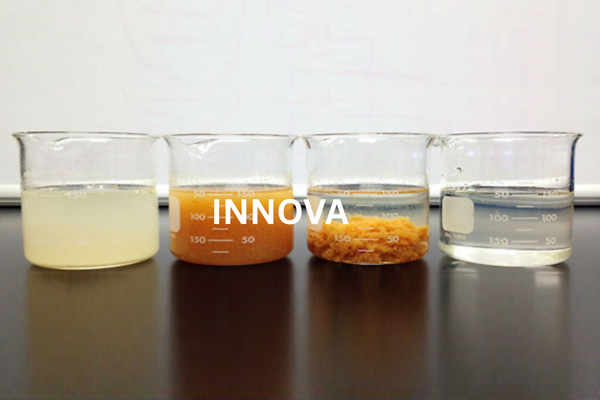
Innovacorp India manufactures, exports, and supplies flocculants in Mumbai and Maharashtra — anionic, cationic, and non-ionic polyacrylamide grades for sugar mill juice clarification, mud settling, and industrial effluent treatment. The range is supplied as powders and emulsions for continuous dosing in clarifiers and ETP plants. We work with mill process teams and ETP operators across Maharashtra's industrial corridors — Taloja, Ambernath, Thane, and the wider chemical belt — to match the flocculant grade and dose to the actual juice or effluent condition, not just the product name.
Anyone who has run a juice clarifier or an ETP clarifier in Mumbai's industrial belt knows what happens when the flocculant is wrong — the mud settles slowly, the clarified juice stays turbid, and the filter station has to work harder to handle the mud volume. In Mumbai, the additional variable is the coastal discharge norm: the treated effluent has to meet the coastal discharge standards, and a flocculant that does not settle the solids properly shows up in the TSS and turbidity numbers at the outfall. A flocculant that is matched to the juice or effluent condition settles the solids cleanly and keeps the clarified stream within the target. The catch is that condition changes — effluent load shifts with production cycles, and juice condition shifts through the crushing season. The flocculant and dose that worked in week one may need adjustment by week ten. Our technical team works with plants through those adjustments, using jar tests on the actual stream, not lab samples.
The range is organised by charge type and molecular weight. The final grade for your plant or ETP is confirmed after a jar test on your actual stream — pH, suspended solids, and clarifier design all affect the choice.
Grades are available in a range of molecular weights and charge densities — the specific grade is confirmed against your process conditions.
Typical ranges for standard grades. The TDS for the specific product is the final reference for molecular weight, charge density, and dosage.
| Parameter | Typical Range |
|---|---|
| Appearance | White powder or milky emulsion (grade dependent) |
| Charge Type | Anionic / Cationic / Non-ionic |
| Molecular Weight | Medium to very high (grade dependent) |
| Charge Density | 10% – 50% (grade dependent) |
| pH (1% solution) | 4 – 9 (grade dependent) |
| Shelf Life | 12 – 24 months in unopened original packing |
| Storage | Cool, dry, ventilated area away from moisture and direct sunlight |
Dosage depends on the suspended solids load, the pH, and the clarifier design. The ranges below are typical starting points — the final dose is confirmed after a jar test on your actual juice or effluent.
Flocculants work best when dosed as a properly aged dilute solution — under-dilution or over-dilution both reduce performance. Ageing time and dilution ratio are stated on the TDS for each grade.
A flocculant only works if it is matched to the juice or effluent, the pH, and the clarifier design. Our technical team supports Mumbai and Maharashtra plants with jar-test-based grade selection, dilution and ageing guidance for the dilute solution, dose adjustment through the season or production cycle, ETP and sludge dewatering support, coastal discharge compliance support (TSS and turbidity), storage and handling guidance, and TDS/MSDS documentation. If a batch underperforms against the approved specification, we investigate with your plant team before the next dispatch. Share your stream pH, suspended solids load, and clarifier design and we will suggest a grade and starting dose for a jar test.
Anionic polyacrylamide grades are typically used for juice clarification and mud settling in sugar mills. The specific grade and dose depend on juice pH, mud volume, and the clarifier design — the final selection is confirmed after a jar test on your juice.
Anionic flocculants work well in mineral-rich suspensions such as sugar mill juice and mud, where negatively charged particles are bridged by the polymer. Cationic flocculants are typically used for organic-rich suspensions such as sludge dewatering and effluent treatment, where positively charged sites neutralise negative charges.
Innovacorp supplies anionic, cationic, and non-ionic polyacrylamide flocculants for wastewater treatment in Mumbai and Maharashtra. The grade is selected based on the effluent characteristics — suspended solids, charge, and pH — and confirmed after a jar test on your actual effluent.
Technical Data Sheets (TDS) and Material Safety Data Sheets (MSDS) are provided on request for all supplied flocculants, so plant engineers can verify molecular weight, charge density, dosage, and handling requirements before ordering.
Share your stream pH, suspended solids load, clarifier design, current flocculant grade, and estimated monthly quantity. We will confirm the grade, dosage, dilution, packing format, price range, and dispatch timeline — usually within one working day. Call +91-9312871070 with your requirement.
© 2026 Innovacorp India Pvt Ltd. All Rights Reserved. Managed & Developed by Innova Corporate India
 Chat with Us