
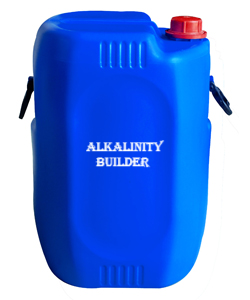
Boiler systems in Muscat's refineries, desalination plants and industrial units share a common vulnerability: feedwater quality that shifts with the source. The city depends on desalinated water blended with limited groundwater, and the blend changes through the year. When the feedwater carries more dissolved CO2 and lower alkalinity, condensate return turns acidic, and carbonic acid corrosion begins eating away at return lines before anyone notices. Oxygen pitting follows. An alkalinity builder is the simplest intervention — a controlled pH raise that keeps boiler water in the protective alkaline range and holds corrosion in check. Innovacorp supplies alkalinity builders for these applications, matched to the boiler pressure and feedwater chemistry rather than sold as a single generic product.
Two mechanisms cause most boiler corrosion in the region. First, carbonic acid corrosion. Dissolved CO2 enters the boiler with feedwater, flashes over with steam, and dissolves into condensate to form carbonic acid. The pH of the condensate drops, often below 6.5, and the return lines corrode from the inside. Second, oxygen pitting. Even small amounts of dissolved oxygen, if not removed by deaeration or chemical scavenging, cause localised pitting that shortens tube life. Both mechanisms are worst when feedwater alkalinity is low and CO2 load is high — exactly the pattern seen when desalinated water dominates the feed blend.
The fix is not just "add caustic." An alkalinity builder is a buffered product, typically based on sodium hydroxide, sodium carbonate, or a blend, formulated to raise boiler water pH without causing caustic embrittlement or carryover. The target pH for industrial boilers is usually 10.5 to 11.5 in the boiler water, and 8.5 to 9.5 in the condensate. Outside these ranges, either corrosion or scaling risk rises.
The builder is dosed into the feedwater or directly into the boiler drum, depending on the system. It raises the pH by neutralising dissolved acids and providing alkalinity reserve. That reserve matters because it buffers against pH swings when feedwater quality changes — a common issue in Muscat's blended water supply.
For condensate return lines, a volatile alkalinity builder (such as cyclohexylamine or morpholine) is often used alongside the boiler water treatment, because it travels with the steam and protects the return system. The choice between non-volatile and volatile builders depends on whether the problem is in the boiler or the condensate loop. Many Muscat plants need both.
| Parameter | Typical Range | Relevance |
|---|---|---|
| Appearance | Clear to pale liquid | Indicates product consistency |
| pH (as supplied, 1% solution) | 11.0–13.0 | Higher pH means lower dose for the same alkalinity raise |
| Active content | 20–40% | Determines dose per unit of boiler water volume |
| Specific gravity | 1.15–1.35 | Affects dosing pump calibration |
| Density | 1.15–1.35 g/cm³ | Same as specific gravity for practical purposes |
| Shelf life (sealed) | 12–24 months | Shorter if exposed to air (CO2 absorption) |
Values above are typical ranges. Final active content and pH depend on the specific grade. Always confirm on TDS before fixing a dose or designing a dosing system.
Typical dose ranges from 50 to 300 ppm of boiler water, adjusted to maintain target pH. In Muscat's high-salinity feedwater, the required dose can be higher because the buffering demand is greater. Dose should be set by water analysis, not by a fixed rule.
Feeding point matters as much as dose. For boiler water treatment, the builder is typically dosed into the feedwater line downstream of the deaerator, or directly into the boiler drum via a chemical feed line. For condensate treatment, the volatile builder is dosed into the steam header or condensate return line. Each point requires its own dosing pump calibration and monitoring.
Final dose and feeding point should be confirmed by a water analysis and, where possible, a short trial before continuous dosing. Overdosing wastes chemical and can cause carryover; underdosing leaves the system exposed to corrosion.
Using the same builder for boiler and RO systems. RO membranes are sensitive to high pH and to certain additives. A boiler alkalinity builder may be unsuitable for RO pH adjustment. The two systems need separate products, even if both are "pH control."
Ignoring condensate return treatment. Many plants dose the boiler but leave the condensate loop unprotected. Carbonic acid corrosion continues in the return lines, and the plant sees tube failures without understanding why. A volatile builder or a filming amine is needed for the return loop.
Setting dose by pH alone. pH is a lagging indicator. Alkalinity reserve (measured as P-alkalinity or M-alkalinity) matters more for buffering against feedwater swings. Dose should be set by alkalinity target, not just pH.
Standard industrial packing: 200 L drums, 1000 L IBCs, or bulk tanker for large volumes. Pack sizes on request. Store in sealed containers in a shaded, dry area away from acids and oxidisers. In Muscat's heat, liquid products should not be exposed to direct sunlight. Opened containers should be resealed promptly — alkalinity builders absorb CO2 from the air, which reduces their effectiveness over time.
Innovacorp works with plant engineers to match builder type, dose and feeding point to the actual boiler system. Share your feedwater analysis, boiler pressure, and condensate return ratio, and we will suggest a starting grade and dose range. Final specification and performance should be confirmed through a water analysis and lab trial before full-scale dosing. We do not claim on-site support in Muscat unless separately confirmed.
An alkalinity builder raises boiler water pH into the alkaline range, typically 10.5 to 11.5, where carbonic acid corrosion and oxygen pitting are reduced. In Muscat's refineries and industrial units, feedwater quality varies with the desalinated water source, so the builder dose must be adjusted to the actual alkalinity and pH of the feedwater. Confirm the target pH range for your boiler type on TDS before dosing.
Dosage depends on feedwater alkalinity, boiler pressure, and condensate return ratio. Typical dose ranges from 50 to 300 ppm for industrial boilers, adjusted to maintain boiler water pH in the target range. In Muscat's high-salinity feedwater, higher doses may be needed. Confirm the dose through a water analysis and lab trial before continuous dosing.
Not always. Boiler alkalinity builders are formulated for high-temperature, high-pressure conditions and may contain components unsuitable for RO membranes. RO pH adjustment usually uses a different grade of caustic or proprietary antiscalant-compatible product. Share your system configuration before selecting a grade.
Store in sealed containers in a shaded, dry area away from acids and oxidisers. In Muscat's heat, liquid products should not be exposed to direct sunlight, as temperature cycling can affect concentration. Opened containers should be resealed to prevent moisture and CO2 absorption, which reduces effectiveness.
Call +91-9312871070 to discuss boiler water pH control for your Muscat plant.
© 2026 Innovacorp India Pvt Ltd. All Rights Reserved. Managed & Developed by Innova Corporate India
 Chat with Us