
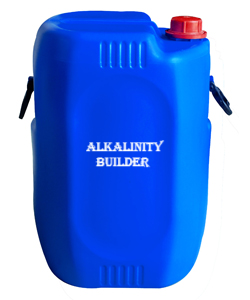
Dutch beet sugar factories run a campaign that opens in September and closes in January, and the raw juice reaching the diffuser in week one is not the same juice arriving in week eighteen. A factory in Dinteloord working early-campaign beet and a plant in Vierverlaten running stored thick juice both face one control problem: the pH window that makes carbonatation work has to be held while the feed chemistry moves underneath it. The alkalinity builder is the product that adjusts that pH before lime and carbon dioxide do their job.
This page covers where the alkalinity builder fits in a Dutch beet factory and in the boiler house on the same site, how the grade is selected, and what to check before a trial. It is not a catalogue of fixed doses, because the dose follows the juice, not the other way around.
Beet sugar purification is a liming and carbonatation process. Raw juice from the diffusion tower is heated, mixed with milk of lime, then carbonated. The calcium carbonate that forms adsorbs non-sugars and settles in the clarifier. The pH at the liming stage decides how completely that precipitation happens and how clean the clarifier overflow runs.
Through a Dutch campaign, beet quality changes. Sugar content, invert level and mineral load all move with growing conditions, harvest timing and storage. A clarifier feed pH that was correct in the first weeks can drift out of range by mid-campaign. The practical control point is the clarifier feed pH, adjusted from daily titration against the incoming juice, not from a fixed monthly setpoint.
If the liming stage runs under-alkaline, the lime reaction is incomplete. Carbonatation produces a finer precipitate that is harder to settle, and the clarifier overflow carries particles that load the downstream filters. Filtration cycles shorten, and the evaporator sees a higher suspended load. That is a plant-wide cost, not a single-stage cost.
Over-alkalisation is its own problem. Excess alkalinity pushes invert sugar destruction further than needed, darkens the juice, and can raise the lime salt load entering the evaporator. The aim is a controlled window, not maximum alkalinity.
There are three points on a Dutch beet factory where an alkalinity builder earns its place. They are separate loops with separate grade requirements, and the same drum should not be assumed to serve all three.
There is no single alkalinity builder. Grade selection is driven by the loop being treated, and the questions below are what the technical team will ask before recommending a grade.
| Loop | Data needed | Why it matters |
|---|---|---|
| Pre-liming juice | Raw juice pH, titratable acidity, buffering curve, flow rate | Sets the dose base and the control range for the liming stage |
| Carbonatation support | First carbonatation end pH, target second carbonatation pH | Controls crystal size and clarifier settling behaviour |
| Boiler water | Feed water analysis, drum pressure, target p-alkalinity, blowdown rate | Protects against acidic corrosion without crossing into embrittlement territory |
Active content, pH as supplied, density, appearance and storage conditions are stated on the TDS for the specific grade under consideration. Final specification is confirmed against the TDS before dispatch. Where a factory requires a juice-contact grade, that requirement is raised at the TDS stage — the grade is not assumed from the page.
Doses for juice-loop alkalinity builders are quoted in ppm on juice flow. Boiler-loop doses are quoted in ppm on boiler water volume. These are two different dose bases and must not be mixed.
Because beet chemistry moves through the campaign, the dose is set against a titration curve from the incoming juice and reviewed at intervals through the campaign. A factory that sets one dose in September and does not review it in December is likely to be over- or under-dosing without knowing it. The final dose for any plant is confirmed after a lab trial on that plant's own juice or boiler water.
Standard industrial packing; pack sizes on request. Store in a closed, ventilated area away from direct sunlight and incompatible acids. Shelf life and specific storage conditions are confirmed on the TDS for the grade supplied.
The technical team works from the factory's own titration data and feed-water analysis rather than from a generic recommendation sheet. Support is remote and document-based: TDS review, dose calculation from the plant's data, and clarification on compatibility with the lime and flocculant programme already in use. No on-site visit is claimed unless it has been separately confirmed.
In a Dutch beet factory, raw juice from the diffuser is limed and then carbonated. The alkalinity builder supports the pH adjustment before carbonatation, helping the calcium carbonate precipitate form and settle. The target pH is set on the juice analysis, not a fixed catalogue figure.
No. Juice treatment and boiler water treatment use different grades and different dose bases. The juice loop grade is selected on buffering load and clarifier feed pH; the boiler grade is selected on softened feed water analysis and target p-alkalinity. Call +91-9312871070 with both loop analyses for separate recommendations.
Beet quality changes through the campaign, and the acid load in raw juice moves with it. A dose set in September may over-alkalise or under-control by December. The control point is the clarifier feed pH, checked by daily titration, not a weekly fixed setpoint.
Active content, pH as supplied, density, appearance and storage conditions are shared on the TDS for the specific grade under consideration. Final specification is confirmed against the TDS before dispatch. Call +91-9312871070 to request the TDS for your loop.
Call +91-9312871070 to discuss the grade for your juice loop or boiler loop, or to request the TDS for the grade under consideration.
© 2026 Innovacorp India Pvt Ltd. All Rights Reserved. Managed & Developed by Innova Corporate India
 Chat with Us