
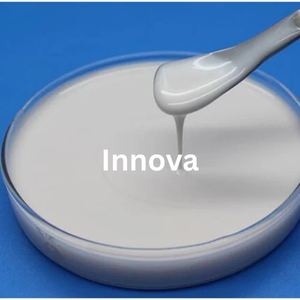
Innovacorp India manufactures and supplies industrial thickeners in Oman — polyacrylamide-based rheology modifiers and flocculants for ETP sludge thickening, mechanical dewatering, and process fluid stability. The range covers anionic, cationic, and non-ionic grades, matched to your sludge or fluid characteristics, with grade and dose confirmed after a jar test.
Industrial thickeners are high-molecular-weight polymers, and two properties determine how they perform in a given system. Molecular weight determines the size of the floc the polymer can build — higher molecular weight bridges more particles into larger, denser flocs. Charge density determines how the polymer interacts with the particle surface — anionic polymers work on positively charged particles, cationic on negatively charged, and non-ionic where charge interaction is not the dominant mechanism. In ETP sludge, the sludge chemistry decides which grade applies. A polymer that works in one plant's sludge may underperform in another's because the charge and solids content differ. That is why jar testing is the starting point, not the product catalogue.
| Property | Typical Value | Notes |
|---|---|---|
| Appearance | White powder or milky emulsion | Grade dependent |
| Charge | Anionic / Cationic / Non-ionic | Application dependent |
| Molecular weight | TDS on request | Grade dependent |
| Active content | TDS on request | Grade dependent |
| pH (1% solution) | TDS on request | — |
| Shelf life | TDS on request | Sealed, cool storage |
Final specification confirmed on TDS for your selected grade. Jar test recommended before full-scale use.
Dose is set by the sludge or fluid characteristics — solids content, charge, and particle size distribution — not by a fixed ppm figure. A jar test is the standard way to determine the right dose: a sample is dosed at several concentrations, stirred at controlled speeds for floc formation, and observed for settling rate, floc size, and supernatant clarity. The dose that gives the best settling at the lowest concentration is the starting point. In ETP sludge, the jar test is run on the actual sludge sample; in process fluids, it is run on the fluid. Do not set dose without a jar test; the optimum varies with sludge and fluid chemistry. Where colour removal is the primary objective rather than settling, colour precipitants are the more direct product.
Standard industrial packing; pack sizes on request.
The visible effects of a well-matched thickener programme show up in sludge handling and throughput. Faster settling means the clarifier can handle a higher flow, or the same flow with a smaller footprint. Denser underflow means less volume to dewater, and drier cake means lower disposal cost. In process fluids, stable viscosity means consistent pumping and no settling in storage. None of these are guaranteed outcomes — they depend on the sludge or fluid chemistry, the dose, and the equipment. The thickener is part of a treatment programme, not a standalone fix.
Two mistakes come up. First, using a thickener as a replacement for a coagulant. The coagulant neutralises charge and forms small flocs; the thickener bridges those flocs into larger ones. Using one without the other often underperforms — coagulant first, thickener second, is the typical order. Second, selecting a polymer by brand or price without a jar test. The charge and molecular weight that work in one sludge may over-dose or under-dose in another. If settling is not improving, run a jar test before increasing dose.
We review your sludge or fluid characteristics, dewatering equipment, and current polymer programme, and recommend a grade and dose. Jar test support is available to confirm performance before full-scale use. Final specification and application rate are confirmed after the trial.
To discuss thickener selection for your ETP, dewatering equipment, or process fluid in Oman, call +91-9312871070. Share your sludge or fluid characteristics, and we will recommend a grade for trial.
Q1. How do thickeners accelerate sedimentation in Oman wastewater plants?
Thickeners are high-molecular-weight polymers that bridge fine particles into larger, denser
flocs. In ETP clarifiers, this increases settling velocity, which produces a denser sludge
underflow and clearer overflow. The right polymer and dose depend on the sludge
characteristics — confirmed after a jar test.
Q2. What is shear-thinning and why does it matter for process fluids?
Shear-thinning means viscosity decreases as shear rate increases. A fluid that is thick when
standing but flows easily when pumped is easier to transport and keeps solids in suspension
during storage. This matters for slurries, suspensions, and process fluids where settling
would otherwise occur. The right rheology modifier depends on the fluid and the target
viscosity profile.
Q3. What is the difference between a coagulant and a thickener?
A coagulant — such as Polydadmac or alum — neutralises the charge on particles so they can
come together. A thickener or flocculant — such as a high-molecular-weight polyacrylamide —
bridges the coagulated particles into larger flocs that settle or dewater faster. They are
complementary: coagulant first, thickener second, is the typical order.
Q4. How should industrial thickeners be stored in Oman's heat?
Store in a cool, shaded area away from direct sunlight and heat sources. Keep containers
sealed and labelled. Polymer emulsions and powders can degrade faster at high temperature, so
stock rotation matters. Shelf life and storage conditions for your specific grade are
confirmed on the TDS.
© 2026 Innovacorp India Pvt Ltd. All Rights Reserved. Managed & Developed by Innova Corporate India
 Chat with Us