
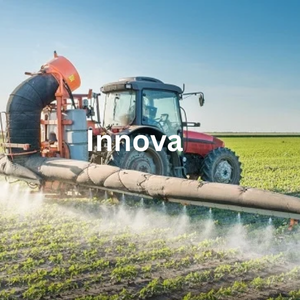
Sonipat's farming runs on a tight rotation. Wheat in winter, mustard alongside, vegetables in between, fodder for the dairy units. The buyer is often the NCR market, which means timing matters as much as yield. And the soil has been worked for generations, which shows up as pH drift, salinity patches, and declining organic matter in some blocks. Innovacorp manufactures, exports and supplies agriculture chemicals for Sonipat's farms — soil conditioners, pH balancers, gypsum amendments, and crop protection inputs. The working conversation starts with your soil report, not a general fertilizer schedule.
Two things set Sonipat apart from a typical Haryana farming district. First, the irrigation water in parts of the belt carries salts, which over years can push the soil towards salinity. Second, the rotation is tight — wheat, mustard, vegetables and fodder follow each other quickly, leaving little fallow time for the soil to recover. Together, these create a specific pattern: pH drifts, salinity patches appear in low-lying areas, and organic matter declines in blocks that are continuously cropped. A general fertilizer schedule does not address any of this. The right input depends on where the pH has drifted, what the salinity reading is, and what the organic matter looks like. This is why we ask for a soil and water report before recommending a grade.
The range is grouped by what it does in the field, not by brand name:
Grade selection depends on your soil test, water quality and crop. We do not recommend a fixed grade for every block.
| Stage | Typical Input | Sonipat Context |
|---|---|---|
| Pre-kharif (May–June) | Gypsum amendment, organic matter | Applied before monsoon sowing on sodic patches |
| Kharif sowing (June–July) | Basal nutrients, water-retention polymer | Fodder, vegetables and limited paddy sowing |
| Kharif growth (Aug–Sept) | Crop protection inputs | Pest pressure builds with monsoon humidity |
| Rabi sowing (Oct–Nov) | Basal nutrients, pH balancer where needed | Wheat and mustard sowing window |
| Rabi growth (Dec–Feb) | Foliar inputs, micronutrient sprays | Mustard aphid, wheat rust pressure |
| Vegetable cycle (year-round) | Nutrient blends, crop protection | Vegetable blocks supplying the NCR market |
The exact fit depends on your crop, your soil report and the water source. We do not push a fixed schedule — we work from your field data.
Dosage for agriculture inputs is not a single number. It moves with the soil test, the crop and the water quality. As a working reference for Sonipat conditions:
These are starting ranges. The final dosage is confirmed after reviewing your soil and water analysis. If you do not have a recent soil test, we can suggest what to get tested before choosing a product.
Solid inputs are packed in 25 kg and 50 kg HDPE bags with moisture barrier liners. Liquid inputs are packed in 5 L, 20 L and 200 L cans. For larger farm blocks or agro-industry buyers, we can arrange bulk bag or drum supply — talk to us about your season requirement and we will match the packing to it.
A few questions that come up in almost every technical discussion:
We keep the conversation practical. Share your soil and water report, your crop, and the stage you are at — we will suggest the grade and the working dosage range. If you are switching from a general fertilizer to a soil-test-based plan, we will walk through the transition so the field does not go into shock. For Sonipat customers, TDS and MSDS are shared on request.
Innovacorp manufactures, exports and supplies soil conditioners, pH balancers, gypsum-based amendments and crop protection inputs suitable for Sonipat's agricultural belt. Each product is supplied with a TDS stating active content and recommended application rate.
Yes. We coordinate supply across Sonipat district, including the agricultural belts around Rai, Ganaur, Murthal and Kharkhoda. Delivery schedules are set based on your seasonal requirement and location.
Yes. Soils in parts of Sonipat show pH drift and salinity patches, particularly where irrigation water carries salts. We supply gypsum-based and lime-based pH balancers, and the right dose is confirmed after a soil test. We recommend getting a recent soil report before choosing a grade.
Yes. We supply in 25 kg and 50 kg bags for solid products, and 5 L, 20 L and 200 L packs for liquids. For Sonipat agro-industries and larger farms, we coordinate on seasonal supply schedules and share MSDS on request.
Tell us your crop, your block, and what your last soil and water test showed. We will suggest the grade and the working dosage range that fit — and if you are planning the full season, we can map the inputs stage by stage. Call +91-9312871070.
© 2026 Innovacorp India Pvt Ltd. All Rights Reserved. Managed & Developed by Innova Corporate India
 Chat with Us