
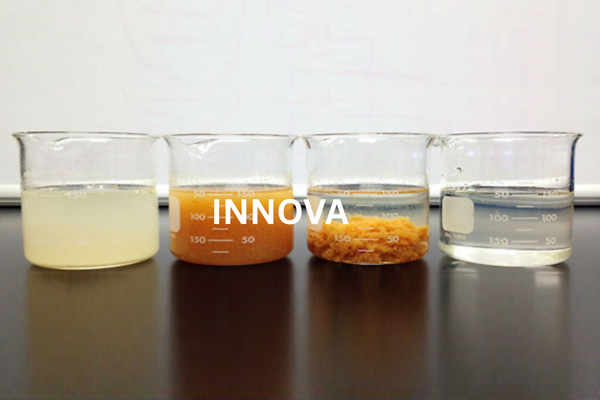
Innovacorp supplies anionic, cationic, and non-ionic polyacrylamide flocculants to sugar mills and effluent treatment plants in Ahmedabad and across Gujarat. In a sugar mill, the flocculant decides how fast the mud settles, how clear the juice comes off the clarifier, and how much sucrose is lost in the filter cake. In an ETP, it decides how well the sludge dewaters. The chemistry is different for the two applications, and the grade has to match the stream.
Sugar juice comes out of the clarifier carrying fine suspended matter — fibre, soil, colloidal impurities, and precipitated calcium salts from liming. If these particles don't gather into large, dense flocs, they settle slowly, carry juice with them into the mud, and leave the clarified juice turbid. Anyone who has run a clarifier through a crushing season knows that a marginal flocculant shows up first as slower settling, then as higher mud volume, and finally as sucrose loss in the filter cake.
| Property | Typical Value |
|---|---|
| Appearance | White granular powder |
| Chemistry | Anionic / Cationic / Non-ionic Polyacrylamide |
| Molecular weight | High (grade dependent) |
| Charge density | Grade dependent; confirmed on TDS |
| Moisture content | < 10% |
| pH (0.1% solution) | 6.0 – 8.0 |
| Shelf life | 24 months in unopened original packing |
Final specification is confirmed after a jar test on your juice or effluent sample.
Dosage depends on juice quality, liming practice, clarifier design, and the flocculant grade. Typical starting ranges:
These are starting points. Final dose is set after a jar test on your sample and a plant trial on your clarifier.
Flocculant selection is not a catalogue decision. The right grade depends on the charge of the particles in your juice or effluent, and the dose depends on your clarifier and residence time. We work with your process and lab team to run jar tests, select the grade, and fix a starting dose you can confirm on the plant. Jar test support is available across Ahmedabad and the surrounding Gujarat sugar belt.
Anionic polyacrylamides are typically used for sugar juice clarification because they help form larger flocs that settle faster and produce a more compact mud. Cationic grades are usually selected for effluent treatment and sludge dewatering rather than juice clarification.
Anionic flocculants carry a negative charge and are used where suspended particles are positively charged — common in sugar juice clarification. Cationic flocculants carry a positive charge and are used for negatively charged suspensions such as biological sludge in ETP.
Typical starting dose is 1–5 ppm on juice, prepared as a 0.1% solution and dosed into the flash or clarifier inlet. Final dose depends on juice quality, liming, and clarifier design, and is confirmed on a plant trial.
Yes. We supply anionic, cationic, and non-ionic polyacrylamide flocculants to sugar mills, refineries, and ETP plants in Ahmedabad and across Gujarat. Call +91-9312871070 to discuss your requirements.
Share your juice or effluent sample details — turbidity, pH, suspended solids, and clarifier type — and our technical team will recommend a flocculant grade and a starting dose. Call +91-9312871070 to discuss your application in Ahmedabad.
© 2026 Innovacorp India Pvt Ltd. All Rights Reserved. Managed & Developed by Innova Corporate India
 Chat with Us