
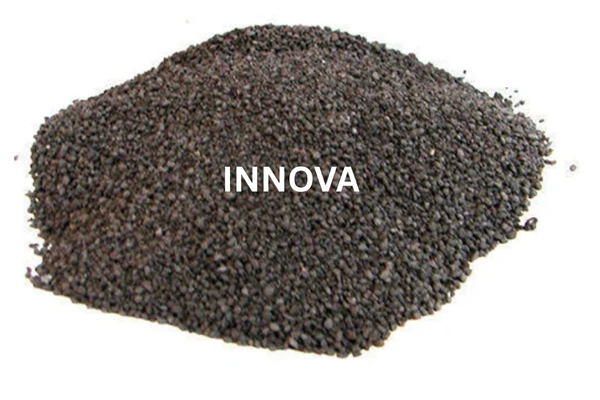
Ahmedabad's groundwater is hard and high in dissolved solids, and in many industrial areas it also carries elevated iron [citation:9]. For a textile dyeing unit in Narol, that iron shows up as staining and shade variation in the finished fabric. For a pharma plant in Vatva, it fouls the RO membranes and resin beds that the process water depends on. Innovacorp India Pvt Ltd manufactures MnO2 catalytic iron removal media for Ahmedabad borewell water, textile processing and pharmaceutical pre-treatment systems — graded for the feed water and the downstream equipment it protects.
Iron in water is usually dissolved ferrous iron (Fe²⁺). It is clear when it comes out of the borewell and turns orange-brown only after it oxidises and precipitates. By the time that happens downstream — on a membrane surface, inside a resin bed, or on a dyed fabric — the damage is already done. RO membranes foul, resin capacity drops, and textile batches show staining that cannot be corrected after the fact.
That is why iron removal sits at the front of the treatment train, ahead of softening, RO or DM. The media oxidises the dissolved iron on contact and traps the resulting solid in the bed, so the water that reaches the downstream equipment is already iron-free. The sizing and backwash design follow from the iron concentration and the flow rate, not from a standard package.
The media is a manganese dioxide coated filter material. As dissolved ferrous iron passes through the bed, it contacts the MnO2 surface and oxidises to insoluble ferric iron. The ferric hydroxide is trapped in the bed and removed during backwash. The media acts as a catalyst — it is not consumed in the reaction — but the catalytic surface does degrade over time and the bed eventually needs replacement.
Manganese removal follows the same mechanism, though it typically needs a higher pH or a stronger oxidant than iron alone. Where the feed carries both iron and manganese, the media grade and the operating conditions are set accordingly.
The right media depends on the iron concentration, the presence of manganese, the dissolved oxygen level, and the backwash capability of the filter vessel. It is confirmed after a water analysis, not from a catalogue.
Appearance, bulk density, effective size, uniformity coefficient, and service flow rate are stated on the product TDS for each grade. Because the grade varies by application — a media for high-iron borewell water is not the same as one for a low-iron municipal source — we do not publish a single spec table that would apply to every programme. TDS on request.
Backwash frequency depends on the iron concentration in the feed, the media volume, and the service flow rate. A plant on high-iron borewell water will backwash more often than one on a lower-iron source. The backwash is typically run at a rate that expands the bed by 30–50%, using treated water, followed by a rinse to waste before returning to service.
Final media volume and backwash schedule are set from the water analysis and confirmed by monitoring the treated water iron level and the pressure drop across the bed. TDS with the full application table is available on request.
Standard industrial packing; pack sizes on request. Media should be stored in a dry, covered area away from contamination. It should be kept free of dirt and organic matter before loading into the filter vessel. Shelf life and storage conditions are stated on the TDS.
The most frequent issue is sizing the filter for the average flow rate and then running it above that during peak production, which shortens the service cycle and lets iron breakthrough. The second is backwashing on a fixed schedule instead of on pressure drop or treated water iron level, which either wastes treated water or lets the bed exhaust. The third is skipping the pre-chlorination or oxidation step where the feed is anaerobic, which leaves the iron in a form the media cannot remove efficiently. The fourth is using the wrong media grade for water that carries both iron and manganese, which leads to manganese breakthrough even when the iron is under control.
We review the feed water analysis, the filter vessel design, and the downstream equipment to recommend a media grade and bed volume, and support the backwash schedule. Support is remote and lab-based; on-site visits are arranged only where a plant specifically requests them and where the scope is agreed in advance.
MnO2 media works by catalytic oxidation. Dissolved ferrous iron (Fe²⁺) contacts the media surface, oxidises to insoluble ferric iron (Fe³⁺), and is captured within the media bed. A backwash cycle then removes the trapped iron hydroxide and restores the bed. The media acts as a catalyst and is not consumed in the reaction, though it does require periodic backwashing and eventual replacement when the catalytic surface is exhausted.
Textile dyeing and processing units in Narol and Vatva need iron removal because iron causes staining and shade variation in the finished fabric. Pharmaceutical plants need iron removal as a pre-treatment stage ahead of RO or DM systems, since iron fouls membranes and resins. Food processing and commercial buildings on borewell water also use iron removal to protect downstream equipment and meet water quality requirements.
Both media oxidise dissolved iron, but they differ in operating requirements. Catalytic MnO2 media typically needs a shorter contact time and can operate at higher flow rates, and it does not require potassium permanganate regeneration in the same way as greensand. The right choice depends on the iron concentration, the presence of manganese, and the plant's backwash capability. Final media selection is confirmed after a water analysis.
Backwash frequency depends on the iron concentration in the feed, the media volume, and the service flow rate. A plant on high-iron borewell water will backwash more often than one on a lower-iron source. The backwash schedule is set from the water analysis and adjusted by monitoring the treated water iron level and the pressure drop across the bed.
Call +91-9312871070 to discuss your feed water analysis, filter vessel design, and downstream equipment, and to request a TDS for the media grade that fits your system.
© 2026 Innovacorp India Pvt Ltd. All Rights Reserved. Managed & Developed by Innova Corporate India
 Chat with Us