
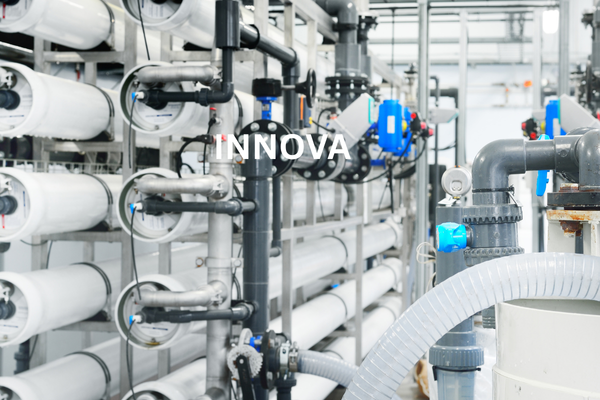
An RO plant in Bhiwadi's industrial belt runs on groundwater that carries a specific mix of minerals — calcium, magnesium, silica and sulfate, in concentrations that vary from block to block. That mix is what determines how fast the membrane scales, how often CIP is needed, and how much recovery the plant can actually achieve without fouling. Innovacorp manufactures, exports and supplies RO antiscalants for industrial RO plants in Bhiwadi. The range covers calcium carbonate, calcium sulfate and silica scale control grades, and the working conversation starts with your feed water analysis, not a fixed product chart.
Three things in Bhiwadi's groundwater cause most RO problems. First, hardness — calcium and magnesium — which scales as calcium carbonate on the membrane surface as the concentrate stream concentrates. Second, silica — which is more difficult to control than carbonate scale, because it does not respond to standard threshold inhibitors the same way and can form a glassy deposit that is hard to remove. Third, sulfate — which scales as calcium sulfate, particularly at higher recovery rates where the concentrate approaches saturation. Each of these needs a different antiscalant chemistry. A grade that handles calcium carbonate well may not handle silica at all. This is why we ask for your feed water analysis before recommending a grade — the mineral profile, not the TDS alone, decides which antiscalant fits.
The range is grouped by the scale type it targets, because that is how selection actually works:
Grade selection depends on your feed water analysis, recovery rate and target CIP interval. We do not recommend a fixed grade for every plant.
Antiscalants do not remove scale-forming minerals from the water. They change the way those minerals behave at the membrane surface. A few practical points:
The mechanism matters because it determines which grade to use. A threshold inhibitor for calcium carbonate will not control silica — silica needs a different chemistry and a higher dose.
| Property | Typical Value |
|---|---|
| Appearance | Clear to pale yellow liquid |
| Active Content | 20 – 50% (grade-dependent) |
| pH (as supplied) | 2 – 6 |
| Density | 1.10 – 1.25 g/cm³ |
| Solubility | Fully miscible in water |
| Shelf Life | 12 – 24 months from date of manufacture (unopened) |
| Storage | Cool, dry, away from direct sunlight and incompatible chemicals |
Final specification is confirmed against the product TDS for each grade.
RO antiscalant dosing is set on feed water chemistry and recovery rate, not on a fixed ppm. As a working reference for Bhiwadi plants:
These are starting ranges. Final dosing is set after reviewing your feed water analysis and running a scaling projection for your target recovery. Our team works with your plant engineer on this.
A few questions that come up in almost every technical discussion:
We do not sell drums and walk away. For Bhiwadi RO plants — auto, steel, ceramics and other industrial units — we review your feed water analysis, run the scaling projection for your target recovery, and recommend the grade and dosing range. If CIP frequency is climbing or permeate flow is dropping, call us — we will look at the operating data with you. TDS and MSDS are shared on request.
Innovacorp manufactures, exports and supplies RO antiscalants for calcium carbonate, calcium sulfate and silica scale control in Bhiwadi's industrial RO plants. Grades differ in active content and target scale type, and are selected based on your feed water analysis.
In Bhiwadi's industrial areas, groundwater often has high mineral content. An antiscalant helps prevent calcium carbonate and silica from scaling the membrane, which supports longer intervals between chemical cleaning (CIP) cycles and stable permeate flow.
Our grades are formulated for a range of TDS conditions, including high-TDS groundwater. The right grade and dose depend on your specific water analysis — share your feed water report and we can advise on the suitable grade and dosing range.
Yes. We supply in 5 L, 20 L and 50 L cans, and 200 L drums for larger consumption. For Bhiwadi units, we coordinate on delivery schedules based on consumption and share TDS and MSDS on request.
Tell us your feed water analysis, target recovery rate and current CIP frequency. We will suggest the grade and the working dosing range for your plant. Call +91-9312871070.
© 2026 Innovacorp India Pvt Ltd. All Rights Reserved. Managed & Developed by Innova Corporate India
 Chat with Us