
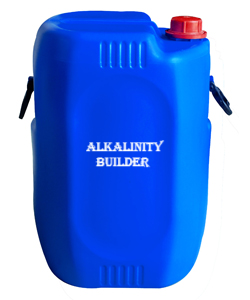
Boiler water that drifts acidic attacks the protective magnetite film on tube surfaces, and the corrosion rate rises sharply as pH falls. But pushing pH too high creates a different problem: free hydroxide can concentrate in high-heat-flux zones and cause caustic embrittlement. Innovacorp India supplies alkalinity builders for boiler water treatment in China, formulated to hold pH in the working alkaline range without overshooting into caustic risk. The dose is set on your feedwater and boiler water analysis, not on a fixed catalogue number.
Boiler corrosion is not a single mechanism. At low pH, hydrogen ions attack the magnetite layer directly, and the corrosion rate climbs steeply as pH drops. This is acidic corrosion, and it is most often seen in condensate return systems where dissolved carbon dioxide forms carbonic acid. At the other end, when free hydroxide alkalinity is high and can concentrate locally — under deposits or at sites of high heat flux — caustic corrosion can occur, leading to gouging or, in the worst case, caustic embrittlement. The alkalinity builder's job is to keep the water in the band between these two failure modes.
Boiler water pH is generally held above 11.0 to prevent sticky sludge that adheres to surfaces. But the upper limit matters just as much: pH above roughly 11.5 increases the risk of caustic attack, because the free hydroxide concentration can reach damaging levels at the metal surface even when bulk water analysis looks acceptable. The alkalinity builder works as a buffer, holding the reserve without allowing free hydroxide to run uncontrolled. The exact control range is not universal — it depends on boiler pressure, feedwater quality and the specific treatment programme in use.
An alkalinity builder is not a standalone treatment. It sits alongside oxygen scavengers, scale inhibitors and condensate treatment, each addressing a different failure mode. In the feedwater line, it adjusts the incoming alkalinity before the water reaches the boiler. In the boiler itself, it maintains the reserve that neutralises any acidic excursions. And in condensate return, it helps offset carbonic acid formed from bicarbonate breakdown. The feed point and dose are set on the system layout and the water chemistry at each stage — a single point of addition rarely covers the whole circuit effectively.
| Parameter | Typical Range |
| Form | Liquid (standard) / Concentrated liquid |
| pH of concentrate | Alkaline (specific value in TDS) |
| Active content | Product-specific (TDS on request) |
| Density | Product-specific (TDS on request) |
| Shelf life | Product-specific (TDS on request) |
Full TDS is provided on request. Specification is confirmed against the product TDS before dispatch.
Dosage is set on the feedwater and boiler water alkalinity, not on a fixed figure per tonne of steam. Working reference: the builder is dosed to maintain the target pH and alkalinity reserve in the boiler water, with the dose adjusted as feedwater quality changes. The dosage unit is ppm, consistent across product and location pages. Control testing — pH and alkalinity at minimum — is essential, because both underdosing (acidic corrosion risk) and overdosing (caustic concentration risk) have consequences. Exact dosage is confirmed after water analysis.
Standard industrial packing for liquid alkalinity builder is 200 L drums. Concentrated grades are available where storage space is limited and dose volume needs to be lower. Store in a cool, dry area away from acids and oxidisers. Pack sizes are confirmed based on handling and storage setup.
Three data points narrow the product choice: (1) current boiler water pH and alkalinity (P and M alkalinity), (2) feedwater alkalinity and the treatment programme already in place, and (3) boiler operating pressure, because the safe caustic limit shifts with pressure. Without these, any recommendation is a guess. We ask for these before quoting a specification.
We work with your boiler operators and water treatment engineers to review water analysis data and recommend an alkalinity builder specification that fits the system. We do not claim on-site presence in China; support is provided through data review and written recommendations. For systems with variable feedwater quality, we can discuss control ranges and testing frequency.
Q: What pH should boiler water be maintained at using an alkalinity builder?
A: Boiler water pH is typically maintained above 11.0 to prevent sticky sludge formation and acidic corrosion. However, it should not exceed 11.5, because excessive free hydroxide can concentrate locally and cause caustic embrittlement. The exact control range depends on boiler pressure and feedwater chemistry.
Q: How does alkalinity builder prevent acidic corrosion in boilers?
A: Acidic conditions in boiler water accelerate corrosion because hydrogen ions attack the protective magnetite film. The alkalinity builder neutralises acidity and maintains a stable alkaline reserve, supporting the formation and integrity of the magnetite layer on tube surfaces.
Q: What dosage of alkalinity builder is used in boiler water?
A: Dosage is set on the feedwater and boiler water alkalinity, not on a fixed figure. It is confirmed after water analysis. The dosage unit is ppm, consistent across product and location pages. Overdosing can raise free hydroxide above safe limits, so control testing is essential.
Q: What is the standard packing for alkalinity builder supply?
A: Standard industrial packing for liquid alkalinity builder is 200 L drums. Pack sizes are confirmed based on handling and storage conditions.
Call +91-9312871070 to discuss your boiler water chemistry and request TDS.
© 2026 Innovacorp India Pvt Ltd. All Rights Reserved. Managed & Developed by Innova Corporate India
 Chat with Us