
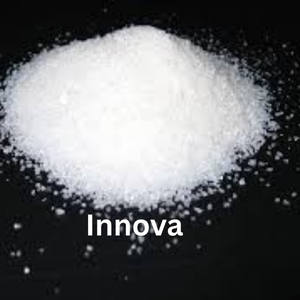
Cross-linked polymers that hold water in the root zone and lock liquids in industrial waste — supplied to China by Innovacorp.
Innovacorp India Pvt Ltd manufactures, exports and supplies Super Absorbent Polymers (SAP) to China for agriculture, industrial waste management, hygiene and cable water-blocking. SAP is a cross-linked polymer network that absorbs and holds aqueous solutions many times its own dry weight, forming a stable gel. We supply both potassium polyacrylate grades (preferred in agriculture where soil salinity is a concern) and sodium polyacrylate grades (industrial and hygiene use). Final specifications are confirmed after lab trial against your application.
Each SAP granule is a three-dimensional cross-linked network. When it contacts water, the network expands into a hydrogel that resists evaporation and mechanical pressure. The relevant performance metric is Liquid Retention Capacity (LRC) — how much liquid the gel holds under load. LRC varies by grade, particle size and the ionic content of the water or soil solution, which is why we test against your actual site conditions rather than quote a single figure.
Grade selection is the single decision that affects performance more than any other. Three questions usually settle it:
Once these three are clear, we send the matching grade's TDS and MSDS with the quotation, so you can check the numbers against your own lab before ordering. If you are unsure which grade fits, call +91-9312871070 with your soil report, water analysis or sludge data and we will shortlist two grades for a trial.
Dosage depends on soil type, crop, irrigation practice and the grade selected, so we do not publish a single figure that would be wrong for most fields. For agriculture, typical field trials begin with a small plot dose mixed into the root zone before planting; the exact kg/acre is fixed after you share your soil test and crop. For industrial waste solidification, the dose is set by the liquid-to-solid ratio of your sludge and confirmed by a bench trial. Call +91-9312871070 with your soil report or sludge analysis and we will recommend a starting dose.
Standard packing is 25 kg moisture-barrier bags; jumbo bags and custom pack sizes can be arranged on request. Store in a dry, covered area away from direct sunlight and moisture.
Our technical team works with your agronomist or process engineer to select the right grade, fix a starting dose and interpret trial results. We do not claim on-site presence in China — support is provided remotely, and any on-site visit is confirmed case by case. Call +91-9312871070 to discuss your application.
Potassium polyacrylate grades are typically preferred in agriculture where soil salinity is a concern, because they release potassium rather than sodium as they break down. The right grade and particle size depend on your soil test and crop — share your soil report and we will shortlist two grades for a plot trial.
SAP is usually mixed into the root zone before planting. Dose depends on soil type, crop and irrigation practice — typical field trials begin with a small plot dose in the kg/acre range, but the exact figure is fixed after a soil test and a plot trial, not from a catalogue default.
Free absorbency depends on the grade, particle size and the ionic content of the water or soil solution. We do not publish a single figure because it varies by grade and application — the exact absorbency for your grade is confirmed on the TDS with the quotation.
Standard packing is 25 kg moisture-barrier bags; jumbo bags and custom pack sizes can be arranged on request. Final packing and quantity are confirmed on the order.
Call +91-9312871070 to discuss your SAP requirement.
© 2026 Innovacorp India Pvt Ltd. All Rights Reserved. Managed & Developed by Innova Corporate India
 Chat with Us