
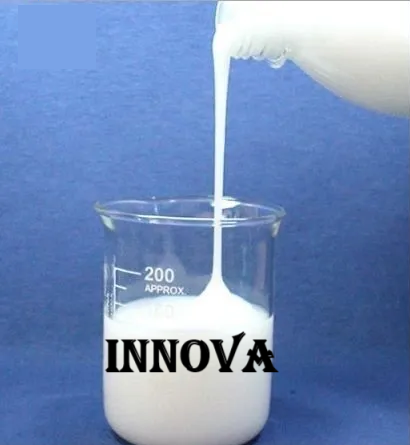
Innovacorp manufactures silicone-based and ester-based defoamers for sugar mills, distilleries, and industrial water systems. If foam is slowing your evaporators, causing syrup overflow, or eating into fermentation yields, the right antifoam chemistry usually fixes it within one dosing cycle.
Foam is not just a cosmetic problem. In cane juice extraction and clarification, foam traps air and reduces heat transfer. In multiple-effect evaporators (MEE), foam-over means syrup losses, floor spills, and unplanned downtime. In distillery fermenters, foam blocks headspace and lowers ethanol yield. Anyone who has worked a crushing season knows that a foaming evaporator can cost more than the defoamer itself.
| Property | Typical Value |
|---|---|
| Appearance | Milky white to pale yellow liquid |
| Active content | 10% – 30% (grade dependent) |
| pH (1% solution) | 6.0 – 8.0 |
| Specific gravity | 0.98 – 1.05 |
| Viscosity | Grade dependent; confirmed on TDS |
| Shelf life | 12 months in unopened original packing |
Final specification is confirmed after a lab trial against your process conditions.
Dosage depends on foam severity, temperature, and the sugar stream being treated. Typical starting ranges:
These are starting points. Our technical team works with your process engineers to fix the actual dose after a plant trial.
Foam problems are rarely solved by a catalogue number. We work with your process engineers to select the right chemistry — silicone or non-silicone — and to fix the dose on your actual stream. Plant trial support is available PAN India.
A defoamer knocks down foam that has already formed. An antifoam prevents foam from forming in the first place. Most of our products do both, which is why we usually call them defoamer-antifoam combinations.
Silicone-based defoamers are the usual choice for high-temperature multiple-effect evaporators because they hold up under heat. Where silicone carryover is a concern, a non-silicone ester-based grade is preferred.
Not always. Fermentation needs a grade that will not affect yeast activity, while ETP foam is mostly surfactant-driven and responds to different chemistry. We usually recommend two different grades for the two streams.
Start with the range given in the Application and Dosage section above, then confirm on a plant trial. Final dose depends on foam severity, temperature, and the specific stream.
Share your foam problem — stream, temperature, and current dose if any — and our technical team will recommend a grade and dosage. Call +91-9312871070
© 2026 Innovacorp India Pvt Ltd. All Rights Reserved. Managed & Developed by Innova Corporate India
 Chat with Us