
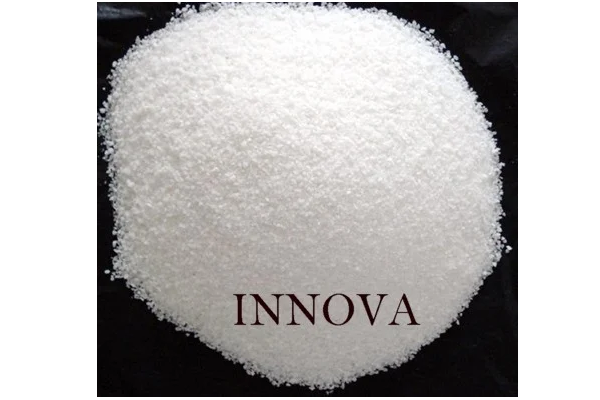
Innovacorp India supplies polyelectrolytes in Jaipur — anionic, cationic, and non-ionic polyacrylamide grades for sugar juice clarification, textile effluent treatment, and sludge dewatering. The product is a polymer chemistry choice, not a single product: the charge type, charge density, and molecular weight decide which grade fits which stream.
Polyelectrolytes are water-soluble polymers with charged groups along the chain. When they are added to a liquid with suspended particles, two things happen:
The balance between these two mechanisms depends on the polymer's charge density and molecular weight. A high-charge, low-molecular-weight polymer works mainly by neutralisation. A low-charge, high-molecular-weight polymer works mainly by bridging. Most applications need a combination, and the right balance depends on the stream.
| Type | Charge | Where It Fits in Jaipur |
|---|---|---|
| Anionic PAM (APAM) | Negative | Sugar juice clarification (bridging the lime-treated floc), mineral processing, some textile effluent streams |
| Cationic PAM (CPAM) | Positive | Organic sludge dewatering (food processing, textile dyeing, biological sludge), some primary clarification streams |
| Non-ionic PAM | Neutral | Specific filtration applications where charge neutrality is required; some mining and mineral processing streams |
Jaipur's industrial belt uses all three, but the fit is different for each cluster:
The polymer's performance is shaped by two main variables:
The right combination depends on the application. Sugar juice clarification typically uses high molecular weight anionic PAM. Sludge dewatering typically uses cationic PAM with a moderate to high charge density. The exact grade should be confirmed by a jar test on the actual stream.
Polyelectrolytes are dosed as dilute solutions, not as dry powder. The make-down procedure matters as much as the product selection:
The dosing point should be where there is enough mixing to disperse the polymer but not so much shear that the flocs are broken. In a clarifier, the polymer is typically dosed just before the flocculation stage. In a sludge dewatering system, it is dosed into the sludge line before the dewatering equipment.
The most common mistake in polyelectrolyte selection is choosing a grade from a catalogue without testing the actual stream. The charge type, charge density, and molecular weight that work for one plant may not work for another, even within the same cluster. Jaipur's industrial streams vary widely — a textile ETP in Sanganer may have a different sludge profile from a chemical unit in VKI.
The jar test should use the actual stream — juice, effluent, or sludge — at the temperature and concentration of the process. It should test a range of doses and, where possible, a range of charge types. The result tells you which polymer works, at what dose, and whether a combination of coagulant and flocculant is needed.
The second mistake is overdosing. A polyelectrolyte that is overdosed can re-stabilise the particles by reversing the charge, which makes the clarification worse. The dose should be set at the minimum that achieves the target clarity or dewatering performance.
Standard industrial packing is used for bulk supply. Pack sizes and format are shared on request. Store in a cool, dry place away from direct sunlight and moisture. Keep containers sealed until use. Dry powder grades should be protected from moisture to prevent caking.
We work with sugar refinery process teams and textile ETP operators in Sanganer, Sitapura, and VKI on polyelectrolyte selection and dose guidance. That means reviewing your stream, the charge profile, and your existing treatment scheme before suggesting a grade. We do not claim on-site support unless it has been confirmed for your location. What we can do is review your data and tell you whether the polymer fits your treatment line.
Anionic polyacrylamide (APAM) is the common choice for sugar juice clarification. It works by bridging the lime-treated floc particles into larger, faster-settling flocs. The molecular weight and charge density should be matched to the juice composition and the clarifier design. A jar test on the actual juice is the reliable way to select the grade.
The choice depends on the sludge. Organic sludge — from food processing, textile dyeing, or biological treatment — usually responds better to cationic polyelectrolyte, which neutralises the negative charge on the organic particles. Inorganic sludge, such as from metal hydroxide precipitation or mineral processing, often responds better to anionic polyelectrolyte. A jar test on the actual sludge is the only reliable way to confirm which one works.
Higher molecular weight generally means longer polymer chains, which can bridge more particles and form larger flocs. But higher molecular weight also means higher viscosity and slower dissolution, which can affect dosing and mixing. The right molecular weight depends on the application — sugar juice clarification and sludge dewatering do not necessarily need the same grade.
Standard industrial packing is used for bulk supply. Pack sizes and format are shared on request. Store in a cool, dry place away from direct sunlight and moisture. Keep containers sealed until use. Dry powder grades should be protected from moisture to prevent caking.
Call +91-9312871070 to discuss your Jaipur polyelectrolyte application. Tell us whether your stream is sugar juice, textile effluent, or sludge, and we will tell you which charge type and molecular weight to trial.
© 2026 Innovacorp India Pvt Ltd. All Rights Reserved. Managed & Developed by Innova Corporate India
 Chat with Us