
"Scale Doesn't Just Slow You Down. It Changes the Metal Underneath."
Innovacorp India manufactures and supplies descaling chemicals for industrial cleaning in Assam, where scale on heat transfer surfaces is one of those problems that gets worse the longer it is left alone. A thin scale layer on a boiler tube or heat exchanger reduces heat transfer, raises fuel demand and, if left long enough, starts under-deposit corrosion on the metal underneath. Our descaling range is built around removing that scale without attacking the base metal, using inhibited acid and chelating chemistries matched to the scale type.
Descaling and anti-scalant treatment are often confused, but they do different jobs. Anti-scalant treatment prevents scale from forming in the first place, and is dosed continuously during operation. Descaling removes scale that has already formed, usually during a planned cleaning shutdown. The two are complementary: a good anti-scalant programme reduces how often you need to descale, and descaling restores performance when scale has already built up. Our anti-scalants for evaporator systems cover the prevention side.
An inhibited acid descaler is an acid-based cleaning chemical that contains a corrosion inhibitor. The acid dissolves the scale — calcium carbonate, calcium sulphate, silica or mixed deposits — while the inhibitor slows the acid's attack on the base metal. Without the inhibitor, the acid would remove scale but also pit or thin the tube wall. The inhibitor is what makes the difference between a controlled cleaning and a damaged heat exchanger.
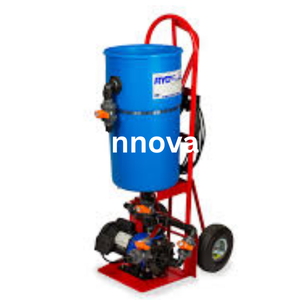
CIP (Clean-In-Place) cleaning circulates a cleaning solution through the equipment without dismantling it. The solution dissolves scale and deposits, then is flushed out. CIP is common in refineries, paper mills and food processing plants where heat exchangers and pipelines need regular cleaning without a full shutdown. The key to CIP descaling is matching the cleaning chemistry to the scale type and the metallurgy, because a chemistry that works on one scale may not work on another, and a chemistry that is safe on mild steel may not be safe on copper alloys.
Plants sometimes use a stronger acid dose or a longer contact time to remove stubborn scale, without checking whether the scale type is the actual problem. Silica scale, for example, does not dissolve well in plain acid no matter how strong the dose — it needs a different chemistry. Increasing the dose on the wrong scale type wastes chemical and can attack the metal. Analysing the scale before choosing the descaler is the step that most often explains why one cleaning works and another does not.
Typical parameters buyers ask about include active content, pH of the product, corrosion inhibitor concentration, density and shelf life. Exact values differ by product type, and are confirmed on the product TDS. Final specification is confirmed after a scale analysis on your own system.
Dosage is set based on the scale type, the scale thickness and the system volume, so there is no single figure that fits every plant. The descaler is usually circulated through the equipment at a controlled concentration and temperature for a set contact time, then flushed out. The concentration and contact time are confirmed on a trial, not from a catalogue figure.
Standard industrial packing is used, with pack sizes on request. Store in a dry, ventilated area away from direct sunlight and incompatible chemicals. Keep containers sealed until use.
Our team helps plant engineers in Assam match the descaler to the scale type and the system's metallurgy. Selection support is provided by phone and shared data; final specification is confirmed after a scale analysis on your own system.
Descaling vs anti-scalant? Descaling removes scale that has already formed; anti-scalant prevents scale from forming in the first place.
What is an inhibited acid descaler? An acid-based cleaner with a corrosion inhibitor that protects the base metal while the acid dissolves the scale.
How is CIP cleaning used? It circulates cleaning solution through the equipment without dismantling it, then flushes it out.
What scale types are common in Assam's boilers? Calcium carbonate, calcium sulphate and silica, depending on feedwater quality; the scale should be analysed before choosing the descaler.
To discuss descaling chemicals for your plant in Assam, call +91-9312871070.
Related reading: anti-scalants for evaporator systems and cooling water treatment chemicals if your plant needs both prevention and cleaning.
© 2026 Innovacorp India Pvt Ltd. All Rights Reserved. Managed & Developed by Innova Corporate India
 Chat with Us