
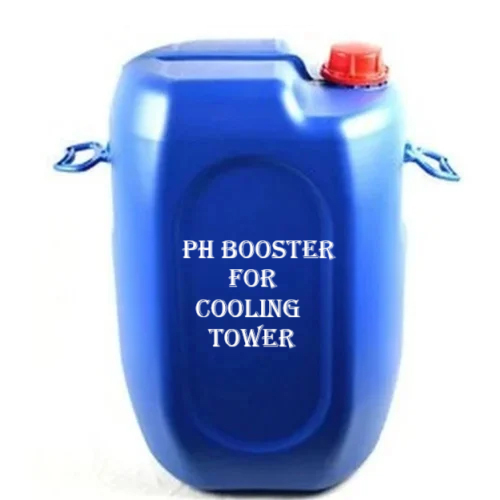
When a cooling tower in Assam starts showing a pH that drifts below 7 on a Monday morning, or a heat exchanger tube bundle fails sooner than its design life, the cause is often the water chemistry, not the metal. Innovacorp's pH booster for cooling water in Assam is an alkalinity builder that raises the pH back into the programme's working band, so the corrosion inhibitor can do its job and the LSI stays within a passivating range.
Cooling water is rarely just water. It carries dissolved minerals, is exposed to the atmosphere in the cooling tower, and cycles through heat exchangers where temperature swings change the chemistry. The Langelier Saturation Index (LSI) combines pH, calcium hardness, total alkalinity, temperature and dissolved solids into one number that predicts whether the water will tend to deposit calcium carbonate scale (positive LSI) or corrode metal (negative LSI). Neither extreme is good: too positive and the exchanger fouls, too negative and the metal pits. A pH booster is the simplest way to shift a drifting LSI back into the mildly positive band that supports passivation, without over-treating the water with scale inhibitor.
Cooling towers in Assam operate under conditions that affect pH stability. The high humidity and long monsoon mean that open cooling towers absorb atmospheric CO₂ more readily than dry-climate towers, which lowers the pH of the recirculating water. Monsoon also changes make-up water quality — surface water carries more turbidity and organic load during the rains, and borewell chemistry shifts as recharge changes. Many industrial facilities draw borewell water with variable hardness, which changes the LSI without any change to the chemical programme. And in facilities where process heat exchangers are cooled by the same circuit, small acidic leaks from the process side can drag the pH down without obvious warning. All of these effects mean the pH setpoint in Assam needs monitoring that is more frequent than a quarterly check.
Typical deployments across Assam include:
Sugar mills in Assam can also use a pH booster for condenser cooling water, but this is one application among many — the product is not sugar-specific.
These three are often confused. This is a quick clarification; final selection depends on the water analysis and the existing treatment programme.
| Chemical | Primary function | Typical role in a cooling programme |
|---|---|---|
| pH booster / alkalinity builder | Raises pH and adds carbonate/bicarbonate alkalinity | Keeps LSI in the mildly positive band |
| pH adjuster (acid) | Lowers pH | Used when LSI is too positive (scale risk) |
| Scale inhibitor | Prevents crystal growth on hot surfaces | Threshold inhibition, complementary to pH control |
| Corrosion inhibitor | Passivates metal surface | Works best at the correct pH band |
| Biocide | Controls microbial growth | Biofilm control; independent of pH but affected by it |
The best programme is not a single product — it is a balanced set of products matched to the water analysis and monitored against LSI, not just pH. Final selection depends on your water profile.
The most common mistake is watching pH alone and ignoring alkalinity — a pH booster adds both, and if alkalinity is already high, dosing just for pH can push LSI too positive and cause scale. The second is overdosing to chase a single reading — pH is a moving target in an open tower, and a pump set to the setpoint with a reasonable tolerance will do better than a fixed dose chasing every reading. The third is using the same pH setpoint in summer and monsoon — make-up water chemistry changes with the season, and the setpoint should be reviewed. The fourth is treating a pH drop as a dosing problem only — if a heat exchanger is leaking process fluid into the cooling side, the pH will keep dropping no matter how much booster is added; the leak needs fixing first.
| Property | Typical direction |
|---|---|
| Appearance | Clear to slightly hazy liquid |
| Active content | TDS on request |
| pH (as supplied) | Alkaline (grade-dependent); confirm in TDS |
| Density | TDS on request |
| Recommended dose | TDS on request (ppm of circulating water) |
| Foaming tendency | Low-foam grade; confirm in TDS |
| Shelf life | TDS on request |
Final specification and dose are confirmed against the product TDS and a water analysis of your cooling circuit.
pH booster is dosed in ppm of circulating water, fed into the basin or the circulation line with a dosing pump. The pump is set to hold the programme's pH setpoint (with a working tolerance of about ±0.2 pH) rather than a fixed flow — a fixed flow chases the pH swing after it happens, while a setpoint control keeps the water inside the band. The starting dose is in the product TDS, and the working dose is fixed from the pH and alkalinity trends over a few days. Where a plant already doses scale inhibitor, the booster is added upstream so the inhibitor sees the correct pH as soon as possible.
Standard industrial packing; pack sizes on request.
1. Why does my cooling water pH drop overnight?
Three common reasons: CO₂ absorption from the atmosphere in the open tower,
biological activity producing acids in the basin, or an acidic process leak through
a heat exchanger. The pattern of the drop helps — a gradual overnight drift points to
CO₂ or biology, a sudden step change points to a leak. Check alkalinity and LSI
together, not just pH.
2. Is LSI the same as pH?
No. pH is one input to LSI, alongside calcium hardness, total alkalinity,
temperature and total dissolved solids. A water can have a "correct" pH of 8.0 and
still be scale-forming if alkalinity and hardness are high. The LSI calculation
combines all five, and a booster changes both pH and alkalinity — so both are
monitored after dosing.
3. Can I use the same booster for boiler water and cooling water?
No. Boiler water and cooling water have different chemistry requirements, different
temperature profiles and different targets. A cooling water booster is designed to
shift LSI in an open recirculating system; a boiler water treatment chemical is
designed for a closed, high-temperature system. Use the correct product for the
circuit.
4. How often should the dosing pump be recalibrated?
Monthly is a reasonable baseline. pH and alkalinity in an open tower change with
make-up water chemistry and COC, so a pump calibrated at the start of the season
may not be giving the right dose by the middle of it. Recalibrate against the actual
dosing rate you are seeing, not the pump's theoretical flow.
Need help setting a pH setpoint and LSI target for your cooling circuit, or reviewing a pH swing you have been chasing? Our team can work with your plant engineers on dose and control strategy. Call +91-9312871070.
© 2026 Innovacorp India Pvt Ltd. All Rights Reserved. Managed & Developed by Innova Corporate India
 Chat with Us