
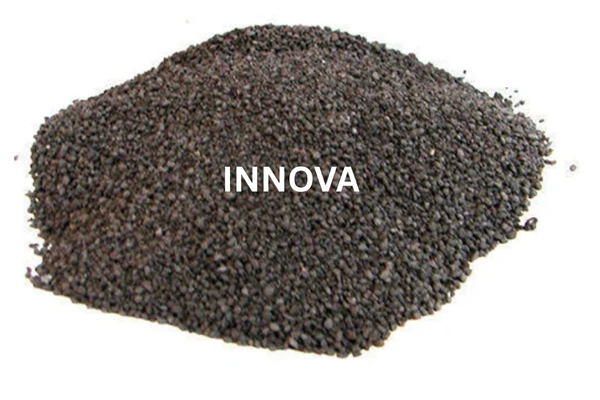
When a tea estate bungalow in upper Assam keeps getting brown stains on washbasins despite a new filter, or a small hospital near Guwahati sees iron in its CSSD feedwater line, the issue usually is not the filter design — it is the media inside it. Innovacorp's iron removal media in Assam range is a catalytic MnO2-based media suited to the region's groundwater conditions, so the oxidation-and-filtration cycle stays predictable across the year.
Dissolved iron in groundwater is usually in the ferrous (Fe²⁺) form, which is colourless and passes straight through ordinary filters. Catalytic MnO2 media accelerates the oxidation of Fe²⁺ to Fe³⁺ on the bead surface; the Fe³⁺ then precipitates as iron hydroxide particles that are trapped inside the bed. Soluble manganese (Mn²⁺) follows a similar catalytic pathway. The media is not a consumable filter — it is a catalyst, which is why proper backwashing and periodic regeneration decide its working life as much as the raw water quality does.
Assam's groundwater in many districts carries noticeable dissolved iron, and in some areas manganese is also present. Two practical consequences follow. First, iron staining on fixtures, laundry and process equipment is a recurring complaint from households, tea estates and small industries. Second, iron and turbidity in shallow aquifers can rise after the monsoon, when recharge changes the water chemistry — a filter that was working in February may need attention in July. Media selection and backwash schedules should be set with this seasonal variation in mind, not with a fixed annual reset. Arsenic occurrence is reported in some Assam districts; the page does not claim arsenic removal — iron and manganese are the primary targets of this media, and any arsenic discussion should follow the buyer's own regulatory framework.
Typical deployments include:
Both are catalytic media, but the operating requirements differ. This quick comparison helps narrow down the right choice.
| Parameter | MnO2 catalytic media | Greensand |
|---|---|---|
| Oxidation mechanism | Catalytic on MnO2 surface | Catalytic on glauconite surface |
| Regeneration oxidant | KMnO4 (grade-dependent) | KMnO4 (continuous or intermittent) |
| Service flow rate | Grade-dependent; confirm in TDS | Lower than MnO2 media typically |
| Backwash rate | Higher; media is denser | Lower |
| Typical use | Higher iron loads, tighter footprint | Moderate iron loads, conventional design |
Final selection depends on raw water iron, manganese, pH, oxidant availability and the filter vessel design. A lab trial on your raw water confirms the choice.
The most common mistake is under-backwashing — media bed packs down, channelling starts, and the filtered water iron rises even though the media is still good. The second is backwashing at the wrong rate — too low and the bed does not expand, too high and media is lost to the drain. The third is skipping regeneration because filtered water still looks clear — the media is exhausting slowly, and by the time iron breaks through, the whole bed needs replacement. The fourth is ignoring pH — catalytic media has an operating pH window, and pushing beyond it reduces efficiency. A simple log of raw iron, filtered iron, backwash frequency and pressure drop catches all four early.
| Property | Typical direction |
|---|---|
| Appearance | Black to dark brown granular media |
| Base material | MnO2-coated / MnO2-based (grade-dependent) |
| Bulk density | TDS on request |
| Effective size / uniformity coefficient | TDS on request |
| Service flow rate | TDS on request |
| Backwash rate | TDS on request |
| Bed depth | TDS on request |
| Operating pH range | TDS on request |
Final specification, flow rates and bed depth are confirmed against the product TDS and a lab trial on your raw water.
Iron removal media is not dosed like a chemical — it is loaded once into a filter vessel and maintained through backwash and periodic regeneration. Backwash frequency depends on the iron load: heavy iron water needs more frequent backwashing than light load. Regeneration, where the grade requires it, uses an oxidant such as potassium permanganate at a dose stated in the TDS; the exact figure is confirmed with your raw water iron and vessel design. Sizing is typically based on the service flow rate per unit area of bed, not on a fixed media volume.
Standard industrial packing; pack sizes on request.
1. What iron level can this media handle?
Catalytic MnO2 media typically handles dissolved iron in the range of a few ppm up
to about 10 ppm, depending on pH, organic matter and manganese presence. Above that
range, pre-aeration or a two-stage design is usually needed. Confirm with a raw
water analysis and a lab trial before sizing.
2. Does it remove manganese as well as iron?
Yes, soluble manganese (Mn²⁺) follows a similar catalytic pathway on MnO2 media, but
manganese oxidation is slower than iron and often needs a higher pH. The page
discusses iron and manganese as primary targets; arsenic is not claimed for this
media.
3. How often does the media need backwashing?
Backwash frequency depends on the iron load and the vessel design. Heavy iron water
may need daily backwashing; lighter loads may run two to three days between
backwashes. The backwash rate is stated in the TDS; the schedule is set from the
actual pressure drop and filtered water iron, not from a fixed calendar.
4. When should the media be replaced?
Replacement is indicated when filtered iron rises even after correct backwashing and
regeneration, when pressure drop increases permanently, or when media loss during
backwash becomes significant. A media sample analysis confirms the point of
replacement.
Need help sizing an iron removal filter or choosing between MnO2 media and greensand for your Assam facility? Our team can work with your plant or estate engineers to suggest a suitable grade. Call +91-9312871070.
© 2026 Innovacorp India Pvt Ltd. All Rights Reserved. Managed & Developed by Innova Corporate India
 Chat with Us