
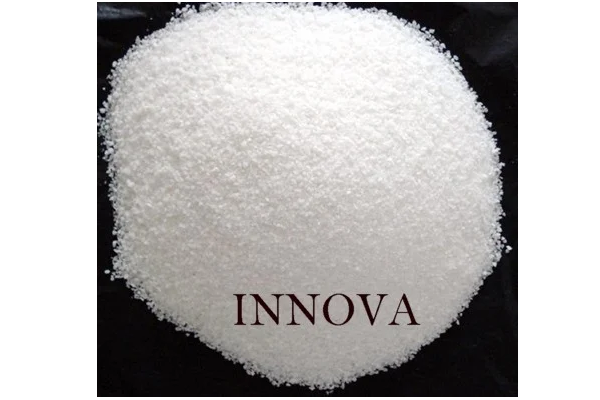
Polyelectrolytes are the workhorses of solid-liquid separation. In an Australian municipal STP, a mining tailings thickener, or a food processing ETP, the same principle applies: fine particles that will not settle on their own can be gathered into larger flocs with the right polymer, and those flocs settle or dewater at a practical rate. Innovacorp supplies anionic, cationic, and non-ionic polyelectrolytes for these applications across Australia. This page covers how the polymer types differ, where each fits, how to select the right grade, and what to check when floc formation underperforms.
Polyelectrolytes are water-soluble polymers with charged groups along the chain. When added to a suspension, they work through two mechanisms:
Getting the charge right is the whole game. An anionic polymer added to a negatively charged sludge will not adsorb effectively — both repel each other. A cationic polymer on the same sludge will neutralise the charge and bridge the particles. The reverse is true for positively charged mineral sludges.
Anionic polyelectrolyte (APAM). Negatively charged. Used for mineral sludges and suspensions where the particles carry a positive surface charge — mining tailings, aggregate washing, some industrial clarifiers. Also used in combination with cationic coagulants in water treatment, where the coagulant neutralises charge and the anionic polymer bridges the resulting micro-flocs.
Cationic polyelectrolyte (CPAM). Positively charged. Used for organic sludges where the particles carry a negative charge — municipal sewage sludge, food processing sludge, paper mill sludge. The cationic charge neutralises the organic particle charge and the polymer chain bridges the flocs. This is the most common polymer type for sludge dewatering in Australian STPs.
Non-ionic polyelectrolyte. No net charge. Used where charge neutralisation is not the primary mechanism, or where the sludge chemistry is variable and a charged polymer would be unpredictable. Less common than anionic or cationic grades but useful in specific filtration and thickening applications.
Municipal wastewater treatment. Sludge dewatering is the largest application. Cationic polymer is dosed into the sludge before the centrifuge, belt press, or screw press. The polymer flocculates the sludge solids so the machine can produce a drier cake and a clearer centrate or filtrate. Polymer performance directly affects cake dryness, haulage cost, and the solids load returned to the head of the plant.
Mining and tailings management. Tailings thickeners use anionic or cationic polymer (depending on the ore and process) to settle fine particles and produce a denser underflow. Better flocculation means higher underflow density, less water tied up in the tailings, and lower dam or storage volume.
Water treatment plants. Potable water treatment uses polyelectrolyte as a flocculant aid after coagulant addition. The coagulant (alum, PAC, or ferric) neutralises charge and forms micro-flocs; the polymer bridges them into larger flocs that settle in the clarifier or are removed in the filter. For the coagulant side of this sequence, our Polydadmac cationic coagulant for sugar and water clarification page covers the charge-neutralisation step in detail.
Food processing ETPs. Dairy, meat, and brewing wastewater contains organic solids that dewater poorly without polymer. Cationic polyelectrolyte improves sludge dewatering and reduces the volume of sludge for disposal.
Sugar processing (application area). In sugar mills, anionic polymer is used as a flocculant aid after liming and coagulant addition. The lime and heat precipitate impurities; the coagulant neutralises charge; the anionic polymer bridges the flocs so they settle in the clarifier. The polymer does not replace the coagulant or the lime — it works downstream of them. Our juice clarification polymers for Australian sugar mills page covers the clarifier application in more detail.
Polyelectrolyte selection is not a catalogue exercise. The same sludge can respond very differently to two polymers with similar specifications. Key selection variables:
The only reliable way to select a grade is a jar test or plant trial on the actual sludge or water. A polymer that looks correct on paper may not be the best performer in practice.
Sludge dewatering. Typical dose ranges from 1 to 10 kg per tonne of dry solids, depending on sludge type and polymer grade. The dose is usually expressed as kg polymer per tonne dry solids (kg/t DS). The optimum is the lowest dose that gives acceptable cake dryness and centrate clarity.
Water treatment clarification. Doses are much lower — typically 0.1 to 1 ppm in the water, depending on the coagulant dose and the raw water quality.
Mining tailings. Dose depends on the ore type, particle size distribution, and thickener design. Typical ranges are in the tens to hundreds of grams per tonne of solids, confirmed by thickener trial.
Make-up considerations for powder polymer:
Final dose and make-up procedure should be confirmed by jar test or plant trial.
When flocculation underperforms, the cause is not always the polymer dose. Work through the variables:
| Property | Anionic (APAM) | Cationic (CPAM) | Non-ionic |
|---|---|---|---|
| Appearance | White granular powder | White granular powder | White granular powder |
| Charge density | Low to high (grade dependent) | Low to high (grade dependent) | Neutral |
| Molecular weight | High (grade dependent) | Medium to high (grade dependent) | High |
| Recommended make-up concentration | 0.1% – 0.5% | 0.1% – 0.5% | 0.1% – 0.5% |
| pH stability | Broad range | Broad range | Broad range |
| Shelf life | TDS on request | TDS on request | TDS on request |
Final specifications depend on grade. TDS available on request. Jar test recommended before full-scale dose changes.
Standard industrial packing. Pack sizes on request.
Innovacorp can review your sludge or water analysis and current polymer programme to identify potential mismatches. For plants where polyelectrolyte is part of a broader treatment programme, our microbial culture for ETP and STP bioaugmentation page covers the biological treatment side, and our membrane chemicals for Australian RO and cooling systems page covers the membrane side. We work with your operations team to select the right polymer type and dose. Final operating decisions remain with your plant team.
The choice depends on the sludge charge. Organic sludges from municipal STPs and food processing typically carry a negative charge and respond best to cationic polymers. Mineral sludges from mining and aggregate washing often carry a positive charge and respond to anionic polymers. A jar test or charge titration on the actual sludge is the only reliable way to confirm the correct polymer type and dose.
Over-dosing can cause charge reversal, where particles re-stabilise and repel each other instead of flocculating. Other causes include inadequate mixing at the flocculation stage, polymer solution that has been aged too long, or a polymer charge that does not match the sludge. Check mixing energy and solution age before increasing the dose further.
Typical dose ranges from 1 to 10 kg per tonne of dry solids for sludge dewatering, depending on the sludge type and the polymer's molecular weight and charge density. For water treatment clarification, doses are much lower. Final dose should be confirmed by jar test or plant trial on your specific sludge or water.
Powder polymer should be dispersed slowly into water under gentle agitation to avoid fisheyes. Typical make-up concentration is 0.1% to 0.5% for powder grades. The solution needs an ageing period (usually 30 to 60 minutes) before use to fully hydrate, and should be used within the recommended window before activity declines.
Call +91-9312871070 to discuss your polyelectrolyte requirement.
© 2026 Innovacorp India Pvt Ltd. All Rights Reserved. Managed & Developed by Innova Corporate India
 Chat with Us