
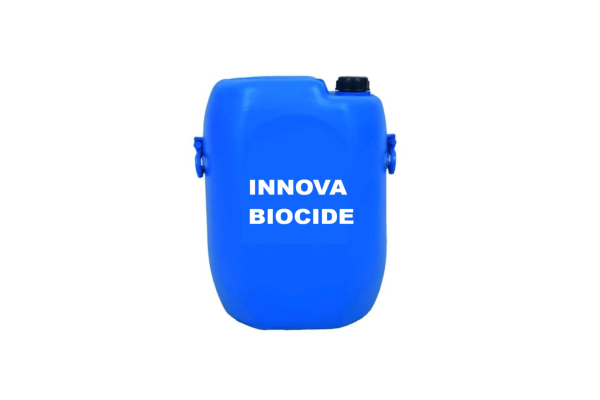
A cooling tower operator in the Ballabhgarh cluster usually asks the same question when the first biofilm shows up: should this be an oxidizing shock or a non-oxidizing maintenance dose? The answer depends less on the biocide brand and more on the tower's microbial load, the discharge route, and the water chemistry feeding the tower. Innovacorp supplies oxidizing and non-oxidizing biocides for Ballabhgarh cooling towers and RO plants, and this page is written as a selection guide rather than a single-product page.
Groundwater in this belt runs 300 to 700 ppm hardness with 2 to 10 ppm iron, while Yamuna canal water is softer at around 200 to 400 ppm hardness. That difference matters for biocide selection because hardness and iron can consume part of an oxidizing biocide before it reaches the microorganisms, which is why a plant switching between the two water sources often sees its oxidizing programme behave differently from one week to the next. Non-oxidizing biocides are less affected by hardness, which is one reason they are commonly used alongside an oxidizing programme rather than as a replacement for it.
The two families work on different principles and suit different duties.
DBNPA is a non-oxidizing biocide that acts quickly and then degrades into carbon dioxide, ammonia and bromide ion, with a half-life in the 4 to 12 hour range. That short residual suits two duties in the Ballabhgarh belt. On a cooling tower, it is used as a shock biocide at 50 to 100 ppm once or twice a week, which knocks back the biofilm without leaving a long-lived residue in the discharge. On an RO plant, it is used as a membrane-compatible sanitiser at 50 to 100 ppm for 2 to 4 hours. Its limitation is the same as its strength: it does not give long residual protection, so it is usually paired with a maintenance biocide rather than used alone.
Isothiazolinone works at low dose and gives longer residual protection than DBNPA, which makes it a common choice for continuous maintenance dosing on cooling towers and for metalworking fluid preservation. It is biodegradable and effective against bacteria, fungi and algae, but it is incompatible with some amines and reducing agents, so the programme has to be checked against the other chemicals in the system. For a Ballabhgarh plant that wants a steady background biocide between DBNPA shocks, isothiazolinone is the usual pick.
The table below is a starting point, not a fixed rule. The final choice is confirmed from the TDS and a trial on your system.
Grade-specific values (appearance, active content, pH, density, shelf life) are shared against your system duty. The final specification is confirmed from the TDS and a trial. TDS on request.
Standard industrial packing; pack sizes on request.
The first mistake is choosing a biocide by brand rather than by duty: a grade that works on a metalworking sump is not the right pick for a cooling tower, and the other way round. The second is running an oxidizing programme on hard groundwater without checking how much of the dose is being consumed by hardness and iron before it reaches the microorganisms. The third is using DBNPA alone and expecting residual protection; it is a shock biocide, and the maintenance dose has to come from a different grade. A water test and a trial on the actual system settle all three before a full plant change.
Our team works with your plant engineers on biocide selection, dosing point and trial design. Final specification is confirmed from the TDS and a trial on your system.
Which biocide works best for a cooling tower in Ballabhgarh?
Cooling tower treatment in Ballabhgarh often combines an oxidizing biocide for shock treatment with a non-oxidizing biocide for residual control, which is the combination recommended by ASHRAE 188 and CTI. DBNPA and isothiazolinone are the common non-oxidizing choices for this belt. The exact programme depends on the tower's microbial load and discharge route, and is confirmed from the TDS and a trial.
What DBNPA dose is used in Ballabhgarh cooling towers and RO plants?
DBNPA is effective in the 10 to 50 ppm range for general microbial control, while cooling tower shock dosing is often set at 50 to 100 ppm once or twice a week, and RO membrane sanitisation at 50 to 100 ppm for 2 to 4 hours. The exact dose for your system is confirmed from the TDS and a trial, because the microbial load and the system volume both affect the result.
Is isothiazolinone or DBNPA better for a Ballabhgarh cooling tower?
The two work differently. DBNPA acts fast and degrades quickly, which suits shock dosing and systems where a short residual is acceptable. Isothiazolinone gives longer residual protection at low dose, which suits continuous maintenance dosing. Many Ballabhgarh plants use both in a rotating programme rather than picking one. The choice is confirmed from the TDS and a trial on your circulating water.
How does hard water in Ballabhgarh affect biocide choice?
Ballabhgarh groundwater runs 300 to 700 ppm hardness with 2 to 10 ppm iron, and that load can consume some oxidizing biocides before they reach the microorganisms. Non-oxidizing biocides are less affected by hardness, which is one reason they are often used alongside an oxidizing programme. The biocide choice is confirmed from a water test alongside the TDS, not from the hardness number alone.
For biocide selection, dosing programme design or a trial on your cooling tower or RO plant, call +91-9312871070. Our team works with your plant engineers on the trial protocol and the final specification.
© 2026 Innovacorp India Pvt Ltd. All Rights Reserved. Managed & Developed by Innova Corporate India
 Chat with Us