
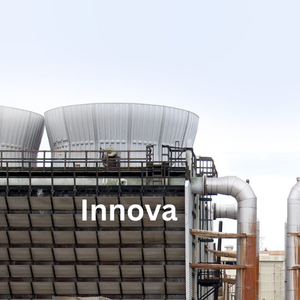
Dehradun's Selaqui industrial area is known for its pharmaceutical cluster, with HVAC systems running chiller plants and cooling towers to maintain clean room conditions and process temperatures. Food processing units, packaging plants and light engineering facilities also run cooling towers for process cooling. Dehradun's water supply comes largely from groundwater, and local water quality studies show hardness levels above 200 mg/L in river and industrial areas, with total hardness reaching around 290 mg/L in some parts of the district. When this water is used as cooling tower makeup, scale formation on heat transfer surfaces is a real risk. Cooling tower chemicals — scale inhibitors, corrosion inhibitors and biocides — are what keep the system running efficiently.
Cooling towers concentrate the minerals present in makeup water as water evaporates. Dehradun's groundwater carries hardness from calcium and magnesium salts. When the water cycles through the tower, these salts concentrate and can precipitate on heat exchanger surfaces as scale. Scale acts as an insulator, reducing heat transfer and forcing the chiller to work harder.
The same water can also be corrosive, depending on its dissolved gas content and pH. And the warm, oxygenated environment of a cooling tower is ideal for microbial growth — biofilm on fill surfaces and in the basin reduces cooling efficiency and can harbour harmful organisms. A complete chemical programme addresses all three: scale, corrosion and microbial growth.
A pharma HVAC system in Selaqui typically includes chiller plants, condenser water loops and cooling towers. The chemical programme has three main components:
For pharma units, the chemical programme may also need to consider the discharge of blowdown water, since the plant's ETP or drain may have consent conditions. The chemicals selected should be compatible with the downstream treatment.
Food processing units in Dehradun use cooling towers for process cooling — for example, cooling water for pasteurizers, chillers or condensers. The cooling load may be smaller than a pharma HVAC system, but the water chemistry challenges are similar. The makeup water hardness drives the scale risk, and the warm tower environment drives the microbial risk.
For smaller systems, a blended chemical programme may be practical — a single product that combines scale and corrosion inhibition, with a separate biocide. For larger systems, separate dosing of scale inhibitor, corrosion inhibitor and biocide gives more control. The right approach depends on the system size, the water quality and the operator's preference.
| Parameter | Typical Range |
|---|---|
| Appearance | Clear to coloured liquid |
| pH (concentrate) | Product-dependent |
| Specific gravity | 1.0–1.3 at 20°C, product-dependent |
| Dosage form | Liquid, dosed via chemical feed pump |
Ranges shown are typical for commercial cooling tower chemicals. Final values are confirmed against the sample lot and shared as TDS before order confirmation.
Cooling tower chemical dosage depends on the makeup water analysis, the cycles of concentration and the system volume. For scale inhibitors, dosage is typically expressed in ppm relative to makeup water, and is set to prevent scale at the target cycles. For corrosion inhibitors, dosage is set to maintain the protective film, often with a residual target. For biocides, dosage is set to achieve a shock dose or maintain a residual, depending on the product and the programme.
These are indicative approaches. Final dosage for a Dehradun unit is confirmed after a water analysis and, where possible, a trial run with the actual system.
Cooling tower chemicals are supplied in standard industrial packing. Pack sizes and material options are confirmed against the buyer's handling setup before dispatch. Store in a cool, dry area away from direct sunlight. Liquid products should be protected from freezing. Keep containers sealed when not in use.
Cooling tower treatment is not a fixed-dosage exercise. Dehradun's groundwater quality varies across the city, and each cooling system has its own operating parameters. We review the makeup water analysis and the system conditions before recommending a product and dosage. For pharma HVAC systems in Selaqui and food processing units across Dehradun, a water analysis is the starting point.
Call +91-9312871070 to discuss your cooling tower water analysis and current treatment programme.
Dehradun's groundwater has high hardness, often above 200 mg/L in river and industrial areas. For cooling towers using this water, a scale inhibitor is the first priority, followed by a corrosion inhibitor and a biocide programme. The specific product selection depends on the makeup water analysis and the cycles of concentration.
Selaqui's pharma units run HVAC systems with chiller plants and cooling towers. The chemical programme typically includes scale inhibition for the condenser, corrosion inhibition for the chilled water loop, and a biocide rotation for the cooling tower. The programme is set against the makeup water analysis and the system's operating parameters.
Some blended formulations combine scale and corrosion inhibition, but microbial control usually requires a separate biocide. The biocide may be oxidising or non-oxidising, and it is typically dosed on a schedule separate from the scale and corrosion inhibitors. The combination depends on the system and the water quality.
Dosage depends on the makeup water hardness, alkalinity, and the cycles of concentration the tower is running at. A water analysis is the starting point. For scale inhibitors, dosage is typically expressed in ppm relative to makeup water. For biocides, dosage is set to maintain a residual or to achieve a shock dose, depending on the product.
Share your makeup water analysis and cooling system details. We will review the hardness, alkalinity and cycles of concentration, and recommend a chemical programme for your cooling tower. Call +91-9312871070 to start the discussion.
© 2026 Innovacorp India Pvt Ltd. All Rights Reserved. Managed & Developed by Innova Corporate India
 Chat with Us