
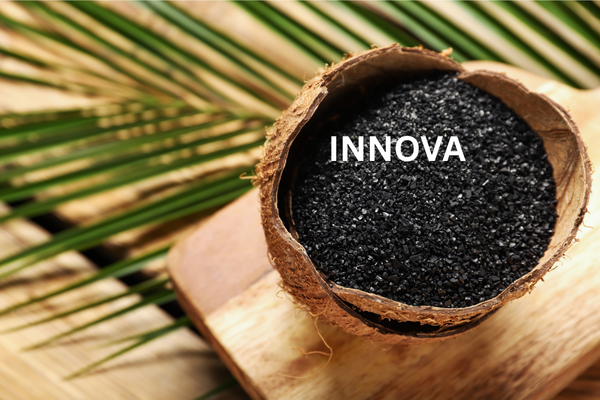
Innovacorp India manufactures and supplies activated carbon for Bhutan — powder (PAC) and granular (GAC) grades for water treatment and pharmaceutical applications. The range is built for plants working with Bhutan's surface water and spring sources, where colour, odour, and dissolved organics vary with the monsoon.
Bhutan's drinking water comes mainly from surface water and springs, and the monsoon changes what those sources carry. Intense rainfall mobilises sediment and organic matter, pushing turbidity and colour up for weeks at a time. National surveillance data has shown that microbial and turbidity compliance dip during these periods, and residual chlorine levels are often below target. For a plant treating this water, activated carbon sits at a specific point in the chain: after clarification and before disinfection, removing dissolved organics that give colour and taste, and in some cases dechlorinating treated water before it reaches a process or a discharge point.
The carbon has to match the water. A grade that works on one spring source may underperform on another with a different organic load. That is why the starting point is always your water analysis, not a catalogue page.
Bhutan's industrial activity is concentrated in a few estates. Pasakha Industrial Estate in Chhukha is the largest, with metal and chemical-based units making up a significant share of its industries. Phuntshorabtending Industrial Park in Samdrup Jongkhar hosts a smaller cluster of mineral and chemical industries. These units need water treatment for their own processes and boilers, and some generate effluent that requires colour and organic removal before discharge.
On the pharma side, Bhutan's economic roadmap lists pharma and medicine as a priority manufacturing sector. A pharma unit needs carbon for API purification and process water treatment — with a specification that is documented, repeatable, and confirmed against the product stream. That is a different grade from what a municipal water plant uses, and the difference matters.
Coconut shell carbon has a microporous structure. It is hard, and it works well on low-molecular-weight organics and colour bodies — the kind of load you see in drinking water and some process streams. Coal-based carbon has a mesoporous structure, which gives it more room for larger molecules; it is often used in wastewater and effluent polishing. Wood-based carbon has a broader pore distribution and is a general-purpose choice for food and beverage decolorization.
None of these is universally better. A plant treating monsoon-loaded surface water and a pharma unit purifying an API stream are asking different things from the carbon. The grade selection follows the application.
Powder activated carbon (PAC) is dosed into a batch process, mixed, and removed by filtration. It suits plants that already have filtration and need fast contact on a varying load — a common setup for seasonal colour and taste control. Granular activated carbon (GAC) is packed into a column or bed, and the water flows through continuously. It suits plants that want steady treatment over time and can accommodate a fixed bed in the treatment train.
A useful check: if your plant already filters after dosing, PAC is the simpler addition. If you are designing a new treatment line or replacing a bed, GAC may fit the footprint better. Either way, the final choice is confirmed after a lab trial with your water.
TDS on request. The relevant parameters — iodine value, mesh size, bulk density, moisture, ash — are confirmed against your application after a lab trial. We do not publish a single spec sheet for activated carbon because the range covers multiple grades for different duties.
Dosage is application-specific. For drinking water PAC, the starting range is typically in the low tens of ppm, adjusted against the raw water's colour and organic load. For GAC columns, the design parameter is empty bed contact time (EBCT), which is set from the flow rate and the target contaminant. For pharma and food streams, the dose is confirmed against the product specification and the pharmacopoeial requirement for the grade.
We do not publish a single number because a number without your water analysis is a guess. What we do is review your analysis, propose a starting dose, and adjust it through a lab trial and then plant monitoring — iodine value, breakthrough curves, and treated water quality.
Standard industrial packing; pack sizes on request.
A water plant with seasonal colour and a pharma unit with a fixed process stream need different selection logic. For the water plant, the question is: how fast does the load change, and can the plant handle filtration after dosing? If yes, PAC gives flexibility. For the pharma unit, the question is: what does the certificate need to say, and can the grade meet it batch after batch? That leans toward a documented GAC or a washed PAC with a fixed specification.
The common mistake is buying one grade for both duties. A general-purpose carbon that works acceptably in a water plant may not meet a pharma specification, and a pharma-grade carbon used in a water plant is an unnecessary cost.
If colour or odour breaks through earlier than expected, the first check is the inlet water — a monsoon spike can exhaust a bed faster than the design assumed. The second is the carbon itself: iodine value tells you the remaining adsorption capacity, but it does not tell you which compounds are breaking through. A breakthrough curve against your specific target is more useful than a single number.
If a GAC bed is losing capacity unevenly, check for channelling — water finding a path of least resistance through the bed instead of contacting the full carbon mass. And if a PAC dose seems to stop working, check the filtration step: PAC that is not removed carries over and can foul downstream equipment.
We work with plant engineers and procurement teams to match a carbon grade to the application, review water or product analysis, and support lab trials and breakthrough testing. Final specification and dosage are confirmed after a lab trial. For Bhutan requirements, call +91-9312871070.
Which activated carbon grade suits Bhutan's drinking water sources?
Bhutan's surface and spring sources carry seasonal turbidity and colour, especially
during the monsoon. Coconut shell PAC is often used for batch colour and odour
removal, while coal-based GAC is packed into columns for continuous treatment. The
right grade depends on your raw water analysis — confirmed after a lab trial.
Can activated carbon remove iron and manganese from Bhutan's spring water?
Standard activated carbon is not designed for iron and manganese removal. These metals
are typically handled by oxidation and filtration before carbon contact. Carbon is used
downstream to remove colour, odour, and dissolved organics. Share your water analysis
and we will review the treatment sequence with your engineers.
What is the difference between PAC and GAC for a water treatment plant?
PAC is dosed as a powder into a batch process and removed by filtration — used where
contact time is short and filtration is available. GAC is packed into a column or bed
and the water flows through it continuously — used where steady treatment over time is
needed. The choice depends on your plant layout and flow rate.
How should activated carbon be stored before use?
Keep bags sealed and stored in a dry, covered area away from moisture and strong
odours. Activated carbon adsorbs vapours from the air, so it should not be stored near
solvents or chemicals. Once a bag is opened, use it within a reasonable period or
reseal it properly.
Call +91-9312871070 to discuss your activated carbon requirement for a water treatment or pharma application in Bhutan. Share your water or product analysis and our team will help you select a grade and plan a lab trial.
© 2026 Innovacorp India Pvt Ltd. All Rights Reserved. Managed & Developed by Innova Corporate India
 Chat with Us