
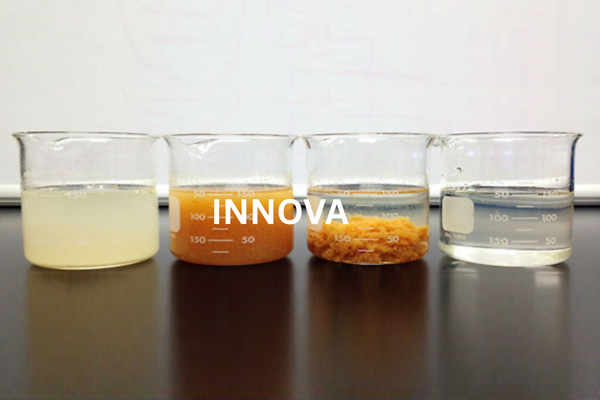
Innovacorp India Pvt Ltd is a manufacturer, exporter, and supplier of flocculant for sugar mills in Bhutan. Our range covers anionic, cationic and non-ionic polyacrylamide (PAM) flocculants used in juice clarification, mud settling and effluent treatment. Anyone who has worked a clarifier knows the pattern: settleable solids vary with cane variety, soil and rainfall, and a polymer that works in one week's crush does not always work in the next. The right approach is a jar test on the actual juice — not a fixed dosage carried over from another mill.
Raw juice carries soil, bagacillo and colloidal proteins that do not settle on their own in a reasonable time. Flocculants bridge these particles into larger, denser flocs, which settle faster in the clarifier. Faster settling means shorter retention time, less thermal exposure of the juice, and clearer clarified juice going to the evaporators. Clearer juice means less fouling on evaporator tubes, and less sucrose lost in the filter cake. The same chemistry is used in effluent treatment to thicken sludge and improve dewatering — the difference is the charge type and the dose.
| Property | Typical Range |
|---|---|
| Appearance | White to off-white granular powder |
| Type | Anionic, cationic or non-ionic (grade dependent) |
| Molecular weight | 5 – 20 million Daltons (grade dependent) |
| Charge density | 10% – 50% mole (grade dependent) |
| Moisture content | ≤ 10% |
| pH (0.1% solution) | 5.0 – 8.0 |
| Solubility | Dispersible in water; requires slow addition and gentle agitation |
| Shelf life | 24 months in unopened original packing |
| Storage | Cool, dry area; protect from moisture |
Final specification is confirmed against the product datasheet and after a jar test on your process stream.
Dosage depends on the stream (juice, syrup, ETP), solids load, pH and the type of polymer. Indicative starting ranges:
Feed points and dosing method (continuous or batch) are discussed with your process engineers. Final dosage is confirmed after a jar test on your process stream.
Flocculant programs work only when they match the process stream. We work with your process engineers on polymer selection (anionic vs cationic vs non-ionic), jar testing, dosage calculation, and program reviews across the campaign. Final specification, dosage and packaging are confirmed after a jar test on your process stream.
Innovacorp India Pvt Ltd
2B / BW Shalimar Bagh, Opp. BQ Market, Near DLF Mall
New Delhi - 110088, India
Phone: +91-9312871070
Q1. Which flocculant is used for juice clarification in Bhutan's sugar
mills?
Sugar mills in Bhutan typically use anionic polyacrylamide flocculant for juice clarification,
where the polymer bridges suspended solids into larger flocs that settle faster in the
clarifier. Innovacorp manufactures, exports and supplies anionic and cationic flocculants for
sugar mills in Bhutan.
Q2. How does flocculant help with mud settling in a clarifier?
Flocculant binds fine suspended solids into larger, denser flocs. These flocs settle faster than
individual particles, which reduces the clarifier retention time and helps compact the mud. The
right dose is confirmed through jar testing on the actual juice.
Q3. Can the same flocculant be used for ETP sludge dewatering?
Not always. Juice clarification typically uses anionic flocculant, while ETP sludge dewatering
typically uses cationic flocculant because the organic solids carry a negative charge. The grade
should be selected based on the stream and confirmed through a jar test.
Q4. Do you supply flocculant in bulk across Bhutan?
Yes. We supply in bulk to sugar mills and effluent treatment plants across Bhutan. Packing
options and dosing recommendations are discussed with your process engineers based on the
stream, solids load and settling target.
Send us your process stream, solids load, and the results of a recent jar test (or a sample we can test), and our technical team will propose a flocculant program that fits your mill. Call +91-9312871070 to speak with our team and request a sample, datasheet or a quote.
© 2026 Innovacorp India Pvt Ltd. All Rights Reserved. Managed & Developed by Innova Corporate India
 Chat with Us