
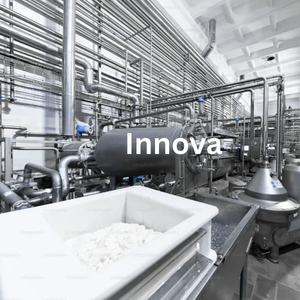
Innovacorp India Pvt Ltd is a manufacturer, exporter, and supplier of sugar chemicals in Bhutan. Our range covers juice clarification chemicals, decolourising agents, mill sanitation biocides, evaporator antiscalants, defoamers and viscosity modifiers. Sugar processing has many chemical touchpoints — from the milling tandem to the boiling house to the boiler and ETP — and each one has its own constraints. The right program is built around the mill's juice profile, water chemistry and process stage, not a fixed list of products.
A sugar mill runs on a chain of chemical decisions: how well the juice clarifies, how much sucrose is lost to microbial activity, how much scale builds on evaporator tubes, how stable the boiler water is, and how well the ETP handles the load. Each of these is influenced by a different chemical — a polyelectrolyte for settling, a biocide for microbial control, an antiscalant for evaporators, an oxygen scavenger for the boiler, and a bio-culture for the ETP. The chemistry has to work together, not in isolation. That is why a mill-scale program is built around the plant's actual conditions, confirmed through jar tests and plant trials.
Because sugar chemicals cover a wide product range, the table below gives indicative ranges. Actual specification is confirmed per product against the datasheet.
| Property | Typical Range |
|---|---|
| Appearance | Liquid, powder or granular (product dependent) |
| pH (as supplied) | 1.5 – 12.0 (product dependent) |
| Active content | 20% – 99% (product dependent) |
| Density (at 25°C) | 0.95 – 1.30 g/cm³ (liquid products) |
| Solubility | Water-soluble or water-dispersible (product dependent) |
| Shelf life | 12 – 24 months in unopened original packing (product dependent) |
| Storage | Product-specific; refer to SDS for each chemical |
Final specification is confirmed against the product datasheet and after a plant trial on your process.
Dosage depends on the process stage, the stream and the target result. Representative starting ranges:
Feed points, dosing method and program design are discussed with your process engineers. Final dosage is confirmed after a jar test or plant trial.
Sugar chemicals work only when the program matches the mill's process conditions. We work with your process engineers on juice profile review, water chemistry analysis, dosage calculation and program reviews across the campaign. Final specification, dosage and packaging are confirmed after a plant trial on your process.
Innovacorp India Pvt Ltd
2B / BW Shalimar Bagh, Opp. BQ Market, Near DLF Mall
New Delhi - 110088, India
Phone: +91-9312871070
Q1. How do sugar mill biocides help reduce sucrose loss?
Sucrose loss in a sugar mill is often driven by microbial activity — Leuconostoc and other
bacteria convert sucrose into dextran and other polysaccharides. Mill sanitation biocides help
control these microbes at the crushing stage, which supports sucrose recovery. Innovacorp
manufactures, exports and supplies these biocides for sugar mills in Bhutan.
Q2. What is the role of viscosity reducers in sugar processing?
Viscosity reducers are used in massecuite and molasses handling to improve fluidity. Better
fluidity supports boiling, crystallisation and centrifugal separation, and can reduce energy
consumption in those stages. The actual effect depends on the massecuite composition and the
process conditions.
Q3. How do evaporator antiscalants help sugar mills?
Evaporator antiscalants slow the deposition of scale on heat transfer surfaces. This helps
maintain heat transfer efficiency and reduce the frequency of evaporator cleaning, which is a
scheduled downtime event in most mills.
Q4. Do you supply sugar chemicals in bulk across Bhutan?
Yes. We supply in bulk to sugar mills and refineries across Bhutan. Packing options and dosing
programs are discussed with your process engineers based on the process stage, microbial load
and the target outcome.
Send us your juice profile, water chemistry, process stages and target outcomes, and our technical team will propose a sugar chemical program that fits your mill. Call +91-9312871070 to speak with our team and request a sample, datasheet or a quote.
© 2026 Innovacorp India Pvt Ltd. All Rights Reserved. Managed & Developed by Innova Corporate India
 Chat with Us