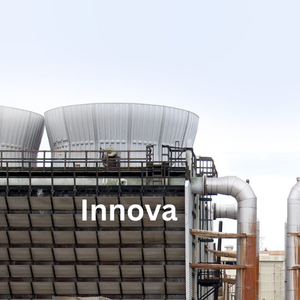
Manufacturers, Exporters, Suppliers of Cooling Tower Chemicals in Tanzania

Cooling Tower Chemicals — Biocides, Scale Inhibitors and Dispersants in Tanzania - Innovacorp India

Cooling Tower Chemicals for Tanzania's Industrial Water Systems

Innovacorp India is a manufacturer, exporter, and supplier of Cooling Tower Chemicals to Tanzania — biocides, scale inhibitors, corrosion inhibitors, and dispersants for industrial cooling water systems. Supplied to process plants across Tanzania, with export documentation and shipping support.

A cooling tower is a heat exchanger that works in open air — which means it is also an open biological system. Warm water, sunlight, and airborne nutrients create the conditions for scale, corrosion, and biological fouling to develop together. Treat one and ignore the others, and the system still loses efficiency. The right cooling water programme treats all three — scale, corrosion, and biofouling — with chemistry matched to the water and the system, not a fixed recipe.

The Three Problems Every Tanzania Cooling Tower Faces

  • Scale: Calcium carbonate and silica deposit on heat transfer surfaces as water evaporates and cycles of concentration (COC) increase. Scale insulates the surface, which raises energy consumption for the same cooling duty.
  • Corrosion: Dissolved oxygen, chloride, and low pH attack metal surfaces — particularly in Tanzania's coastal and high-chloride water sources. The result is metal loss, leaks, and shortened equipment life.
  • Biofouling: Algae, bacteria, and biofilm form in the warm, sunlit environment of the tower. Biofilm not only reduces heat transfer but also harbours corrosion-causing bacteria under the deposit.

How Cooling Tower Chemistry Works — by Function

Each chemical family addresses a different problem, and each works on a different mechanism:

  • Scale inhibitors: Work by threshold inhibition — a low dose interferes with crystal nucleation and growth, so scale-forming ions stay in solution beyond their normal solubility limit.
  • Corrosion inhibitors: Form a thin film on metal surfaces — anodic, cathodic, or mixed inhibitors — that slows the electrochemical corrosion reaction.
  • Biocides: Oxidising biocides (chlorine, bromine, or PAA-based) and non-oxidising biocides (isothiazolinone, glutaraldehyde-based) control microbial growth. They are typically alternated to prevent resistance and to address both planktonic bacteria and biofilm.
  • Dispersants: Keep suspended solids — silt, organic debris, corrosion products — from settling in low-flow areas of the system.

Our Product Range for Tanzania Cooling Systems

Product Family Function
Scale InhibitorsThreshold inhibition of calcium carbonate and silica
Corrosion InhibitorsAnodic, cathodic, or mixed film-forming protection
Oxidising BiocidesChlorine, bromine, or PAA-based microbial control
Non-Oxidising BiocidesIsothiazolinone or glutaraldehyde-based control
Bio-DispersantsBiofilm penetration and removal
Sludge DispersantsSuspended solids dispersion in low-flow areas

Product selection depends on your water analysis, system design, and COC target — confirmed at the enquiry stage.

Where Cooling Tower Chemicals Are Used in Tanzania

  • Process cooling: Chemical, textile, food processing, and pharma plants across Tanzania's industrial belt — where cooling water quality affects process consistency.
  • Power and cogeneration: Condenser cooling and auxiliary cooling systems — where heat transfer efficiency directly affects generation output.
  • Sugar mill cooling: Juice cooling and process water recirculation in Tanzania's sugar belt.
  • HVAC and chillers: Commercial and industrial HVAC cooling systems — where biofilm and scale affect energy consumption.

Dosing and Programme Design

Dosing depends on the water chemistry, system volume, COC, and target programme. Typical starting guidance for Tanzania systems:

  • Scale inhibitor: Dosed continuously — rate confirmed against water analysis and COC target.
  • Corrosion inhibitor: Dosed continuously — rate confirmed against metal types and water chemistry.
  • Biocides: Oxidising and non-oxidising biocides alternated — dose and frequency confirmed against microbial load and system volume.
  • Dispersants: Dosed continuously or intermittently — rate confirmed against suspended solids load.

We recommend a water analysis and a system review before establishing the programme. Final dosing is confirmed with your plant team.

Packing for Export to Tanzania

  • HDPE drums (liquid products)
  • HDPE-lined bags (powder products)
  • Jerry cans (small-volume products)
  • IBC tanks on request (bulk supply)
  • Packaging suited for sea freight; export documentation handled for Tanzania
  • Storage: cool, dry, away from direct sunlight; keep containers sealed until use

What Changes When the Programme Matches the System

  • Scale controlled at your COC target — not at a generic condition
  • Corrosion inhibitors matched to your metal types and water chemistry
  • Biocides alternated to prevent resistance and address biofilm
  • Dispersants matched to your suspended solids load
  • Programme confirmed against water analysis, not a fixed recipe

Water Analysis & System Review

We work with cooling tower operators, plant engineers, and utility teams in Tanzania on product selection, dosing, and programme design. The starting point is a water analysis (hardness, alkalinity, chloride, silica, TDS) and a system review (volume, COC, metallurgy), followed by a recommended programme and, where required, a trial before full-scale dosing. Export documentation and shipping coordination are handled for Tanzania.

Frequently Asked Questions

1. Do you export Cooling Tower Chemicals to Tanzania?

Yes. We export cooling tower chemicals to Tanzania — biocides, scale inhibitors and dispersants for industrial cooling water systems — with export documentation and shipping support. Port of discharge and shipping terms are confirmed at the quotation stage.

2. Which cooling tower problems do your chemicals address in Tanzania?

Our range addresses the three main cooling tower problems: scale (calcium carbonate and other mineral deposits), corrosion (on metal surfaces), and biological fouling (algae, bacteria, and biofilm). Each product is matched to the specific problem — confirmed after a water analysis of your system.

3. How are biocides dosed in Tanzania cooling towers?

Biocide dosing depends on the system volume, cycles of concentration (COC), and microbial load. Oxidising and non-oxidising biocides are typically alternated to prevent resistance — dose and frequency confirmed against your cooling water programme.

4. What are the shipping terms for Cooling Tower Chemicals to Tanzania?

Cooling tower chemicals are shipped in HDPE drums, jerry cans and IBC tanks depending on the product form, with export documentation handled for Tanzania. Shipping terms, port of discharge and lead time are confirmed at the quotation stage.

Request a Quote

For pricing, samples, or a technical discussion on Cooling Tower Chemicals for your Tanzania facility, call us at +91-9312871070. Our team will help you design the right programme for your system.

Our Products

WhatsApp Chat with Us