
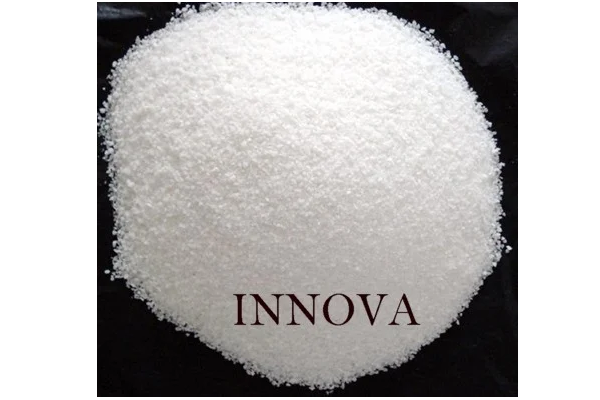
Innovacorp India is a manufacturer, exporter, and supplier of Polyelectrolyte to Tanzania — anionic, cationic, and non-ionic PAM for sugar juice clarification, sludge dewatering, and industrial effluent treatment. Supplied to sugar mills and process plants across Tanzania, with export documentation and shipping support.
Polyelectrolyte is not one product. It is a family of water-soluble polymers, and the charge type — anionic, cationic, or non-ionic — determines what it does. Anionic PAM bridges suspended solids in juice clarification; cationic PAM neutralises negatively charged organic particles in sludge dewatering; non-ionic PAM suits applications where charge neutrality is required. Using the wrong charge type is like using the wrong key — it may fit, but it will not turn. The right charge type and molecular weight are confirmed against your process, not from a datasheet headline.
| Charge Type | Mechanism | Typical Use |
|---|---|---|
| Anionic PAM (APAM) | Bridging — binds particles into larger flocs | Sugar juice clarification, potable water treatment |
| Cationic PAM (CPAM) | Charge neutralisation — neutralises negative particles | Sludge dewatering, ETP, primary clarification |
| Non-Ionic PAM | Bridging — where charge neutrality is required | Specialty filtration, vacuum filter applications |
Charge type and molecular weight are confirmed against your process — on a jar test.
Sugar juice carries suspended solids — soil, bagacillo, colloidal proteins — that are stabilised by negative surface charges. Anionic PAM works through a bridging mechanism: the long polymer chain attaches to multiple particles, binding them into larger flocs that settle faster than the individual particles would. Cationic PAM works through charge neutralisation: the positive charge neutralises the negative particle surface, allowing the particles to come together. In practice, sugar mills often use a combination — a coagulant to destabilise, followed by an anionic flocculant to bridge. The right sequence and dose are confirmed on a jar test.
Grade selection depends on your process and charge profile — confirmed at the enquiry stage.
| Property | Typical Value |
|---|---|
| Appearance | White powder or milky emulsion (grade-dependent) |
| Chemistry | Anionic, cationic, or non-ionic polyacrylamide |
| Molecular Weight | Grade-dependent; confirmed on datasheet |
| Charge Density | Grade-dependent; confirmed on datasheet |
| Solid Content | Grade-dependent (powder or emulsion) |
| pH (1% solution) | Near-neutral to slightly acidic, grade-dependent |
| Shelf Life | 12–24 months (unopened, dry storage), grade-dependent |
Final specification confirmed after a jar test on your process stream.
Dosage depends on the process stream, solids load, and charge type. Typical starting guidance for Tanzania mills:
We recommend a jar test on your process stream before establishing the dose. Final dosage is confirmed with your process engineers.
We work with sugar mill process engineers and effluent treatment teams in Tanzania on polyelectrolyte selection, jar testing, and dosing. The starting point is a jar test on your process stream — from there we recommend the charge type, molecular weight, and dose, and where required, support a plant trial before full-scale dosing. Export documentation and shipping coordination are handled for Tanzania.
Yes. We export polyelectrolyte to Tanzania — anionic and cationic PAM for sugar juice clarification, sludge dewatering and industrial ETP — with export documentation and shipping support. Port of discharge and shipping terms are confirmed at the quotation stage.
For organic sludge dewatering, cationic polyelectrolyte is typically used — its positive charge neutralises negatively charged organic particles, supporting floc formation and cake solids. The right grade and dose depend on the sludge characteristics — confirmed after a jar test.
Anionic polyelectrolyte works through a bridging mechanism — it binds suspended solids in sugar juice into larger flocs, supporting settling and clarity. Dose and sequence depend on the juice conditions — confirmed on a jar test.
Polyelectrolyte is shipped as a powder in HDPE-lined bags and as an emulsion in HDPE drums, with export documentation handled for Tanzania. Shipping terms, port of discharge and lead time are confirmed at the quotation stage.
For pricing, samples, or a technical discussion on Polyelectrolyte for your Tanzania mill or process plant, call us at +91-9312871070. Our team will help you select the right charge type for your process.
© 2026 Innovacorp India Pvt Ltd. All Rights Reserved. Managed & Developed by Innova Corporate India
 Chat with Us