
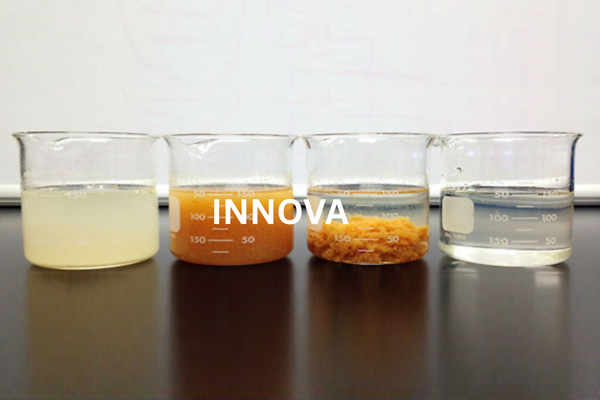
Innovacorp India is a manufacturer, exporter, and supplier of Flocculant to Tanzania — anionic and cationic polymers for sugar juice clarification and industrial effluent treatment. Supplied to sugar mills and process plants across Tanzania, with export documentation and shipping support.
Anyone who has run a juice clarifier in Tanzania's sugar belt knows the problem: settling is slow, mud volume is high, and sugar gets trapped in the mud — which means recovery losses that show up at the end of the season. Flocculant is not a single product. Anionic grades suit juice clarification; cationic grades suit effluent treatment and sludge dewatering. The right grade, molecular weight, and dose depend on the juice characteristics and the clarifier design — not on the datasheet headline.
Tanzania's sugar mills — Kilombero, Mtibwa, Kagera, and the surrounding cane belt — run juice clarification under conditions where settling performance directly affects recovery. Flocculant bridges the destabilised colloidal particles into larger flocs, which settle faster and carry less juice with them. The practical result is clearer juice going into evaporation, lower mud volume, and less sugar lost in filter cake. But the grade and dose have to match the juice — a flocculant that works on one mill's cane may not suit another's.
Flocculants are water-soluble polymers — usually polyacrylamide (PAM) based — with long molecular chains. When added to juice after liming and heating, the polymer chain bridges the destabilised colloidal particles, forming larger, denser flocs that settle faster than the individual particles would. Anionic PAM is typically used for juice clarification; cationic PAM is used for effluent treatment and sludge dewatering, where the charge profile is different. Molecular weight, charge density, and the form (powder or emulsion) affect performance — confirmed against your juice and clarifier design.
Grade selection depends on your juice or effluent characteristics and clarifier design — confirmed at the enquiry stage.
| Property | Typical Value |
|---|---|
| Appearance | White powder or milky emulsion (grade-dependent) |
| Chemistry | Anionic, cationic, or non-ionic polyacrylamide |
| Molecular Weight | Grade-dependent; confirmed on datasheet |
| Charge Density | Grade-dependent; confirmed on datasheet |
| Solid Content | Grade-dependent (powder or emulsion) |
| pH (1% solution) | Near-neutral to slightly acidic, grade-dependent |
| Shelf Life | 12–24 months (unopened, dry storage), grade-dependent |
Final specification confirmed after a jar test on your juice or effluent.
Dosage depends on the juice or effluent characteristics, flocculant grade, and process conditions. Typical starting guidance for Tanzania sugar mills:
We recommend a jar test on your juice or effluent before establishing the dose. Final dosage is confirmed with your process engineers.
We work with sugar mill process engineers and ETP teams in Tanzania on flocculant selection, jar testing, and dosing. Support includes guidance on feed point, make-down procedure, and interaction with your existing clarification and effluent treatment programme — along with export documentation and shipping coordination.
Yes. We export flocculant to Tanzania — anionic and cationic polymers for sugar juice clarification and industrial ETP — with export documentation and shipping support. Port of discharge and shipping terms are confirmed at the quotation stage.
Sugar mills typically use anionic polyacrylamide for juice clarification, where it helps flocculate colloidal impurities and supports mud settling. Cationic grades are used for effluent treatment and sludge dewatering. The right grade depends on the juice or effluent characteristics — confirmed at enquiry.
Flocculant is shipped as a powder in HDPE-lined bags and as an emulsion in HDPE drums, with export documentation handled for Tanzania. Shipping terms, port of discharge and lead time are confirmed at the quotation stage.
Dosage depends on the juice or effluent characteristics, flocculant grade, and process conditions. Typically dosed as a dilute solution into the juice line or clarifier feed — dose confirmed after a jar test. Final dosage is confirmed with your process engineers.
For pricing, samples, or a technical discussion on Flocculant for your Tanzania sugar mill or ETP plant, call us at +91-9312871070. Our team will help you select the right grade for your process.
© 2026 Innovacorp India Pvt Ltd. All Rights Reserved. Managed & Developed by Innova Corporate India
 Chat with Us