
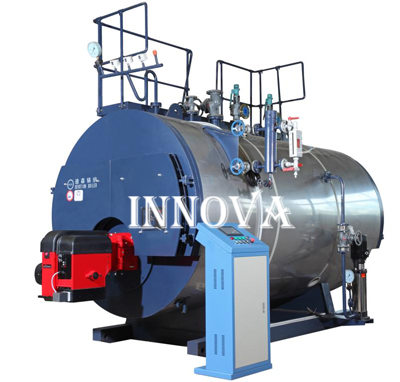
A boiler programme is not one chemical. It is a set of chemicals, each doing a specific job at a specific stage of the system, and the programme works only when the chemicals are chosen to fit the feedwater and the boiler, not the other way round. A mill that buys a scale inhibitor alone, and skips the oxygen scavenger, has solved half a problem.
Innovacorp India manufactures and supplies boiler chemicals in Agartala for the industrial boilers that run tea processing, food processing and general manufacturing in the region. This page is a category overview — the types of boiler chemicals, what each one does, and how to choose between them. The treatment programme itself (how the chemicals are sequenced across feedwater, boiler water and condensate stages) is covered on a separate page, so the two pages answer different questions.
Boiler water problems come from four directions, and each needs a different chemical response:
A programme that addresses only one of these leaves the others to develop quietly, and the failure mode that eventually appears is not always the one the plant was watching for.
Scale inhibitors work at sub-stoichiometric doses — they do not remove the hardness salts, they stop them from depositing on the tube surface. The mechanism is usually threshold inhibition, where the inhibitor adsorbs onto the growing crystal and prevents it from attaching to the metal. The result is a soft, dispersible solid that leaves with the blowdown rather than baking onto the tube.
Antiscalants are the same idea applied to specific scales — silica, calcium carbonate, calcium sulphate. The choice between a general scale inhibitor and a specific antiscalant depends on the feedwater analysis. A boiler with a silica problem needs a silica-specific product, not a general inhibitor.
Dissolved oxygen is the main cause of pitting corrosion in boiler systems. Mechanical deaeration removes most of it, but the residual oxygen that remains is enough to pit a tube over time. Oxygen scavengers react with the residual oxygen before it reaches the metal, and the choice of scavenger depends on the boiler pressure and the feedwater temperature.
At low pressure, sodium sulphite is the usual choice; at higher pressure, it breaks down into corrosive compounds and a different scavenger is needed. This is one of the places where a boiler chemical programme has to be matched to the boiler, not copied from a datasheet.
Boiler water pH has to sit in a narrow range: too low and the protective magnetite layer breaks down, too high and caustic embrittlement becomes a risk at high pressure. Alkalinity builders raise and buffer the pH together, which gives more stable control than caustic soda alone, especially where the feedwater alkalinity varies through the season.
The target pH depends on the boiler pressure, and the same product at the same dose can be correct for one boiler and wrong for another. This is why the dose is set from the water analysis rather than from a fixed figure.
Suspended solids in boiler water settle on tube surfaces if they are not kept moving. Sludge conditioners and dispersants keep the solids in suspension so that they leave with the blowdown rather than forming a deposit. They are particularly useful where the feedwater has high suspended solids or where the boiler has a history of deposit formation.
These are often treated as optional, but a boiler that runs without them tends to accumulate deposits in low-flow areas, which then become the starting point for under-deposit corrosion.
Condensate return lines are a separate corrosion environment. Carbonic acid, formed when CO₂ dissolves in condensate, attacks the return lines and the condensate tank. Condensate treatment uses neutralising amines or filming amines to protect these lines, and the choice depends on the condensate system and the plant's steam use.
Condensate corrosion is often overlooked because the damage is on the return side rather than in the boiler itself. A programme that protects the boiler but not the condensate lines is only half a programme.
The distinction matters when you are selecting a supplier. This page covers the category — what each chemical does and how to choose between types. The treatment programme is the sequencing: which chemical goes into feedwater, which into the boiler, which into the condensate, and how the blowdown is managed. A programme designed around your boiler and feedwater will use fewer chemicals than a collection of products bought individually, because each chemical is doing a job that the others are not duplicating.
| Parameter | Details |
|---|---|
| Form | Liquid and powder (product dependent) |
| Category | Scale inhibitors, oxygen scavengers, alkalinity builders, sludge conditioners, condensate treatment |
| Application | Industrial boilers — feedwater, boiler water, condensate |
| Active content | TDS on request (per product) |
| pH (as supplied) | TDS on request |
| Density | TDS on request |
| Shelf life | TDS on request |
Dosage is expressed in ppm of feedwater or boiler water, and is set per product from the water analysis and the blowdown practice. A fixed ppm is not reliable across boilers, because the same product at the same ppm behaves differently in a low-pressure tea-processing boiler and a high-pressure unit. We share a starting range from the TDS and confirm it after the first analysis cycle.
Feeding points follow the programme: oxygen scavenger and scale inhibitor into the feedwater line downstream of the deaerator, alkalinity builder into the boiler drum or feedwater line depending on the arrangement, sludge conditioner into the boiler, and condensate treatment into the condensate return. The dosing pumps have to be set up so that the chemicals do not interfere with each other before they reach their intended stage.
Standard industrial packing; pack sizes on request. Store in a cool, dry place away from direct sunlight, and keep the drum closed when not in use. Follow the SDS for handling.
We help with product selection, programme design and interpretation of your water analysis. Where a number cannot be confirmed without a trial, we say so. Final specifications are confirmed after a lab trial on your water sample.
Which boiler chemicals are needed for a low-pressure industrial boiler?
A low-pressure industrial boiler usually needs a scale inhibitor, an oxygen scavenger and a sludge conditioner, with alkalinity control where the feedwater is low in natural alkalinity. The exact combination depends on the feedwater analysis and the boiler's blowdown practice, so the starting point is a water test rather than a standard package.
What is the difference between oxygen pitting and caustic embrittlement?
Oxygen pitting is localised corrosion caused by dissolved oxygen attacking the tube surface, usually under deposits or in low-flow areas. Caustic embrittlement is a different problem — it happens at high pressure where concentrated caustic attacks the steel at stressed points such as rivets and tube ends. Both are boiler water chemistry problems, but the causes and the chemical programme are different.
How is a boiler chemical programme different from buying chemicals individually?
A programme coordinates the chemicals across feedwater, boiler water and condensate stages, so that the dosing at one stage does not work against the chemical at another. Buying chemicals individually can leave gaps between the stages, which is where most boiler problems start. We supply both the chemicals and the programme design.
What dosage of boiler chemicals is used in industrial boilers in Agartala?
Boiler chemical dosage is expressed in ppm of feedwater or boiler water, and is set from the water analysis and the blowdown practice. A fixed ppm is not reliable across boilers, because the same product at the same ppm behaves differently in a low-pressure tea-processing boiler and a high-pressure unit. The starting figure comes from your TDS and is confirmed after the first analysis cycle.
For product selection, programme review or a sample discussion for your boiler, call +91-9312871070. We will ask about your boiler pressure, feedwater source and current programme first, because that is what decides the right combination.
Related reading: boiler water treatment programme for feedwater, boiler water and condensate stages and alkalinity builder for boiler water pH control.
© 2026 Innovacorp India Pvt Ltd. All Rights Reserved. Managed & Developed by Innova Corporate India
 Chat with Us