
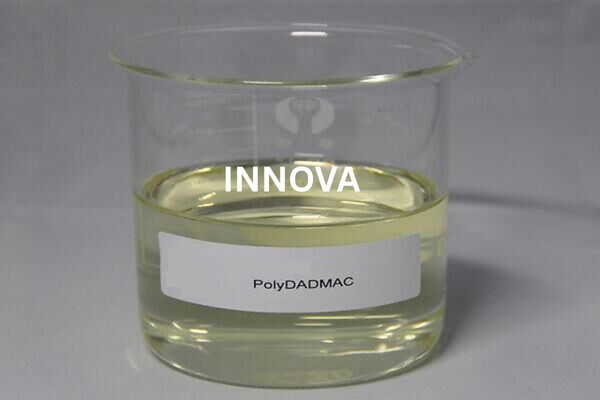
Why does a cationic polymer solve in one plant what alum cannot touch in another? The answer is usually the charge on the solids, not the dose. PolyDADMAC — poly diallyl dimethyl ammonium chloride — is a high-charge cationic organic polymer that neutralises the negative surface charge of colloidal particles and lets them come together without adding a metal salt. In Agartala, that property is most useful where the effluent or process water carries fine colour and colloidal solids that a conventional coagulant only partially clears. Innovacorp India manufactures and supplies PolyDADMAC in Agartala for effluent treatment, DAF units, process water and colour removal, with the grade selected against the actual effluent chemistry rather than a catalogue number.
The city's coagulation load is broader than a single application. Agartala has bamboo-paper operations producing coloured effluent, tea processing units with wash-water solids, municipal and industrial water treatment plants, and the small ETPs attached to the industrial estate around Bodhjungnagar. Each of these has a different charge profile and a different settling behaviour, and the PolyDADMAC grade that works in one will underperform in another if the jar test is not representative. Below is a charge-first guide: how PolyDADMAC differs from alum, where dosing and dilution usually go wrong, and how to choose a grade without over-dosing.
Both PolyDADMAC and alum work by neutralising the negative charge on colloidal particles, but they do it differently. Alum adds a metal salt that hydrolyses in water and produces a hydroxide floc; PolyDADMAC is an organic polymer that carries a fixed positive charge on its backbone. The practical differences show up in three places: sludge volume (PolyDADMAC produces less), pH sensitivity (PolyDADMAC stays ionised across a wider range), and the type of colour it can remove (PolyDADMAC is often better on dissolved anionic colour bodies that alum leaves behind). Neither is universally better — the right choice depends on the effluent, the sludge handling available, and the discharge limits the plant is working to.
PolyDADMAC is almost always a primary coagulant, not a standalone treatment. The notes below map the common streams seen in West Tripura to the stage where PolyDADMAC usually comes in.
Bamboo and paper effluent. PolyDADMAC as the primary coagulant for colour and colloidal solids, followed by an anionic flocculant to build larger flocs. The jar test should use the actual effluent, since colour chemistry varies with the process.
DAF units for food and beverage effluent. PolyDADMAC dosed into the coagulation zone ahead of the flocculant, with the DAF recycle and pressure conditions reproduced in the jar test. Dosing point and mixing energy matter as much as the dose.
Municipal and industrial water treatment. PolyDADMAC as a coagulant aid where the raw water carries colour or fine colloidal solids that alum alone does not clear. The dose is confirmed on a jar test at the plant's actual pH.
Process water for food and beverage units. PolyDADMAC where the process water needs clarification without adding metal salts. The grade is selected for the process stream and the outlet quality target.
The two most common PolyDADMAC failures in Agartala plants are over-concentrated feed and over-mixing. Over-concentrated feed happens when the polymer is dosed neat or at a dilution that is too strong, so the polymer chains coil instead of extending and the charge neutralisation is uneven. Over-mixing happens when the coagulation zone is stirred too fast or for too long, which breaks the micro-flocs before the flocculant can build them into larger flocs. In both cases the polymer is not at fault; the dosing routine is. A dilution chart on the dosing skid and a jar test that reproduces the plant's actual mixing energy fix more PolyDADMAC complaints than switching grades does.
What is the difference between PolyDADMAC and alum for ETP coagulation?
PolyDADMAC is a cationic organic polymer that neutralises the negative surface charge of colloidal particles without adding a metal salt. Alum works through a similar charge mechanism but adds sulphate and metal ions, which increases sludge volume. The choice depends on the effluent type and the sludge handling available at the plant.
How is PolyDADMAC dosed in a DAF or clarifier?
PolyDADMAC is dosed as a dilute solution into the coagulation zone, ahead of the flocculant and before the DAF or clarifier. The dosing point, dilution and mixing energy are confirmed on a jar test, since over-mixing or a concentrated feed can break the micro-flocs.
Can PolyDADMAC help with colour removal in Agartala's bamboo and paper effluent?
PolyDADMAC is often used as the primary coagulant for colour and colloidal solids in bamboo and paper effluent, followed by a flocculant to build larger flocs. The dose is confirmed on a jar test with the actual effluent sample, since colour chemistry varies with the process.
What is the shelf life and storage condition for liquid PolyDADMAC?
Liquid PolyDADMAC is usually supplied in standard industrial containers and should be stored under cover, away from direct sunlight and freezing. The label shelf life is confirmed on the technical documentation, and the working solution should be prepared fresh rather than stored for long periods.
PolyDADMAC is supplied in a range of molecular weights and charge densities, and the grade matters more than the dose in most plants. A low-molecular-weight, high-charge grade is usually better for dissolved colour bodies and for charge neutralisation in a DAF; a higher-molecular-weight grade builds larger flocs and is often used where the clarifier is the main separation step. The jar test should compare at least two grades at three doses each, and the decision should be made on overflow clarity, floc size, sludge volume and the dose that gets there — not on a single-point comparison. Where the plant has a DAF unit, the jar test should reproduce the DAF's recycle and pressure conditions, since the flotation behaviour is different from gravity settling.
Liquid PolyDADMAC is supplied in standard industrial containers; pack sizes on request. The product should be stored under cover, away from direct sunlight and freezing, and the working solution should be prepared fresh rather than stored for long periods. Dosing lines and pumps should be flushed with water after each batch, since dried polymer can block small-bore lines. Because the correct dilution depends on the grade and the dosing system, the final dilution is confirmed against the product's technical documentation.
We help plant and quality teams work through grade selection, jar test design, dosing point and dilution. Final specification and dilution are confirmed on a jar test with your effluent sample. For Agartala-specific questions, call +91-9312871070 and our technical team will walk through the coagulation stage with you. If your plant also runs a boiler or treats its own water, the boiler chemicals range and the water treatment chemicals range cover the adjacent stages. Related products are on our PolyDADMAC product page and the Agartala industrial chemicals page.
© 2026 Innovacorp India Pvt Ltd. All Rights Reserved. Managed & Developed by Innova Corporate India
 Chat with Us