
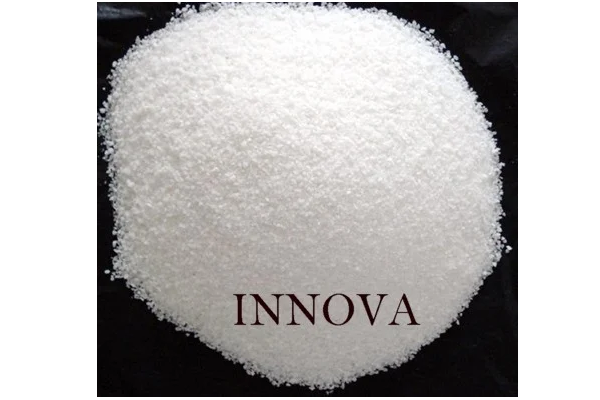
Two polyelectrolytes with the same label can behave completely differently in the same clarifier. One builds large, shear-stable flocs at a low dose; the other over-doses at half the rate and leaves a hazy overflow. The difference is not the brand — it is the charge density, the molecular weight and the dissolution routine, and in Agartala's mixed effluent streams those three variables decide more outcomes than the product name does. Innovacorp India manufactures and supplies polyelectrolytes in Agartala for effluent treatment, sludge dewatering and process clarification, with the grade selected against the charge and the solids rather than a catalogue number.
This page is written for the reader who already knows the plant needs a polymer and now has to choose between anionic, cationic and non-ionic grades. It explains how charge density and molecular weight work against each other, where dissolution and ageing usually go wrong, and how the Agartala climate changes the storage and dosing routine. The application side — clarifier operation, jar test design, DAF dosing — is covered on our flocculant page for Agartala, so the two pages together cover the full selection decision.
Polyelectrolytes are described by two numbers that pull in opposite directions. Charge density is the fraction of the polymer backbone that carries a charged group; it controls how strongly the polymer attaches to the particle surface and how quickly the charge is neutralised. Molecular weight controls the chain length; it decides how far the polymer can bridge between two particles and how large the resulting floc becomes. A high-charge, low-molecular-weight polymer attaches fast but builds smaller flocs; a low-charge, high-molecular-weight polymer bridges far but is easier to over-dose. Most plant problems come from choosing one number without checking the other against the actual solids.
The grade family should follow the charge on the solids, not the other way around. The notes below map the common streams seen in West Tripura to the family that usually fits first.
Bamboo and paper effluent. Often a two-polymer approach: a cationic polymer for charge neutralisation, followed by a high-molecular-weight anionic polymer for bridging. The combination is confirmed on a jar test, since the sludge chemistry changes with the process.
Tea processing wastewater. Leaf fines and organics carry a negative charge, so a medium-charge cationic polymer is usually the first test. A low-dose anionic top-up is added only if the flocs need more size.
Municipal and industrial water treatment. Anionic or non-ionic polymer depending on the raw water turbidity and the coagulant used upstream. The charge on the coagulated solids decides the family.
Sludge dewatering (filter press, centrifuge, screw press). Cationic polymer for organic sludges, anionic for mineral and paper sludge. Charge density matters more than molecular weight for cake dryness, while molecular weight matters more for drainage rate.
The two most common polyelectrolyte failures in Agartala plants are over-concentrated dissolution and aged working solutions. Over-concentrated dissolution happens when the powder is mixed at a concentration above the label's recommendation — the polymer chains coil instead of extending, and the dose that worked in the jar test underperforms in the plant. Aged working solutions happen when a batch is prepared in the morning and used until evening; most polyelectrolytes lose activity within hours of dissolution, and the loss is faster in Agartala's warm, humid months. In both cases the polymer is not at fault; the routine is. A dissolution chart on the dosing skid and a working-solution log that records the preparation time fix more polymer complaints than switching grades does.
How do I choose a polyelectrolyte by charge density for Agartala ETP sludge?
Charge density is the first filter, not the only one. Organic sludges usually respond to a medium-to-high charge cationic polymer, while mineral and paper sludges often need a high-molecular-weight anionic grade. The final choice is confirmed on a jar test that compares at least two charge densities at three doses each.
What is the difference between molecular weight and charge density in a polyelectrolyte?
Molecular weight controls the chain length and the bridging distance between particles, while charge density controls how strongly the polymer attaches to the particle surface. A high-molecular-weight, low-charge polymer bridges well but can over-dose easily; a low-molecular-weight, high-charge polymer is more forgiving on dose but builds smaller flocs.
How is polyelectrolyte powder dissolved for dosing in Agartala plants?
Powder polyelectrolyte is dissolved in a dilute solution under gentle mixing, usually at a concentration well below the label's maximum, and left to age for the recommended time before dosing. In Agartala's humid climate, powder should be stored in its moisture-barrier bag and the working solution prepared fresh, since aged solutions lose activity.
Which polyelectrolyte is used for sludge dewatering in bamboo and paper units?
Bamboo and paper sludge is often treated with a cationic polymer for charge neutralisation followed by an anionic polymer for bridging, depending on the sludge chemistry. The combination and the dose are confirmed on a jar test and a filter press trial, since the sludge varies with the process.
Most polyelectrolyte datasheets list the charge type, the charge density range, the molecular weight range, the recommended dissolution concentration and the shelf life in dry form. The numbers that matter for selection are the charge density and molecular weight ranges — not the single "typical" value — because the actual grade sits inside a range and the plant's performance depends on where in that range the batch falls. The dissolution concentration matters as much: a polymer that is mixed at 0.5% instead of 0.1% will not perform the same way in the plant, even if the jar test uses the correct figure. When comparing two suppliers, ask for the range, not the midpoint.
Powder polyelectrolyte is hygroscopic, and Agartala's humid months are hard on open bags and half-used sacks. A caked bag does not dissolve evenly, and the resulting solution underperforms even at the correct dose. The practical routine is to keep powder in its moisture-barrier bag until the dosing skid is ready, to reseal part-used bags with a clip rather than leaving them open, and to store the powder off the floor and away from the wall. Liquid grades are less sensitive to humidity but freeze at low temperatures and separate if stored too long; the storage instructions on the label should be followed rather than assumed.
Polyelectrolyte is supplied as powder in moisture-barrier bags or as liquid in standard industrial containers, depending on the grade. Pack sizes on request. Store under cover, away from direct sunlight, moisture and freezing. Dosing lines and pumps should be flushed with water after each batch, since dried polymer can block small-bore lines.
We help plant and quality teams work through grade selection, dissolution routine, jar test design and storage conditions. Final specification and dissolution programme are confirmed on a jar test with your sample. For Agartala-specific questions, call +91-9312871070 and our technical team will walk through the polymer selection with you. If your plant also runs a boiler or treats its own water, the boiler chemicals range and the water treatment chemicals range cover the adjacent stages. Related products are on our polyelectrolyte product page and the Agartala industrial chemicals page.
© 2026 Innovacorp India Pvt Ltd. All Rights Reserved. Managed & Developed by Innova Corporate India
 Chat with Us