
“Bind The Solids. Release The Water. Reduce Disposal Cost.”
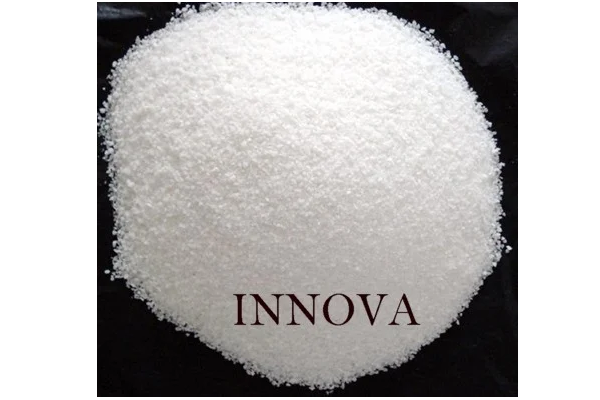
Innovacorp is a manufacturer of polyelectrolyte for effluent treatment and sewage treatment plants. Polyelectrolytes are high-molecular-weight water-soluble polymers — also called polyacrylamide (PAM) — that are used as flocculants in wastewater treatment. They bind fine suspended particles into larger flocs through a bridging mechanism. In clarification, this makes the solids settle faster. In sludge dewatering, it releases the water trapped in the sludge, which gives a drier cake and reduces disposal cost. We manufacture anionic, cationic and non-ionic grades in powder and emulsion form. Every batch is manufactured at our facility and tested before dispatch.
Wastewater treatment produces sludge, and handling that sludge is one of the biggest operating costs in an ETP or STP. Wet sludge is mostly water — if it is not dewatered properly, the plant ends up transporting and disposing of water along with the solids. Polyelectrolytes solve this by binding the fine particles into larger, denser flocs that release water easily during pressing or centrifuging. This gives a drier cake, which reduces the volume to be disposed and the cost per tonne of sludge. In clarification, the same bridging mechanism makes the solids settle faster, which allows higher flow rates through the clarifier.
Indicative values from our standard polyelectrolyte range. Final specification is confirmed against your sludge characteristics.
| Parameter | Typical Value |
|---|---|
| Appearance | White powder / Milky white emulsion |
| Type | Anionic / Cationic / Non-ionic PAM |
| Molecular Weight | High (as per grade) |
| Charge Density | Low to High (depends on type) |
| pH (0.1% solution) | 5.0 – 8.0 |
| Shelf Life | 24 months (powder) / 6 months (emulsion) |
Dosage depends on the sludge characteristics and the dewatering equipment. Indicative ranges:
Exact dosage should be confirmed with our technical team based on your effluent and sludge analysis.
Sludge characteristics change with the process and the season, and the right polyelectrolyte depends on the charge of the suspended particles. Our technical team works with your ETP operator or environmental engineer to review effluent analysis and recommend the right polymer type and dosage. For large ETPs, we arrange jar tests and plant trials before finalising the recommendation.
Q. What is the difference between anionic and cationic polyelectrolytes?
Anionic polyelectrolyte carries a negative charge and is used for treating inorganic suspended
solids. Cationic polyelectrolyte carries a positive charge and is used for organic solids and sludge
dewatering.
Q. How do polyelectrolytes help in sludge dewatering?
They bind fine particles into larger flocs through a bridging mechanism. Larger flocs release water
more easily during pressing or centrifuging, which gives a drier cake.
Q. What is the dosage of polyelectrolyte in ETP?
Typical dosage ranges from 5 to 20 ppm on sludge for dewatering and 2 to 10 ppm for clarification.
Call +91-9312871070 for guidance.
Q. Do you supply polyelectrolyte in bulk?
Yes, we supply powder in 25 kg bags and emulsion in 200 litre drums. Bulk quantities available on
request.
© 2026 Innovacorp India Pvt Ltd. All Rights Reserved. Managed & Developed by Innova Corporate India
 Chat with Us