
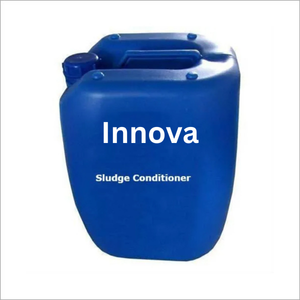
“Release The Water. Dry The Cake. Reduce The Disposal Cost.”
Innovacorp is a manufacturer of sludge conditioners for effluent treatment and sewage treatment plants. Sludge coming out of the biological treatment stage is mostly water — often 95% to 98% by volume. Before it can be disposed, this water has to be removed. Sludge conditioners are chemicals that are dosed before the dewatering equipment to release the bound water from the sludge, so the filter press or centrifuge produces a drier cake. A drier cake means less volume to transport and lower disposal cost. Our sludge conditioners are formulated for filter presses, belt presses and decanter centrifuges. Every batch is manufactured at our facility and tested before dispatch.
Sludge handling is one of the biggest operating costs in an ETP or STP. Wet sludge is heavy and bulky, and transporting it costs money per tonne. If the sludge is not conditioned properly before dewatering, the filter press or centrifuge produces a wet, sloppy cake that is difficult to handle and expensive to dispose. Conditioning chemicals solve this by binding the fine sludge particles into larger flocs that release water easily. This gives a drier, more compact cake, which reduces the volume to be transported. Conditioning also improves the clarity of the filtrate, which can be recycled back into the plant.
Indicative values from our standard sludge conditioner range. Final specification is confirmed against your sludge characteristics.
| Parameter | Typical Value |
|---|---|
| Appearance | Clear to pale yellow liquid |
| Type | Polymer-based conditioner |
| pH (0.1% solution) | 5.0 – 8.0 |
| Active Content | 30% – 50% |
| Density | 1.05 – 1.20 g/cc |
| Shelf Life | 12 months from manufacture |
Dosage depends on the sludge characteristics and the dewatering equipment. Indicative ranges:
Exact dosage should be confirmed with our technical team based on your sludge analysis and dewatering equipment.
Sludge characteristics change with the process, the season and the upstream treatment. Our technical team works with your ETP operator or environmental engineer to review sludge analysis and recommend the right conditioner and dosage. For large plants, we arrange jar tests and plant trials before finalising the recommendation.
Q. How does a sludge conditioner reduce disposal costs?
It releases bound water from the sludge matrix. This increases the dry solids content in the cake,
which reduces the weight and volume that has to be transported.
Q. Is it compatible with all types of dewatering equipment?
Yes, our sludge conditioners work with filter presses, belt presses and decanter centrifuges. The
formulation provides good shear resistance for centrifuge applications.
Q. What is the dosage of sludge conditioner?
Typical dosage ranges from 5 to 20 ppm on sludge for dewatering and 20 to 50 ppm for conditioning
before thickening. Call +91-9312871070 for guidance.
Q. Do you supply sludge conditioner in bulk?
Yes, we supply in 35 kg / 50 kg carboys and 200 litre HDPE drums. Bulk quantities available on
request.
© 2026 Innovacorp India Pvt Ltd. All Rights Reserved. Managed & Developed by Innova Corporate India
 Chat with Us