
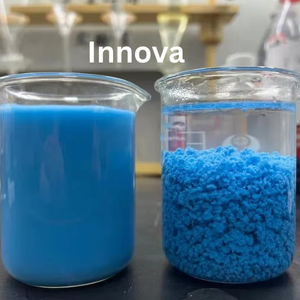
“Remove Colour. Reduce COD. Meet Discharge Norms.”
Innovacorp manufactures decolourizing agents for effluent treatment and industrial process liquors. Colour in wastewater comes from dyes, pigments, polyphenols and organic degradation products. Biological treatment alone does not remove colour, because the chromophore groups in these molecules resist degradation. If colour is not removed at the ETP, the treated water fails discharge norms and cannot be reused. Our decolourizing agent is a cationic polymer that binds with anionic colour bodies, forms flocs, and allows them to be separated from the water. The same chemistry is used in sugar refineries to reduce colour in process liquors. Every batch is manufactured at our facility and tested before dispatch.
Colour in effluent is one of the most visible signs of pollution, and regulators are tightening discharge norms across India. Many industrial clusters are also moving towards Zero Liquid Discharge (ZLD), where the water must be clean enough to reuse and the salt recovered must be free of colour. Decolourizing agents work by chemically binding with colour-causing molecules so they can be removed by settling or filtration. Doing this early in the ETP also helps reduce COD, because the organic molecules that carry colour also contribute to oxygen demand. Removing them at the source reduces load on downstream biological treatment.
Indicative values from our standard decolourizing agent range. Final specification is confirmed against your effluent or process liquor characteristics.
| Parameter | Typical Value |
|---|---|
| Appearance | Clear to pale yellow liquid |
| Type | Cationic polymer |
| pH (1% solution) | 3.0 – 6.0 |
| Active Content | 30% – 50% |
| Viscosity (cps at 25°C) | 50 – 300 |
| Density | 1.05 – 1.20 g/cc |
| Shelf Life | 12 months from manufacture |
Dosage depends on the colour load, COD level and application. Indicative ranges:
Exact dosage should be confirmed with our technical team based on your effluent or liquor analysis.
Effluent colour and COD load vary with process conditions and raw materials. Our technical team works with your ETP operator or process chemist to review analysis and recommend the right dosage and application point for your plant. For large ETPs and ZLD systems, we arrange plant trials before finalising the recommendation.
Q. What industries benefit from decolourizing agents?
Decolourizing agents are used in textile effluent treatment to remove dye colour, and in sugar
processing to reduce colour in process liquors. Innovacorp manufactures for both industries.
Q. Can this agent reduce COD along with colour?
Yes, decolourizing polymers help reduce COD by precipitating organic colour-causing molecules from
the effluent. The exact COD reduction depends on the effluent composition and dosage.
Q. What is the dosage of decolourizing agent?
Typical dosage ranges from 100 to 500 ppm depending on the application. Call +91-9312871070 for
guidance.
Q. Is decolourizing agent safe for food processing?
For sugar processing applications, we recommend product selection based on your process
requirements. Our technical team can share relevant documentation on request.
© 2026 Innovacorp India Pvt Ltd. All Rights Reserved. Managed & Developed by Innova Corporate India
 Chat with Us