
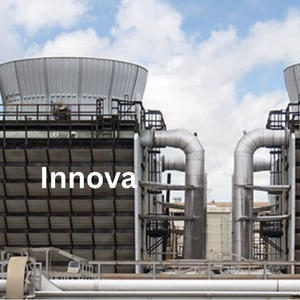
A cooling tower and a cooling circuit are not the same thing. The tower is where heat leaves the water. The circuit is where the water does its work: through condenser tubes, chiller evaporators, plate heat exchangers, and process equipment. For Amritsar’s Focal Point units and sugar mills, the circuit is where fouling shows up as rising approach temperatures, falling chiller efficiency, and higher condenser pressure. Amritsar’s groundwater—TDS 1000 to 3000 ppm, hardness 400 to 800 ppm, with elevated fluoride, iron, and arsenic—makes circuit fouling a certainty if the water is not treated. This page is about the circuit side of the treatment programme.
Heat exchanger fouling in Amritsar chillers and process exchangers comes from three sources, and they do not behave the same way. Scale from hardness and silica deposits directly on the tube surface. It is hard, insulating, and reduces heat transfer. Corrosion products—iron oxide and copper oxides—deposit on tubes and reduce flow. Biofilm traps suspended solids and creates a slime layer that is both insulating and biologically active.
The treatment programme has to address all three. A scale inhibitor that works on calcium carbonate does nothing for biofilm. A biocide that kills bacteria does nothing for hardness scale. The dispersant keeps corrosion products and silt suspended so they leave with blowdown rather than settling in low-flow areas. For Amritsar circuits, where the make-up water carries all three risk factors, a single-product approach is not enough.
Cycles of concentration is the ratio of dissolved solids in the cooling water to dissolved solids in the make-up water. Higher COC means less make-up water and less blowdown, which saves water. But higher COC also means higher dissolved solids, higher scaling ion concentration, and higher corrosion risk.
Amritsar’s starting TDS is already high. A circuit that runs at four cycles on soft water may need to run at two or three cycles on Amritsar groundwater to stay within chemical limits. This is a trade-off, not a failure. The treatment programme and the blowdown practice have to be designed together, with the COC target set by the water chemistry, not by a generic water-saving target.
The approach temperature in a chiller condenser is the difference between the leaving condenser water temperature and the saturated condensing temperature. A clean condenser has a small approach. A fouled condenser has a larger approach, which means the compressor has to work harder to achieve the same cooling. The energy penalty is real and continuous.
For Amritsar’s HVAC and process chillers, the approach temperature is the most useful diagnostic. If it rises over time, fouling is accumulating. The treatment programme should be adjusted before the approach reaches the point where mechanical cleaning is the only option. This is where scale inhibitor, dispersant, and biocide doses are reviewed together against the actual operating data.
An open loop exchanges heat with the atmosphere through a cooling tower. Water is lost to evaporation, dissolved solids concentrate, and make-up water is continuous. The treatment focus is scale, corrosion, and biological growth, with blowdown controlling the concentration.
A closed loop recirculates the same water without atmospheric contact. Water loss is minimal, so dissolved solids do not concentrate the way they do in an open loop. The treatment focus shifts to corrosion inhibition and, in some cases, freeze protection. A closed loop that is treated like an open loop will be over-dosed and under-protected at the same time.
Amritsar’s Focal Point units often have both types on site: an open loop for the main process cooling and a closed loop for chillers or specialised equipment. The two need separate treatment programmes, not one programme applied to both.
Cooling water treatment chemicals are supplied in standard industrial packing. Pack sizes are available on request. Store in a dry, covered area away from direct sunlight and incompatible chemicals. Keep containers closed when not in use. For liquid grades, protect from freezing if the formulation requires it. Use appropriate personal protective equipment during handling and follow the product-specific guidance for dilution and dosing.
We manufacture and supply cooling water treatment chemicals for scale, corrosion, and biological control. For Amritsar circuits, the useful conversation starts with your water analysis and your circuit layout—make-up water TDS and hardness, COC target, blowdown rate, and the metallurgy of your heat exchangers. From there we can suggest a programme and a starting dose, with the understanding that final adjustment happens on your system with your water.
Q: How does high-TDS make-up water affect cycles of concentration in Amritsar cooling systems?
A: Amritsar groundwater carries TDS in the range of 1000 to 3000 ppm. When this water is used as cooling system make-up, the dissolved solids concentrate as water evaporates. Higher cycles of concentration save water but push the dissolved solids and scaling ions higher. For Amritsar systems, the practical COC limit is often lower than in soft-water regions because the starting TDS is already high. The treatment programme and blowdown practice have to be designed together to stay within chemical limits.
Q: What causes heat exchanger fouling in Amritsar industrial chillers?
A: Heat exchanger fouling in Amritsar chillers comes from three sources: scale from hardness and silica, corrosion products from the circuit, and biofilm from microbial growth. Scale insulates the tube surface and reduces heat transfer. Corrosion products deposit on tubes and reduce flow. Biofilm traps suspended solids and creates a slime layer. The treatment programme must address all three, not just one.
Q: What is the difference between an open loop and a closed loop cooling system?
A: An open loop cooling system exchanges heat with the atmosphere through a cooling tower, so water is lost to evaporation and dissolved solids concentrate. Make-up water is continuous, and the treatment must handle scaling, corrosion, and biological growth. A closed loop recirculates the same water without atmospheric contact, so water loss is minimal. The treatment focus shifts to corrosion inhibition and freeze protection rather than scale and biocide.
Q: How should cooling water treatment chemicals be stored at an Amritsar facility?
A: Store in a dry, covered area away from direct sunlight and incompatible chemicals. Keep containers closed when not in use. For liquid grades, protect from freezing if the formulation requires it. Use appropriate personal protective equipment during handling and follow the product-specific guidance for dilution and dosing. Standard industrial packing is used; pack sizes are available on request.
To discuss your cooling circuit treatment, call +91-9312871070.
© 2026 Innovacorp India Pvt Ltd. All Rights Reserved. Managed & Developed by Innova Corporate India
 Chat with Us