
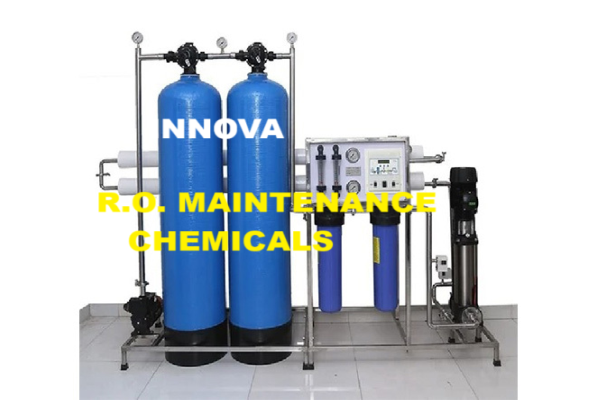
Amritsar's RO plants do not all foul the same way. A chemical unit running at 850 mg/L feed TDS may see calcium carbonate scale building on the membrane within months. A textile plant recycling process water may see biofilm that resists standard alkaline cleaning. A pharma plant with strict water quality targets may see organic fouling that raises permeate conductivity before any pressure drop appears. The cleaning chemical has to match the foulant, and the foulant has to be identified before the CIP is designed.
Innovacorp supplies acid cleaners, alkaline cleaners, and non-oxidizing biocides for RO membrane CIP in Amritsar. This page is about restoration — removing what has already deposited. For prevention, the antiscalant page covers continuous feed dosing before the membrane.
The trigger for CIP is usually a 10 to 15 percent decline in normalised permeate flow, a 10 to 15 percent rise in differential pressure, or a defined increase in salt passage. These are normalised values, not raw gauge readings. A plant that compares today's flow to yesterday's flow without correcting for temperature and feed TDS will clean too often or too late.
Cleaning does not fix every problem. If the membrane has suffered oxidative damage from chlorine exposure, or if the differential pressure has risen because of a mechanical issue such as a failing O-ring or a collapsed spacer, a CIP will not restore performance. The decline has to be diagnosed before the chemical is selected.
Alkaline cleaning removes organic matter, biological fouling, and oils by hydrolysis and dispersion. Acid cleaning dissolves carbonate scale, metal hydroxides, and some sulfate scales. The usual sequence is alkaline first, then acid. This order prevents organic fouling from masking mineral scale underneath it, and it reduces the risk of exposing the membrane to acid when an alkaline step would have removed the bulk of the foulant.
But the sequence is not universal. If the feed water is dominated by hardness and the foulant is clearly carbonate scale, an acid clean may be the starting point. The decision should be based on the feed analysis and, where available, a foulant sample from the membrane or the CIP return line.
Scale usually shows as a decline in salt rejection with a relatively stable differential pressure. The membrane loses its ability to reject dissolved ions because the scale layer disrupts the thin-film composite surface. Biofilm and organic fouling usually show as a rise in differential pressure with relatively stable salt rejection, because the foulant layer blocks flow but does not necessarily create a pathway for ions to pass.
In practice, most fouling is mixed. Amritsar's feed water carries both hardness and organic load, and biological activity in the pretreatment train can seed biofilm even when the membrane itself is not directly exposed to raw water. This is why a single cleaner often does not restore the membrane fully, and why the alkaline-acid sequence is the default rather than a single-step clean.
Antiscalants are not included here. They are a continuous feed product, covered on the RO antiscalant page, not a CIP cleaning chemical.
CIP restores permeability that hydraulic flushing cannot reach. It removes foulant from the membrane surface and from the feed spacer channel. What it cannot do is reverse chemical damage to the polyamide layer, repair a mechanical failure in the element, or compensate for a pretreatment train that is allowing foulant through faster than the CIP can remove it.
If a membrane requires cleaning more often than every three to six months, the problem is usually upstream: inadequate pretreatment, incorrect antiscalant dose, or a feed water change that has not been reflected in the treatment programme. Cleaning more frequently treats the symptom, not the cause.
Standard industrial packing. Pack sizes on request. Store in a cool, dry area away from incompatible chemicals. Refer to the SDS for specific handling and PPE requirements.
We support Amritsar plants with cleaner selection, CIP sequence guidance, and foulant diagnosis review. We do not claim on-site visits or membrane autopsy services unless confirmed separately for your location.
Q: When should an RO plant in Amritsar trigger CIP cleaning?
A: The usual trigger is a 10 to 15 percent decline in normalised permeate flow, or a 10 to 15 percent rise in differential pressure, or a defined increase in salt passage. In Amritsar, where feed TDS varies from 316 to 890 mg/L, the normalised baseline should be established for each plant's specific water and recovery, not taken from a generic number.
Q: Which cleaner should be used first for Amritsar feed water — alkaline or acid?
A: Alkaline cleaning is usually done first to remove organic matter and biofilm, followed by acid cleaning to dissolve mineral scale. This sequence prevents organic fouling from masking scale, and it protects the membrane from unnecessary acid exposure. But the correct sequence depends on the actual foulant, which should be identified before cleaning.
Q: How do you identify whether the foulant is scale, biofilm, or organic?
A: The fouling pattern gives clues. A rapid rise in differential pressure with stable salt rejection often points to particulate or organic fouling. A decline in salt rejection with stable differential pressure often points to scaling or membrane damage. Biofilm usually shows both. A membrane autopsy or a feed and concentrate analysis gives a more definitive answer.
Q: What is the difference between RO antiscalant and RO cleaning chemical?
A: Antiscalant is dosed continuously into the feed water to prevent scale from forming in the first place. Cleaning chemical is used periodically in a CIP procedure to remove foulant that has already deposited on the membrane. They are different products for different stages of the same maintenance programme.
Call +91-9312871070 to discuss your CIP sequence and cleaner selection.
© 2026 Innovacorp India Pvt Ltd. All Rights Reserved. Managed & Developed by Innova Corporate India
 Chat with Us