
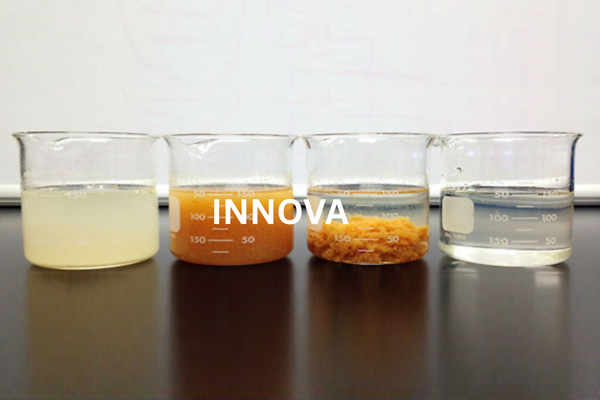
Amritsar’s flocculant demand comes from two different directions. In the Focal Point clusters along Vallah Road and Mehta Road, dyeing units run effluent treatment plants that generate sludge. That sludge has to be dewatered before disposal, and the polymer that does that job is cationic. In the sugar mills—Rana Sugar at Buttar Seviyan and Ajnala Co-operative at Bhalla Pind—the clarifier needs a flocculant to settle the mud from the juice, and the polymer that does that job is anionic. The two applications are not interchangeable. A cationic polymer that works in an ETP may not perform in a sugar clarifier, and vice versa.
Dyeing effluent treatment generates sludge from the coagulation-flocculation stage and from biological treatment. That sludge is a suspension of particles with a negative surface charge. Cationic polyacrylamide carries a positive charge, which neutralises the particle charge and allows the particles to come together into larger flocs. The larger flocs release water more easily in a filter press or centrifuge, which reduces the sludge volume that has to be handled.
For Amritsar’s Focal Point units, the ETP performance is under scrutiny. The NGT order on Amar Color Chem India in July 2024 imposed a Rs 1 crore interim environmental compensation after the unit’s ETP was found non-functional . Sham Dyers at Plot C-51 was also directed to close for operating without a functional ETP . The message is clear: a dyeing unit without a working treatment train is at risk of closure. Flocculant is one part of that treatment train, and its role in sludge dewatering is directly linked to how well the ETP operates.
Sugar juice clarification uses lime and heat to precipitate impurities, then a flocculant to aggregate the precipitated particles into flocs that settle in the clarifier. Anionic polyacrylamide is the standard for this application. The long-chain polymer bridges the particles, forming flocs that are large enough to settle rapidly and compact enough to allow clear juice overflow.
Rana Sugar Mill has recorded 10.29 per cent recovery while Ajnala Co-operative has recorded 8.38 per cent, with the gap attributed to mill capacity and cane availability . Flocculant does not close that gap. But poor flocculation can widen it. If the mud settles slowly, the clarifier capacity drops, and juice residence time increases. If the mud is not compact, more sucrose is lost with the mud. The flocculant programme is one input that affects how efficiently the clarifier performs.
The charge type is the first decision. Anionic polymers work on particles that have a positive surface charge, or in systems where the polymer bridges through hydrogen bonding. Cationic polymers work on particles with a negative charge. Sugar juice clarification, after liming, produces particles that respond to anionic polymers. Dyeing ETP sludge, with its organic and dye-based particles, responds to cationic polymers.
The molecular weight and charge density matter as much as the charge type. A high molecular weight polymer with low charge density works by bridging and is effective at low doses. A low molecular weight polymer with high charge density works by charge neutralisation and may be more effective on fine particles. The selection should be based on a jar test on the actual sludge or juice, not a generic catalogue recommendation.
Flocculants are sensitive to how they are prepared. The powder must be dispersed in water without forming lumps. The solution must be aged for the recommended time before use. The mixing must be gentle—high-shear mixing breaks the polymer chains and reduces effectiveness. A flocculant that performs well in a jar test can fail in the plant if the preparation is wrong.
Dosing point matters too. The flocculant should be added where the mixing energy is sufficient to disperse it but not so high that it breaks the flocs. In a sugar clarifier, the dosing point is typically in the flash mix or the clarifier feed line. In an ETP, it is typically after coagulation and before the flocculation tank. The dose is adjusted based on the observed floc size and the clarity of the overflow.
Flocculant is supplied in standard industrial packing. Pack sizes are available on request. Store in a dry, covered area away from moisture. Once prepared as a solution, use within the recommended shelf life. Prepare in a tank with gentle agitation, not high-shear mixing. Use appropriate personal protective equipment during handling and follow the product-specific guidance for dilution and dosing.
We manufacture and supply anionic and cationic flocculants for sugar juice clarification and effluent sludge dewatering. For Amritsar buyers, the useful conversation starts with your application—what you are clarifying or dewatering, what your current dose is, and what problem you are trying to solve. From there we can suggest a polymer and a starting dose, with the understanding that final confirmation comes from a jar test on your actual stream.
Q: Which flocculant is used for sludge dewatering in Amritsar dyeing ETPs?
A: Cationic polyacrylamide is typically used for sludge dewatering in dyeing ETPs. The positive charge neutralises the negative charge on the sludge particles, allowing them to aggregate into larger flocs that release water more easily in the filter press or centrifuge. The charge density and molecular weight of the polymer should be matched to the sludge characteristics, which vary with the dye class and the treatment process.
Q: Which polymer is used for sugar juice clarification in Amritsar mills?
A: Anionic polyacrylamide is the standard flocculant for sugar juice clarification. The long-chain polymer bridges the destabilised particles from the clarification process, forming large flocs that settle rapidly in the clarifier. The dose depends on the juice quality, the clarification scheme, and the mud volume. For Amritsar mills like Rana Sugar and Ajnala Co-operative, the flocculant is part of the clarification programme, not a standalone treatment.
Q: How does the NGT order on Amar Color Chem affect flocculant use in Amritsar?
A: The NGT order on Amar Color Chem India in July 2024 imposed a Rs 1 crore interim environmental compensation after the unit's ETP was found non-functional. For other dyeing units in the Focal Point, the practical implication is that ETP performance is being monitored. A functioning flocculant programme is part of that performance, because it determines how well the sludge is dewatered and how clear the treated water is. Without proper flocculation, the ETP may fail on suspended solids and COD.
Q: How should flocculant be stored and prepared at an Amritsar plant?
A: Flocculant powder should be stored in a dry, covered area away from moisture. Once prepared as a solution, it should be used within the recommended shelf life, because the polymer chain degrades over time. Prepare the solution in a tank with gentle agitation, not high-shear mixing, which can break the polymer chains and reduce effectiveness. Use appropriate personal protective equipment during handling. Standard industrial packing is used; pack sizes are available on request.
To discuss your flocculant requirement, call +91-9312871070.
© 2026 Innovacorp India Pvt Ltd. All Rights Reserved. Managed & Developed by Innova Corporate India
 Chat with Us