
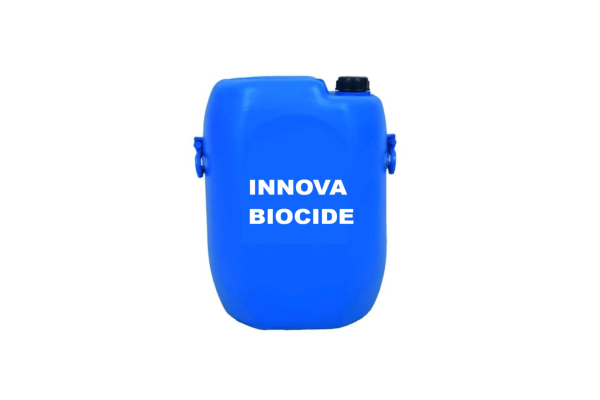
In a sugar mill, the biocide feeding point decides whether the chemistry reaches the bacteria. The cane carrier, the milling tandem, the juice heaters, and the evaporators each present a different microbial load, a different organic load, and a different contact time. Innovacorp manufactures and supplies biocide for sugar industries in Andhra Pradesh, selected on the process stage where the microbial problem occurs, not on a single blanket recommendation.
Leuconostoc mesenteroides enters the mill with the cane and multiplies wherever sugar-rich juice sits long enough at warm temperature. In the milling tandem, contact time is short and organic load is high. In the juice heaters and clarifiers, retention time is longer, and the microbial population has time to establish. In the evaporators, temperature is higher, but biofilm in heat exchangers can still form and protect bacteria from the biocide.
Dextran formation follows the same pattern. Once Leuconostoc produces dextransucrase, the enzyme converts sucrose into dextran, which raises juice viscosity and interferes with crystallization [citation:4][citation:8]. The loss is not only the sucrose consumed. It is also the processing difficulty that follows, including slower filtration and lower recovery.
A complete biocide program covers multiple stages, and each stage has a different requirement.
The feeding point determines the contact time, and the contact time determines which chemistry can act before it is consumed or diluted.
Contact time is the variable that connects the feeding point to the chemistry.
At the cane carrier, juice moves quickly, and the biocide has seconds to minutes to act. A fast-acting oxidizing chemistry is selected where rapid knockdown is needed. At the juice heater, retention time is longer, and a non-oxidizing chemistry with sustained activity can provide protection across the holding time. At the evaporator, the temperature is higher, and the chemistry must remain stable at that temperature.
There is no single biocide chemistry that performs optimally at every stage. A chemistry that works at the cane carrier may be consumed or degraded before it reaches the juice heater. A chemistry designed for sustained activity may be too slow for the cane carrier. The program is built from stage-specific selections, not from one product applied everywhere.
Dose depends on the microbial load at that stage, the organic load, and the contact time. Published literature describes indicative ranges for cane carrier and juice heater applications, but the actual dose is set after reviewing the mill's microbial analysis and process configuration.
A starting dose is recommended for each stage. The final dose is confirmed on a plant trial, because microbial load changes with cane quality and weather through the crushing season.
Biocide specifications depend on the chemistry and the grade. Final specification is confirmed on the technical data sheet for each grade.
TDS on request.
Mill teams in Andhra Pradesh usually want to know three things before they commit to a biocide program: whether the chemistry will act at the stage where the problem occurs, how the dose will change as cane quality shifts, and how to tell whether the program is working. These questions are answered by sampling juice at each stage, measuring microbial load, and reviewing the results against the feeding points and doses in use.
One common mistake is applying the same dose at every feeding point because it is simpler to manage. The cane carrier and the juice heater have different microbial loads and different contact times. A dose that is adequate at the juice heater may be too low at the cane carrier, or too high and wasteful at the evaporator. Stage-specific dosing costs more to manage but performs better.
Biocide is dosed at multiple points because microbial contamination enters and grows at different stages. The cane carrier and milling tandem are the first point, where cane arrives with soil bacteria. Juice heaters and clarifiers are the second, where the juice is warm and retention time allows growth. Evaporators and process streams are the third, where biofilm can establish in heat exchangers. A complete program covers all three.
Contact time varies by stage. At the cane carrier and milling tandem, contact time is short because juice moves quickly. Fast-acting chemistry is selected here. At juice heaters and clarifiers, retention time is longer, and chemistry with sustained activity is used. At evaporators, the temperature is higher and microbial load is lower, but biofilm in heat exchangers may need a different approach. The feeding point determines the contact time, and the chemistry must match the contact time available.
No. The dose depends on the microbial load at that stage, the organic load, and the contact time. Cane carrier application deals with high organic load and short contact time. Juice heater application deals with a cleaner stream but a different microbial population. Indicative ranges exist in published literature, but the actual dose is set after reviewing the mill's microbial analysis and process configuration.
Microbial load is monitored by sampling juice at different stages and measuring microbial counts or dextran levels. A rising trend at a specific stage points to a feeding point or dose problem at that stage. The program is reviewed at the start of the crushing season and adjusted when cane quality or weather changes the microbial load.
Share your process flow, the stages where microbial load is a concern, and your current biocide program. Our technical team will review the feeding points and chemistry against your process. Call +91-9312871070.
© 2026 Innovacorp India Pvt Ltd. All Rights Reserved. Managed & Developed by Innova Corporate India
 Chat with Us