
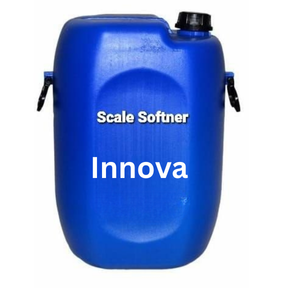
Andhra Pradesh groundwater hardness ranges from 20 to 2,525 mg/L. That is not a narrow band. CGWB data shows 131 samples across the state exceeding the BIS permissible limit of 600 mg/L. A boiler feed water at 300 mg/L hardness needs a different treatment approach than one at 1,500 mg/L. And no single "softener" chemical handles both.
Innovacorp India supplies boiler scale inhibitors and antiscalants for Andhra Pradesh industrial boilers working with this hardness variability. This page is about the two-stage approach that actually prevents scale: upstream softening and in-boiler antiscalant, each doing a different job.
The CGWB assessment puts total hardness in Andhra Pradesh between 20 and 2,525 mg/L, with 131 samples above 600 mg/L. The 2023 groundwater quality data adds another dimension: of 1,149 samples, 9.7% had electrical conductivity above 3,000 µS/cm, and 3.4% had chloride above 1,000 mg/L. High TDS and high hardness together make boiler feed water treatment more demanding.
For a boiler operator, the number that matters is the hardness at the specific site, not the state average. A low-pressure boiler at a site with 200 mg/L hardness can be managed with softening alone. A medium-pressure boiler at a site with 1,200 mg/L hardness needs softening plus antiscalant plus a blowdown programme. The treatment train should follow the water analysis.
Scale forms when dissolved calcium and magnesium precipitate on hot heat transfer surfaces. The precipitation happens because the solubility of these minerals decreases as temperature rises. A chemical added to the boiler cannot remove the hardness minerals from the feed water before they enter. It can only modify what happens after they are inside.
An upstream water softener (ion exchange) removes calcium and magnesium from the feed water, replacing them with sodium. Sodium stays in solution at boiler temperatures and does not form scale. That is the first line of defence.
An in-boiler antiscalant works on the residual hardness that passes through the softener. It uses threshold inhibition (blocking crystal growth sites) and crystal distortion (making the precipitate non-adherent) to keep any residual hardness as a dispersible sludge rather than hard scale. The sludge is removed by blowdown.
The two stages serve different purposes. A softener alone does not handle upset conditions or hardness spikes. An antiscalant alone cannot handle high feed hardness economically. Both are needed when the feed water is hard.
Upstream softening is the primary treatment for hardness removal. Ion exchange softeners are regenerated with sodium chloride and produce softened water with near-zero hardness. They are effective but require regeneration and produce a chloride-rich waste stream. For high-TDS feed water, reverse osmosis may be preferred because it removes both hardness and dissolved salts.
In-boiler antiscalant is the secondary treatment. It handles the residual hardness that passes through the softener, and it provides a buffer when the softener is offline for regeneration or when the feed water quality shifts. Phosphate-based conditioning is common for low-pressure boilers; polymer-based antiscalants are used across pressure ranges, with high-temperature stability becoming important above 60 bar.
The selection of the antiscalant grade depends on the boiler pressure and the feed water chemistry. A polymer that works at 10 bar may degrade at 80 bar. The TDS and the boiler manufacturer's recommendations should be the starting point.
Phosphate conditioning uses sodium phosphate to react with residual calcium and magnesium, forming a soft sludge that is removed by blowdown. It is a well-established approach for low and medium-pressure boilers. The phosphate reserve in the boiler water is maintained within a target range, and the sludge is conditioned to stay non-adherent.
Polymer dispersants work differently. They attach to crystal nuclei and prevent crystal growth, and they disperse the particles so they do not agglomerate on the tube surface. Polymer-based antiscalants are often used alongside phosphate conditioning, not instead of it, because they address different parts of the scale formation process.
The specific programme for a boiler in Andhra Pradesh should be set by a water treatment specialist after reviewing the feed water analysis, the boiler pressure, and the operating cycle. A generic dose recommendation is not reliable when the hardness range spans 20 to 2,525 mg/L.
| Parameter | Typical Value / Range |
|---|---|
| Product type | Boiler antiscalant / scale inhibitor, grade dependent |
| Chemistry | Phosphate-based or polymer-based, grade dependent |
| Appearance | Clear to pale liquid, grade dependent |
| pH (as supplied) | TDS on request |
| Dosing range | Set against feed hardness and boiler pressure, TDS on request |
| Boiler pressure suitability | Low, medium, or high pressure, grade dependent |
Specification values vary by product grade. Confirm final spec after feed water analysis and against the TDS.
Supplied in standard industrial packing. Pack sizes on request. Store in sealed containers away from incompatible materials. Follow the safety data sheet for handling. Dosing pumps should be calibrated at commissioning and checked periodically.
Q: What treatment approach suits Andhra Pradesh groundwater with hardness up to 2,525 mg/L?
A: CGWB data shows total hardness in Andhra Pradesh ranging from 20 to 2,525 mg/L, with 131 samples above the BIS permissible limit of 600 mg/L. For boiler feed water at this hardness, upstream softening (ion exchange or RO) is the primary treatment. An in-boiler antiscalant is a secondary measure, not a substitute for softening. The specific combination depends on the boiler pressure and the feed water analysis.
Q: Why can't a single softener chemical solve boiler scale in Andhra Pradesh?
A: Scale forms when dissolved calcium and magnesium precipitate on hot heat transfer surfaces. A single chemical cannot remove the hardness minerals from the feed water before they enter the boiler. Upstream softening removes the hardness; in-boiler antiscalant modifies the crystal structure of any residual hardness to keep it as a dispersible sludge rather than hard scale. Both steps serve different purposes.
Q: How should a boiler antiscalant be selected based on boiler pressure?
A: Low-pressure boilers (below 20 bar) can use phosphate-based conditioning or polymer dispersants. Medium-pressure boilers (20-60 bar) typically use polymer-based antiscalants with good thermal stability. High-pressure boilers (above 60 bar) need antiscalants validated for high-temperature stability, because some polymers lose effectiveness at elevated temperatures. The specific grade should be confirmed against the boiler pressure and the TDS.
Q: How is existing scale removed if prevention was inadequate?
A: Existing scale is removed by mechanical cleaning or chemical descaling, not by antiscalant dosing. Antiscalants prevent scale formation; they do not dissolve established scale. For chemical descaling, the acid or chelant selection depends on the scale composition (carbonate, sulphate, silica). A scale sample analysis is the starting point. Prevention through softening and antiscalant is more economical than repeated descaling.
Call: +91-9312871070 — to discuss boiler scale prevention for your feed water conditions.
© 2026 Innovacorp India Pvt Ltd. All Rights Reserved. Managed & Developed by Innova Corporate India
 Chat with Us