
Andhra Pradesh has 29 sugar mills. Only five are operational in the 2024-25 season. The other 24 could not crush because of insufficient cane supply and financial problems. That concentration changes what the operational mills face: they run longer seasons, draw cane from scattered sources, and process juice that shifts in character more than a mill with a stable reserve area would see.
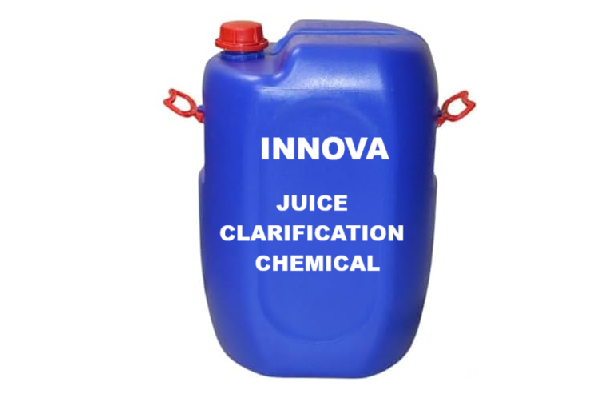
Innovacorp India supplies juice clarification chemicals for Andhra Pradesh mills working under these conditions. This page is about flocculant selection and dosing when cane quality is not steady, rather than a fixed dose for a fixed season.
A Lok Sabha reply in April 2025 stated that Andhra Pradesh's sugar recovery is low due to two reasons: inadequate cane crush and climatic conditions, specifically "less diurnal variation in the temperatures between day and night time." The same reply noted that most sugar factories in the state are located in coastal areas.
Low diurnal variation means cooler nights and warmer days than a high-variation region. For sugarcane, this affects sucrose accumulation and maturity uniformity. When cane arrives at the mill at uneven maturity, the juice composition varies — colloidal content, pH, and the ratio of reducing sugars to sucrose shift through the week. A clarifier designed for steady juice gets a moving target instead.
The area data adds context. Visakhapatnam district had 23.64 thousand hectares under cane in 2020-21. By 2024-25, the estimate was 2.1 thousand hectares. West Godavari fell from 3.11 to 0.7. Krishna from 4.46 to 2.7. East Godavari from 1.72 to 0.3. The cane that remains is more geographically scattered than it was five years ago.
Juice clarification depends on the flocculant destabilising colloidal particles and forming flocs dense enough to settle or float. When cane maturity is uneven, two things change in the juice. First, the colloidal charge profile shifts — early-maturity cane carries different organic impurities than late-maturity cane. Second, the pH can drift more through the day as different cane lots enter the mill.
A flocculant that works well at one pH or one colloidal load may produce smaller flocs or slower settling when the juice shifts. The clarifier then either carries over suspended solids into the evaporator or produces mud with higher sucrose content. Both outcomes cost recovery.
This is not a product quality issue in isolation. It is a selection and dosing issue: the grade and dose need to match the juice that is actually in the clarifier, not the juice that was there last month.
For variable juice, two grade properties matter more than peak performance on a single juice type: floc strength across a pH range, and resistance to organic fouling. A high-molecular-weight anionic polyacrylamide with moderate charge density is usually a better starting point than a grade optimised for one narrow pH window.
If the mill runs a sulphitation process, the flocculant must remain stable in the acidic pH range. If it runs carbonatation, the pH window is different. The grade selection should be confirmed against the mill's process, not against a generic recommendation.
We confirm the grade against the mill's juice analysis, process pH, and clarifier type. For mills running extended crushing seasons (October to July/August, as is common in Andhra Pradesh), a grade that maintains performance across early-season and late-season cane is usually more valuable than a grade with higher peak performance in one window.
Flocculant dose should not be fixed at one ppm for the whole season. A typical starting range for juice clarification is 2–6 ppm on juice basis, but the actual dose must be confirmed through a jar test. When the cane source changes — a new district, a new variety mix, a shift from early to late maturity — the jar test should be repeated.
Feeding point matters as much as dose. The flocculant should be added at a point with sufficient mixing to distribute the polymer, but without high-shear agitation that breaks the floc. Dilution ratio (typically 0.05–0.1% w/v) and solution age (2–3 hours, not older than 24 hours) also affect performance.
When the clarifier shows carryover or mud volume rises unexpectedly, the first check is the flocculant solution age and dilution. If those are correct, the juice pH and cane source should be reviewed before increasing the dose.
| Parameter | Typical Value / Range |
|---|---|
| Appearance | White to off-white free-flowing powder / clear liquid |
| Chemistry | High molecular weight anionic polyacrylamide |
| pH (1% solution) | TDS on request |
| Active content | TDS on request |
| Recommended dilution | 0.05–0.1% w/v in water |
| Shelf life (sealed) | TDS on request |
Specification values vary by product grade. Confirm final spec after lab trial and against the TDS.
Supplied in standard industrial packing. Pack sizes on request. Store powder form in sealed bags in a dry, ventilated area. Reseal after opening. Use prepared solution within 24 hours. In coastal Andhra humidity, keep storage area ventilated.
Q: How does low diurnal temperature variation affect juice clarification in Andhra Pradesh?
A: A Lok Sabha reply noted that Andhra Pradesh's sugar recovery is low partly due to less diurnal variation in temperature between day and night. This affects cane maturity uniformity, which in turn affects juice composition — colloidal content, pH and impurity profile vary more through the crushing season. For clarification, this means flocculant dose should not be fixed at one ppm but confirmed through jar testing as cane quality shifts.
Q: How should flocculant dose be adjusted when cane supply is scattered?
A: When mills draw cane from multiple districts or mixed varieties, the juice arriving at the clarifier changes character through the week. A typical starting range for juice clarification flocculant is 2–6 ppm on juice basis, but actual dose should be confirmed through a jar test. Feeding point and dilution ratio should also be re-checked when the cane source changes.
Q: Which clarification chemical grade suits mills with only a few operational crushing days?
A: With only 5 of 29 mills operational in Andhra Pradesh in 2024-25, the operational mills often run longer crushing seasons to cover the supply gap. This means the clarifier sees cane quality shifting from early-season to late-season maturity. A grade that resists organic fouling and maintains floc strength across variable juice pH is usually a better starting point than a grade optimised for a single maturity window.
Q: How can mud volume be reduced when juice quality is inconsistent?
A: Mud volume depends on the floc structure and the clarifier retention time. When juice quality is inconsistent, a flocculant that produces compact, dense flocs reduces mud volume and sucrose loss in the mud. The specific grade depends on the clarifier type and the juice pH. We confirm the grade against the mill's process parameters and jar test results.
Call: +91-9312871070 — to discuss clarification chemical selection for your mill's cane conditions.
© 2026 Innovacorp India Pvt Ltd. All Rights Reserved. Managed & Developed by Innova Corporate India
 Chat with Us