
A boiler water treatment programme is not a list of chemicals. It is a sequence of stages, each designed to solve a specific problem before the water reaches the next stage. Innovacorp supplies boiler water treatment chemicals for plants in Andhra Pradesh, and the programme is built around your feedwater quality, boiler pressure, and condensate system, not around a standard product package.
The problems in a boiler system start before the water enters the boiler. Hardness salts in the feedwater scale the tubes. Dissolved oxygen pits the metal. Carbon dioxide in the condensate corrodes the return lines. Dissolved solids concentrate in the boiler water and carry over into the steam. Each of these problems has a different control point, and treating one does not solve the others.
Andhra Pradesh's industrial boiler base includes bagasse-based cogeneration units in the sugar belt, process boilers in rice mills and food processing, and high-pressure boilers in chemical and pharmaceutical plants. The KCP Sugar Vuyyuru unit, for example, operates an integrated sugar complex with 15 MW power and 50 KLPD bio-ethanol [citation:17], and the Kakatiya Cement, Sugar & Industries co-generation project uses an 87 ata/515°C bagasse boiler [citation:27]. Each of these systems has a different feedwater quality and a different set of corrosion risks. A programme designed for one is not automatically suitable for another.
Feedwater conditioning is the first line of defence. Its job is to remove or reduce the impurities that would cause problems inside the boiler.
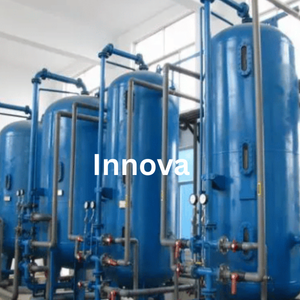
The two main steps are softening or demineralization, and deaeration. Softening removes calcium and magnesium hardness by ion exchange. Demineralization removes all dissolved ions, which is necessary for high-pressure boilers where silica and sodium carryover affect turbine performance [citation:9]. Deaeration removes dissolved oxygen and carbon dioxide by heating the water in a deaerator.
The choice between softening and demineralization depends on the boiler pressure. Low-pressure boilers can operate with softened water. High-pressure boilers need demineralized water because the purity requirements are tighter [citation:24].
Internal treatment controls the chemistry of the water inside the boiler. Even with good feedwater conditioning, some residual hardness and oxygen enter the boiler, and the internal treatment program manages them.
The main components are a scale inhibitor or crystal modifier, an oxygen scavenger, and a pH or alkalinity controller. Phosphate programs are used in high-pressure boilers to precipitate residual calcium as a soft sludge that can be removed by blowdown [citation:7]. Polymer programs are used to disperse suspended solids and prevent them from adhering to tube surfaces. Oxygen scavengers, such as sodium sulfite or DEHA, remove the residual dissolved oxygen that the deaerator did not eliminate [citation:13].
The internal treatment program is selected on the boiler pressure and the feedwater quality. A program that works at low pressure may not provide adequate protection at high pressure, because the reaction kinetics and the concentration of dissolved solids change.
Condensate treatment protects the return lines, not the boiler. Carbon dioxide dissolves in condensate and forms carbonic acid, which lowers the pH and attacks the metal. The corrosion shows up as thinning of the return lines and elevated iron levels in the condensate.
Volatile amines are used to neutralize the carbonic acid and raise the condensate pH. The amine selection depends on the system configuration and the pH target. A filming amine can also be used to create a barrier on the metal surface, but the selection depends on the process requirements and the presence of copper alloys [citation:5].
Blowdown is the removal of a portion of the boiler water to control the concentration of dissolved solids. Without blowdown, the dissolved solids concentrate until they exceed solubility limits and deposit on tube surfaces.
Blowdown is controlled by monitoring boiler water conductivity or dissolved solids. The target is set on the boiler pressure and the feedwater quality. Proper blowdown control allows the boiler to operate at higher cycles of concentration, which reduces makeup water consumption and energy loss [citation:2].
The blowdown rate is not a fixed number. It changes with feedwater quality and steam load. A programme that sets blowdown on a fixed schedule rather than on measured conductivity will either waste water and energy or allow dissolved solids to exceed the safe limit.
Boiler water treatment chemical specifications depend on the product type and the grade. Final specification is confirmed on the technical data sheet for each product.
TDS on request.
Plant teams in Andhra Pradesh usually want to know three things before they commit to a boiler water treatment programme: whether the programme addresses the specific problems in their system, how the programme will be monitored and adjusted, and whether the chemical programme is compatible with the boiler metallurgy and operating pressure. These questions are answered by reviewing the feedwater analysis, the boiler operating parameters, and the condensate system configuration.
One common mistake is treating the programme as a set of independent products. The stages are connected. If the feedwater hardness is high, the internal treatment program has to compensate. If the condensate pH is low, the amine dose has to be adjusted. A programme that is designed stage by stage, with each stage responding to the water quality entering it, performs better than a programme that applies a fixed product dose at every point.
A boiler water treatment programme has four stages: feedwater conditioning (softening or demineralization, deaeration), boiler water internal treatment (phosphate or polymer program, oxygen scavenging), condensate treatment (volatile amines for carbonic acid corrosion), and blowdown control (conductivity-based blowdown to manage dissolved solids). Each stage addresses a different problem, and the stages are designed to work together.
Feedwater treatment happens before the water enters the boiler. It removes hardness, dissolved gases, and impurities. Boiler water treatment happens inside the boiler. It controls the chemistry of the water that is evaporating, including pH, alkalinity, and dissolved solids. Both are needed because the problems they address are different.
Blowdown is controlled by monitoring boiler water conductivity or dissolved solids and removing a portion of the boiler water when the concentration exceeds the target. The target is set on the boiler pressure and the feedwater quality. Proper blowdown control allows the boiler to operate at higher cycles of concentration, which reduces makeup water and energy consumption.
Condensate treatment protects the return lines from carbonic acid corrosion. Carbon dioxide dissolves in condensate and forms carbonic acid, which lowers the pH and attacks the metal. Volatile amines are used to neutralize the acid and raise the condensate pH. Without condensate treatment, the return lines corrode even if the boiler water chemistry is correct.
Share your feedwater analysis, boiler pressure, and condensate system configuration. Our technical team will review the programme stages against your system. Call +91-9312871070.
© 2026 Innovacorp India Pvt Ltd. All Rights Reserved. Managed & Developed by Innova Corporate India
 Chat with Us