
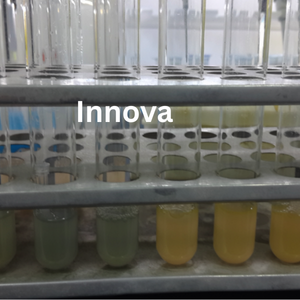
Bahadurgarh's jeans dyeing units are under scrutiny. In July 2025, a joint team of HSPCB, police and municipal officials inspected units in Netaji Nagar and found four operating without consent, without effluent treatment plants, and discharging dye-laden wastewater directly into stormwater drains. Earlier, two similar units in Parnala were closed for the same violations. The problem is not that these units want to pollute. The problem is that conventional biological treatment does not remove dissolved dye colour. Indigo and reactive dyes pass through the biological train largely intact. A dedicated colour reduction step is needed, and that is where a DCD-F based colour reducing agent comes in.
Most ETPs in Bahadurgarh already use PAC or ferric chloride for coagulation. These work well on suspended solids—clay, fibre, grit. They do not work well on dissolved dye molecules. The reason is charge density. A dye molecule is small and carries a specific anionic charge. A coagulant neutralises some of that charge, but not enough to force aggregation at low dosage. Increasing the coagulant dose to compensate produces excess sludge and does not reliably solve the colour problem.
Dicyandiamide-formaldehyde resin, commonly called DCD-F, is a high-charge cationic polymer. It adsorbs onto the dye molecule's anionic sites and neutralises them efficiently. Once the charge is gone, the dye molecules aggregate into flocs that can be settled or filtered. Published research on DCD-F for reactive dye wastewater reports colour removal above 95% at optimised dosage, with effective doses in the range of 35 to 100 mg/L depending on dye concentration [citation:3][citation:8].
A typical treatment train in a jeans dyeing unit runs: equalisation → chemical coagulation → biological treatment → secondary clarification → discharge. Colour reduction is usually inserted between primary coagulation and biological treatment, or after biological treatment before final discharge, depending on the existing plant configuration.
Dosing DCD-F after PAC coagulation and before the biological tank reduces the colour load entering the biology. This protects the biomass from dye toxicity and reduces the colour that the biology has to handle. The flocs formed are removed in the primary clarifier.
If the biological train is already established and the only problem is residual colour, DCD-F can be dosed after secondary clarification, followed by a short settling or filtration step. This is often the simpler retrofit for an existing unit, but it requires a dedicated dosing point and mixing arrangement.
Colour reducing agents are not interchangeable. The selection depends on the dye chemistry and the effluent pH.
Reactive dyes are the most common in jeans dyeing and the hardest to remove. They are designed to bond with cellulose and remain soluble in water. DCD-F with high charge density works best here. The dosage is higher than for disperse dyes, and a jar test is essential to find the neutralisation point.
Indigo behaves differently. It is not truly soluble but dispersed as fine particles. A colour reducing agent alone may not be sufficient; a coagulant followed by DCD-F usually gives better results because the indigo particles need to be destabilised first, then flocculated.
DCD-F performs best in the pH range of 6 to 8. Dyeing effluent is often alkaline, especially from reactive dye processes. If the pH is above 8.5, the polymer's charge sites are partially neutralised and performance drops. pH adjustment before dosing may be necessary.
Dosage is confirmed by jar test on your actual effluent. Indicative ranges from published research and field experience:
Final dosage is confirmed after lab trial with your effluent sample.
Product specifications including appearance, solid content, pH, viscosity and shelf life are available on request. Formulations differ by application, so we do not publish a single fixed specification across the range. TDS on request.
Standard industrial packing. Pack sizes on request.
Floc does not form. The pH is likely outside the effective range. Check pH and adjust to 6–8 before dosing. If pH is correct, the dose may be too low for the dye concentration.
Effluent gets cloudier after dosing. Overdosing has re-stabilised the particles. Reduce the dose and re-test. This is common when operators increase dose to chase a colour target without a jar test.
Colour drops but COD remains high. Colour reducing agents remove colour bodies, not all dissolved organics. If COD compliance is also required, the biological or oxidation step needs to be reviewed separately.
We work with ETP operators to review effluent analysis, select the right grade, and set up a jar test protocol for dosage confirmation. Final specification and dosage are confirmed after lab trial with your sample.
DCD-F stands for dicyandiamide-formaldehyde resin. It is a cationic polymer that neutralises the negative charge on reactive dye molecules, causing them to aggregate into flocs that can be settled or filtered out. Published studies report colour removal rates above 95% for reactive dyes at optimised dosage.
Jeans dyeing uses indigo and reactive dyes that remain colour-intensive after biological treatment. HSPCB inspections in Bahadurgarh have found units discharging coloured effluent without adequate treatment. A colour reducing agent removes the dissolved dye colour before discharge, helping the unit move toward compliance.
PAC works primarily by charge neutralisation and sweep flocculation on suspended solids. DCD-F is a high-charge cationic polymer designed specifically for dissolved colour bodies. It works at lower dosage and produces denser flocs on dye molecules, but it is usually used alongside a coagulant rather than replacing it entirely.
Dosage depends on the dye concentration and the effluent's existing treatment. Published studies on DCD-F for reactive dye wastewater report effective doses in the range of 35 to 100 mg/L. For Bahadurgarh effluent, a jar test on your actual sample is the only reliable way to confirm the dose. Final dosage is confirmed after lab trial.
Call +91-9312871070 to discuss your effluent colour problem.
Related products: if your ETP also needs coagulation support or boiler treatment chemicals, see bulk chemicals for Bahadurgarh manufacturing units and boiler water treatment chemicals for Bahadurgarh. For a comparison of charge-based decolourization approaches, see our page on colour precipitants for Bahadurgarh industrial effluent.
© 2026 Innovacorp India Pvt Ltd. All Rights Reserved. Managed & Developed by Innova Corporate India
 Chat with Us