
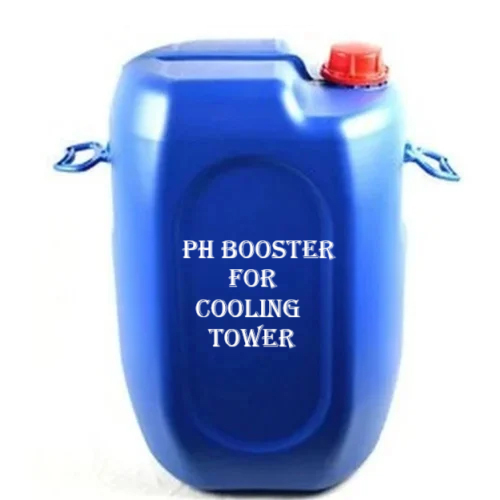
A plant manager in Bahadurgarh usually calls us after a tube leak, not before it. The tower has been running for two summers, the make-up water has slowly changed, and the pH has drifted into a range where the scale inhibitor can no longer hold the circuit stable. The LSI goes negative, the inlet end of the heat exchanger starts pitting, and by the time it shows up on a maintenance report the answer is a new tube bundle. Innovacorp's pH booster for cooling water is built for this exact situation in Bahadurgarh — to help pull the recirculating water back into a band where corrosion inhibitors can work, without pushing it so alkaline that scaling starts.
Bahadurgarh sits on the Haryana side of the NCR industrial belt, and most units here run open recirculating towers on borewell or mixed make-up. Groundwater in this belt is hard, and hardness and alkalinity move through the year as the water table and the mix change. When the tower is pushed to higher cycles of concentration in summer — which is normal, because the ambient heat load is high and evaporation is fast — the chemistry inside the basin changes faster than a manual dosing routine can track. The early sign is a falling pH, then a negative LSI, then pitting at the tube inlet or on the tube sheet. A booster with a documented dose routine helps the circuit hold its band through that summer swing instead of chasing the problem after the leak.
In most Bahadurgarh units the booster is fed into the cooling water return line, upstream of the basin, from a metering pump that is tied to the make-up water flow. It is a separate feed point from the scale inhibitor and the biocide. Its job is to raise the pH and hold it in a band that gives the scale inhibitor room to work, without pushing the water so alkaline that calcium carbonate starts laying down on the tube surface. That band is set per plant, not site-wide, because two Bahadurgarh towers on the same make-up can have very different metallurgy, heat load and COC.
The pH booster is offered in more than one grade, and the choice is driven by the feed system, the target pH band and the compatibility with the existing inhibitor package. A useful starting point:
The right grade for a Bahadurgarh plant is confirmed after we see the water analysis and the existing programme. If you are unsure, share the TDS and the current inhibitor and we will narrow it down.
Typical values for the standard liquid grade are below. Final values depend on the grade and the batch, and are confirmed on the TDS for the specific product.
| Parameter | Typical value |
|---|---|
| Appearance | Clear to slightly hazy liquid |
| pH (as supplied) | Alkaline |
| Active content | TDS on request |
| Density | TDS on request |
| Shelf life | TDS on request |
Dose is expressed as ppm in the recirculating water, and the starting figure depends on the make-up water alkalinity, the acid demand and the COC the plant is running. It is not a fixed number across plants. A lab trial on your water sample is used to settle the starting dose, and the dose is then adjusted in the field until pH and LSI stay in range across a full COC cycle. The final dose for your Bahadurgarh plant is confirmed after that trial.
Standard industrial packing is used for pH boosters. Pack sizes are shared on request against the grade and the application.
The most common one is dosing the booster into the same point as the biocide, which can knock the biocide out of its active window for that shot. The second is setting a pH target once and never re-checking it after the COC goes up in summer. The third is treating the booster as a fix for a scaling problem — it is not. If the LSI is positive and the tubes are scaling, the answer is on the scale inhibitor side, not on the booster side. Getting those three right is usually worth more than any change in dose.
Innovacorp supports Bahadurgarh customers with water analysis review, dose calculation, and help with feed-point layout for new installations. Support is remote unless a site visit has been separately agreed.
Most open recirculating towers are run in the 7.5 to 9.0 band, with the exact set-point fixed by the metallurgy, the scale inhibitor in the programme and the LSI target. Bahadurgarh plants on borewell or mixed make-up should fix the set-point after a water analysis, because the hardness and alkalinity of the source can shift across the year.
Dose is worked out from the make-up water alkalinity, the cycles of concentration the plant runs and the acid demand seen in a trial. It is fed as ppm in the recirculating water and adjusted until pH and LSI sit in range across a full COC cycle. The final figure for your Bahadurgarh circuit is confirmed after a lab trial on your sample.
Yes, the booster is designed to run alongside scale inhibitors and biocides. The feed points should be kept separate so the booster is not dosed into a biocide shot, and the dosing sequence should be checked with your programme so there is no short-term incompatibility in the basin.
The booster ships in standard industrial packing, with pack sizes shared on request against the grade. Storage should follow the TDS for the specific grade, and drums should be kept closed and away from direct sun, which matters in Bahadurgarh's summer.
If you are holding a pH or LSI problem on a Bahadurgarh cooling tower and want a starting dose for your water, call +91-9312871070. We will ask for the water analysis and the current inhibitor and biocide programme, and come back with a recommended grade and a starting dose that you can confirm on trial.
Related reading: cooling water treatment chemicals for the full programme, cooling tower chemicals for basin and fill-side issues, and anti-scalant for the scale side of the same circuit.
© 2026 Innovacorp India Pvt Ltd. All Rights Reserved. Managed & Developed by Innova Corporate India
 Chat with Us