
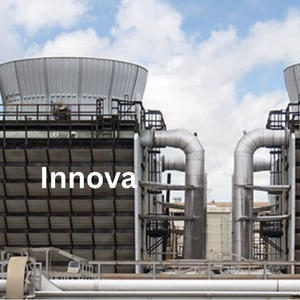
A cooling tower and a closed cooling loop are not the same problem. A tower is open to atmosphere—water evaporates, minerals concentrate, oxygen dissolves continuously. A closed loop is sealed. Water volume stays constant. Oxygen ingress is limited to make-up water and minor leaks. The risks are different: trapped chlorides cause pitting corrosion on steel, initial fill water leaves scale on heat exchanger tubes, and stagnant sections develop localized corrosion that a tower programme would never see. Bahadurgarh's groundwater makes the fill water problem worse. Chloride levels in the region reach well above the permissible limit, and hardness can exceed 3,000 mg/L in some locations. For a footwear unit running a chiller to cool injection moulds, or a sanitaryware plant controlling mould temperature, the cooling loop is critical auxiliary equipment. When it corrodes or scales, production slows before anyone realizes the water chemistry is the cause.
Closed-loop systems are often assumed to be low-maintenance because they do not evaporate. That assumption is wrong in Bahadurgarh. The initial fill water carries whatever is in the local supply. Groundwater data for the region shows total dissolved solids reaching over 10,000 mg/L, total hardness approaching 3,950 mg/L, and chloride exceeding 3,800 mg/L in some samples [citation:3]. A 2026 report from the agriculture department's soil and groundwater testing branch found salinity around 10,000 mg/L against a limit of 7,500, electrical conductivity above 6,000 against a good range of 0–2,500, and chloride at 1.7–2.6 against a limit of 1.3–1.5 [citation:13].
In a closed loop, those dissolved minerals do not leave. They stay in the water, concentrating slightly as make-up is added over time. Chloride attacks the passive oxide layer on mild steel, creating pits that grow deeper under deposit or stagnant conditions. Hardness salts precipitate on the hottest surfaces—typically the heat exchanger tubes or chiller evaporator—reducing heat transfer efficiency. A closed-loop programme has to address both, with chemistry that is compatible with the specific metals in the circuit.
Closed-loop treatment is not a single drum added once. It works across three areas of the circuit, each with a different function.
This is the critical zone. Corrosion inhibitors—typically molybdate, nitrite, or organic film-formers—create a protective layer on mild steel and copper alloys. Scale inhibitors keep calcium carbonate from precipitating on hot tube surfaces. Both are dosed into the loop, usually at the pump suction or expansion tank, and maintained at a target residual through periodic testing.
Closed loops often have dead legs and low-flow sections where water sits for extended periods. These areas are prone to under-deposit corrosion and microbial growth. A dispersant keeps corrosion products and biomass mobile so they can be captured by filtration rather than settling. In some systems, a small sidestream filter is used alongside chemical treatment.
Every litre of make-up water added to the loop brings new dissolved minerals and oxygen. In Bahadurgarh, make-up water quality is the single biggest variable. If the loop is filled with high-chloride, high-hardness water and then topped up with the same, the corrosion and scale potential accumulates over time. Pre-treatment of make-up water—softening, RO, or at minimum filtration—reduces the load on the chemical programme. The chemical dosage then targets the residual risk rather than the full incoming load.
There is no universal closed-loop chemical package. The selection depends on three variables.
A loop with mild steel and copper alloys needs a multi-metal corrosion inhibitor. A stainless steel circuit has different requirements—chloride stress corrosion cracking becomes a concern. The inhibitor chemistry must match the metals it protects, not just the water chemistry.
A small chiller loop in a footwear unit holds a few hundred litres. A sanitaryware plant's process cooling loop may hold several thousand litres. The initial fill dosage and maintenance dosage scale with volume. Dead legs and low-flow sections need higher inhibitor residual to compensate for stagnation.
If the loop is filled with untreated Bahadurgarh groundwater, the chemical programme must handle high chloride and hardness from day one. If the make-up is pre-treated (softened or RO), the chemical demand is lower and the programme can focus on corrosion control rather than scale prevention.
Closed-loop dosage is different from tower dosage. It is based on system volume, not evaporation rate. Indicative starting ranges for common applications:
Final dosage is confirmed after reviewing your system volume, water analysis and metallurgy.
Product specifications including appearance, active content, pH, density and shelf life are available on request. Formulations differ by product type and metallurgy, so we do not publish a single fixed specification across the range. TDS on request.
Standard industrial packing. Pack sizes on request.
Corrosion rates remain high despite inhibitor dosing. Check chloride level in the loop water. If make-up water is bringing in high chloride and the inhibitor is not designed for chloride service, the programme needs adjustment. Also check for stagnant sections—inhibitor cannot protect water that does not reach the metal surface.
Scale forms on chiller tubes despite scale inhibitor. The hottest surface in the loop is where scale forms first. Check the inhibitor's temperature stability. Some polymers lose effectiveness above certain temperatures. Also verify that the dosage is based on loop volume, not make-up rate—closed loops do not evaporate, so the dosage logic is different from towers.
Loop water turns cloudy after treatment. This is often corrosion product that was previously settled and is now dispersed. It indicates the dispersant is working, but a sidestream filter may be needed to remove the suspended solids before they re-deposit elsewhere.
We work with plant maintenance engineers and utility operators to review system volume, water analysis and metallurgy, select the right chemical combination, and set up a testing and maintenance dosing schedule. Final specification and dosage are confirmed after reviewing your system parameters and water analysis.
A cooling tower is open to atmosphere, so evaporation concentrates dissolved minerals and oxygen continuously enters the water. A closed loop is sealed: water volume stays constant, oxygen ingress is limited to make-up and leaks, and the main risks are corrosion from trapped chlorides and scale from initial fill water. The chemical programme and dosage strategy are different for each.
Footwear injection moulding units use chillers to cool moulds quickly. Sanitaryware plants use chillers for mould temperature control. Ceramics and packaging units use closed loops for kiln and press cooling. Commercial buildings and hotels in Bahadurgarh also run HVAC chillers that need water treatment.
Bahadurgarh groundwater carries chloride levels well above the permissible limit. In a cooling circuit, chloride accelerates pitting corrosion on mild steel and stress corrosion cracking on stainless steel. A corrosion inhibitor programme must specifically address chloride attack, not just general oxidation.
Closed-loop dosage depends on system volume, metallurgy and the initial fill water quality. As a starting point, corrosion inhibitors are dosed at 200 to 500 ppm in the initial fill, with periodic maintenance dosing to maintain residual. Final dosage is confirmed after reviewing your system volume and water analysis.
Call +91-9312871070 to discuss your closed-loop or chiller water chemistry.
Related pages: for open cooling tower treatment (basin, fill, biofilm), see cooling tower chemicals for Bahadurgarh manufacturing units. For boiler water treatment in the same facility, see boiler water treatment chemicals for Bahadurgarh.
© 2026 Innovacorp India Pvt Ltd. All Rights Reserved. Managed & Developed by Innova Corporate India
 Chat with Us