
Ask an ETP operator in Bahadurgarh what is actually breaking their day and the answer is rarely the biology. It is the sludge that will not give up its water, the floc that forms in the jar test and then breaks up in the clarifier, or the filtrate that keeps coming back cloudy after the press. Polyelectrolytes sit at that exact point in the line — after the coagulant has done its job and before the water leaves the clarifier or the press — and their job is to turn a slow, water-logged sludge into a fast-settling, dry one. The grade and the dilution matter more than most plants expect. This page is about how polyelectrolytes fit into a Bahadurgarh water or wastewater programme, which grade does what, and what the dose depends on.
Polyelectrolytes are long-chain water-soluble polymers that work by two mechanisms: charge neutralization and inter-particle bridging. In a Bahadurgarh industrial unit, the sludge or the raw water that reaches the flocculation stage is still carrying fine particles that coagulants could not fully destabilize. The polymer bridges across those particles and forms a floc that can settle, float or filter, depending on the stage it is used in. That is the difference between a clarifier that runs at design throughput and one that has to be slowed down to keep the overflow clean. It is also the difference between a filter press that produces a cake you can handle and one that keeps dribbling water on the floor.
The choice of grade is driven by the charge on the particles that need to be brought together, not by the price of the polymer. A working guide for a Bahadurgarh plant:
Two Bahadurgarh plants on similar effluent can end up with different grades once the jar test is run. The grade is confirmed after that test, not before it.
On the water side, the polymer is dosed into the flocculation stage after the coagulant and after pH correction, with a short mixing distance before the clarifier inlet. On the sludge side, it is dosed into the sludge conditioning tank ahead of the filter press or the centrifuge, and the mixing energy there is deliberately lower than the flocculation stage so the floc does not break. In a DAF unit the polymer is dosed ahead of the air release so the floc has time to form and then float. The feed point and the mixing energy together decide whether the same dose works or fails.
Typical values for the powder and emulsion grades are below. Final values are confirmed on the TDS for the specific grade and batch.
| Parameter | Typical value |
|---|---|
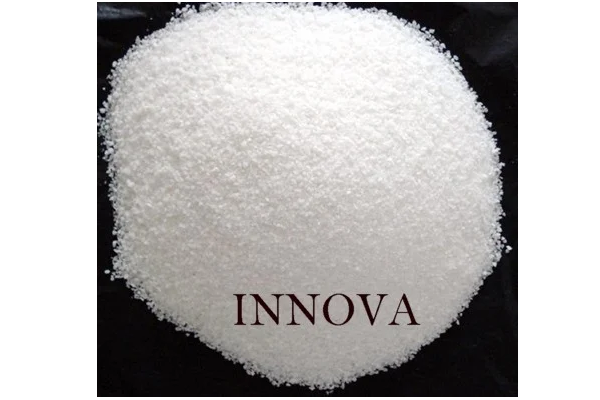
| Appearance | White to off-white powder or milky emulsion |
| Charge type | Anionic / Cationic / Non-ionic |
| Molecular weight | High (TDS on request) |
| Charge density | TDS on request |
| pH (1% solution) | TDS on request |
| Shelf life | TDS on request |
Dose is expressed as ppm in the water for the water side, and as kg per tonne of dry solids for sludge dewatering. The starting figure comes from the solids load, the sludge age and the existing coagulant dose, and it is adjusted in the field once the cake dryness, the filtrate clarity or the settling rate is logged across a week of operation. The polymer is almost always dosed as a dilute working solution, with the concentration given in the TDS, because feeding the neat product or an over-concentrated solution produces fish-eyes and blocks the dosing line. The final dose for your Bahadurgarh line is confirmed after a bench trial on your own sample.
Standard industrial packing is used for polyelectrolytes. Pack sizes are shared on request against the grade and the application.
Polyelectrolytes are used in ETP and CETP sludge dewatering, DAF units, raw water clarification, process water treatment, sludge thickening and filter press conditioning. They are also used in sugar juice clarification, where the mill programme calls for an anionic flocculant after the cationic coagulant.
The most common one is over-diluting the working solution beyond the TDS window, which makes the polymer age faster in the summer heat and lose activity before it reaches the dosing point. The second is feeding the polymer into a tank with too much shear, which breaks the floc as soon as it forms. The third is changing the grade without a jar test — a polymer that worked on last season's sludge can fail on this season's, especially when the biological load shifts. Getting the dilution, the mixing energy and the grade right is usually worth more than increasing the dose.
Innovacorp supports Bahadurgarh customers with jar test data review, grade selection and help with feed-point layout for new installations. Support is remote unless a site visit has been separately agreed.
Organic sludge from a biological ETP is usually dewatered with a cationic polyelectrolyte, because the sludge particles carry a negative surface charge and the cationic polymer neutralizes that charge before bridging the flocs. Mixed or mineral-heavy sludge sometimes responds better to an anionic or non-ionic grade. The right one for a Bahadurgarh plant is picked from a jar test or a bench filter test on your own sludge, and the final grade is confirmed after that trial.
Dose is expressed as ppm in the water or as kg per tonne of dry solids for sludge dewatering, and the starting figure comes from the solids load, the sludge age and the existing coagulant dose. It is adjusted in the field once the cake dryness, the filtrate clarity or the settling rate is logged across a week of operation. The final dose is confirmed after a bench trial on your own sample, not from a catalogue figure.
Polyelectrolyte is normally made up as a dilute working solution before dosing, with the exact concentration given in the TDS for the grade. Over-concentrated working solutions tend to form fish-eyes and block the dosing line, which is a common issue in Bahadurgarh's summer because the solution ages faster in the heat. The working solution should be used within the window stated in the TDS and not stored overnight.
They are usually used at different stages, not in the same tank. A cationic polymer may be dosed at the primary coagulation or sludge conditioning stage, and an anionic polymer at the flocculation stage downstream. The feed points should be separated and the sequence checked during the jar test, because dosing them into the same spot can cancel the charge and weaken the floc in a Bahadurgarh line just as it does anywhere else.
If the cake is wet, the filtrate is cloudy, or the clarifier is carrying floc over on a Bahadurgarh line and you want a starting dose for your polyelectrolyte, call +91-9312871070. We will ask for the jar test data, the current coagulant and polymer programme and the sludge or water analysis, and come back with a recommended grade and a starting dose you can confirm on trial.
Related reading: water treatment chemicals for the full programme, Polydadmac for the cationic coagulant that goes in ahead of the flocculant, and effluent treatment chemicals for the wider ETP line.
© 2026 Innovacorp India Pvt Ltd. All Rights Reserved. Managed & Developed by Innova Corporate India
 Chat with Us