
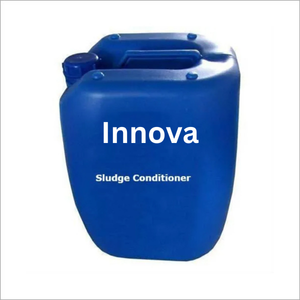
Innovacorp India manufactures polymer sludge conditioners for industrial and municipal wastewater plants in the United States. The product is designed for the step between thickening and dewatering, where the right polymer decides how dry the cake comes out and how much biosolids the plant has to handle. US wastewater treatment includes roughly 16,000 publicly owned treatment works, and industrial plants in food processing, pulp and paper, chemical and metal finishing also run their own sludge dewatering systems. The polymer programme is selected around the sludge type and the equipment, not around a generic product list.
Sludge leaving a clarifier or thickener is mostly water. The solids are held in a loose, compressible matrix that retains water even under pressure or centrifugal force. Without conditioning, a filter press will pass the water slowly and produce a wet cake, and a centrifuge will discharge a slurry rather than a solid. The conditioner flocculates the fine particles into larger, stronger aggregates that release water more easily and resist the shear forces inside the dewatering equipment. The result is a drier cake, lower volume and lower handling cost. In US plants, polymer is one of the highest cost chemical expenditures in wastewater treatment, so the dose and the grade matter as much as the equipment.
The first selection variable is the sludge itself. Primary sludge, waste activated sludge and mixed sludge behave differently. Waste activated sludge is high in organic matter and carries a negative surface charge, which is why cationic polymers are commonly used. Mineral sludge from water treatment or industrial processes may respond better to anionic or non-ionic grades. Aged sludge, or sludge that has gone anaerobic in a holding tank, can change its charge characteristics and require a different polymer or a higher dose. A polymer that works on fresh waste activated sludge may underperform after a weekend of low flow and long holding time.
The same sludge conditioned for a filter press may not perform the same way in a centrifuge. The equipment sets the shear regime, and the polymer has to match it.
Appearance, charge type, molecular weight, active content and shelf life are listed in the product TDS. TDS is available on request for each grade.
Dose is usually expressed as kg of polymer per ton of dry solids, and it is set by a bench test on the actual sludge. The polymer is made down to a dilute solution under gentle agitation and allowed to age before use. Make-down water quality and mixing intensity affect polymer performance as much as the dose itself. The conditioned sludge is then fed to the dewatering equipment at a rate the equipment can handle. Final dose and make-down procedure are confirmed after a plant trial.
Standard industrial packing; pack sizes on request.
The most common cause of high polymer consumption is not the polymer itself. It is poor mixing at the injection point, which prevents the polymer from contacting the solids before the flocs enter the dewatering zone. The second is inadequate make-down: undissolved gel or partially hydrated polymer reaches the sludge and does nothing useful. The third is a change in sludge characteristics that the plant has not adjusted for, such as a seasonal shift in industrial discharge or a change in the treatment process upstream. The fourth is over-dosing to compensate for a feed rate that is too high for the equipment. The fifth is using a polymer that was selected for a different equipment type. Each of these problems looks like a polymer problem but is actually an operating problem.
We work with plant operators and wastewater engineers to review sludge characteristics, equipment type and dewatering targets. TDS and bench test guidance are shared on request. Final specification and dose are confirmed after a bench test and a plant trial on your sludge.
Selection depends on the sludge type (primary, waste activated, or mixed), the dewatering equipment (filter press, belt press, or centrifuge) and the target cake dryness. Cationic polymers are common for organic sludge, while anionic or non-ionic grades may suit mineral sludge. A jar test or bench test on the actual sludge is the starting point.
High consumption usually comes from poor mixing, incorrect polymer make-down, or a sludge that has aged or undergone anaerobic conditions. Over-dosing can also occur when the operator increases dose to compensate for a problem that is not polymer-related, such as a feed rate that is too high for the equipment.
The polymer affects the physical properties of the cake, not the regulatory classification of the biosolids. Disposal or beneficial use options depend on the biosolids quality and the applicable EPA or state requirements. The conditioner is selected to meet the dewatering target without interfering with the intended disposal route.
Dose is usually expressed as kg of polymer per ton of dry solids. The figure depends on the sludge type, the equipment and the target cake dryness. It is set by a bench test and then confirmed in a plant trial. TDS and dosing guidance are available on request.
Call +91-9312871070 to discuss polymer selection and bench test support for your dewatering system.
© 2026 Innovacorp India Pvt Ltd. All Rights Reserved. Managed & Developed by Innova Corporate India
 Chat with Us