
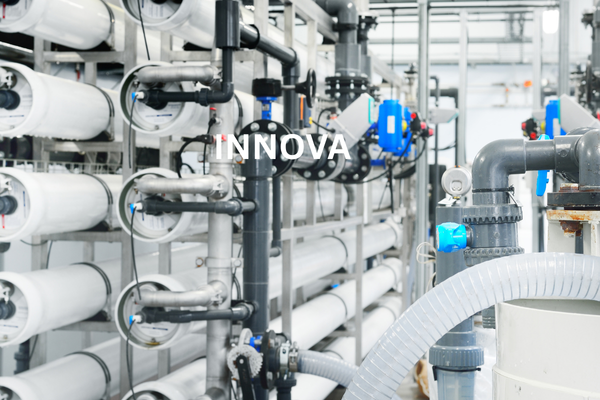
Innovacorp India manufactures antiscalants for reverse osmosis membrane systems in the United States. The product is designed for industrial RO plants that need to push recovery without pushing the concentrate stream past the scaling threshold. US RO systems draw from brackish groundwater, surface water, municipal supply and reclaimed water, and the scaling risk changes with the source. The antiscalant is selected around the salt that is closest to saturation, not around a generic product list.
An RO membrane does not scale because the feed water is saturated. It scales because the concentrate stream becomes saturated as water passes through the membrane. As recovery increases, dissolved salts concentrate in the reject stream, and the least soluble salt reaches its limit first. Calcium carbonate is the most common. Calcium sulfate, barium sulfate and silica follow. The standard way to predict this is the Langelier Saturation Index for lower-TDS brackish water and the Stiff and Davis Stability Index for high-salinity water and seawater. Both indices are calculated on the concentrate stream, not the feed. The antiscalant dose is chosen to keep the index within the membrane manufacturer's limit while holding the target recovery.
Antiscalants do not remove scale-forming ions from the water. They interfere with the crystallisation process. Threshold inhibition means a small dose of polymer keeps a much larger quantity of salt in solution, well beyond its normal saturation point. Crystal distortion means the polymer disrupts the growth of scale crystals so they stay small and dispersed instead of forming a hard deposit on the membrane surface. Both mechanisms depend on the polymer chemistry matching the scale type. A grade built for calcium carbonate will not perform the same way on silica, and a silica-specific grade is needed where soluble silica is the limiting salt.
Appearance, pH, specific gravity, active content and shelf life are listed in the product TDS. TDS is available on request for each grade.
The antiscalant is dosed continuously into the RO feed, upstream of the cartridge filter and the high-pressure pump. Dosage is expressed in ppm in the feedwater and is set from the concentrate stream chemistry, not from a fixed number. The product is dosed as supplied or after dilution depending on the feed system. Final dosage is confirmed after water analysis and a plant trial.
Standard industrial packing; pack sizes on request.
Under-dosing shows up slowly. The first sign is a gradual rise in feed pressure and a drop in permeate flow, followed by a marked increase in salt passage if the scale reaches the membrane surface. By the time the pressure rise is obvious, the scale is already established. Over-dosing is not harmless either. Some polymers can themselves foul the membrane, particularly in the second stage where concentration is highest. The third problem is using the wrong grade for the scale type: a carbonate grade dosed into a silica-limited system will not prevent silica scaling, and the plant will keep cleaning membranes without understanding why. The fourth is ignoring the concentrate index. A dose that worked at one recovery may be insufficient when the plant raises recovery without recalculating the concentrate chemistry.
We work with plant engineers and water treatment operators to review feedwater analysis, calculate the concentrate index and select the grade. TDS and dosing guidance are shared on request. Final specification and dosage are confirmed after water analysis and a plant trial on your feedwater.
Dosage is set from the concentrate stream chemistry. The LSI or Stiff and Davis Saturation Index is calculated for the concentrate, and the antiscalant dose is chosen to keep the index within the membrane manufacturer's limit. The final figure is confirmed after water analysis and a plant trial; TDS and dosing guidance are available on request.
The range covers calcium carbonate, calcium sulfate, barium sulfate and silica. The correct grade depends on which salt is closest to saturation in the concentrate. A water analysis is the starting point; the grade is confirmed after a lab trial.
Antiscalants work by threshold inhibition and crystal distortion, which keeps scale-forming salts in solution beyond their normal saturation point. This can support operation at higher recovery than would be possible without treatment. The maximum recovery is set by the membrane manufacturer and the concentrate chemistry, and should be confirmed before operating above the design figure.
LSI (Langelier Saturation Index) is used for brackish water with lower TDS. S&DSI (Stiff and Davis Stability Index) is used for high-salinity water and seawater. Both predict calcium carbonate scaling potential in the concentrate stream. The correct index depends on the feed TDS.
Call +91-9312871070 to discuss grade selection and concentrate index review for your RO plant.
© 2026 Innovacorp India Pvt Ltd. All Rights Reserved. Managed & Developed by Innova Corporate India
 Chat with Us