
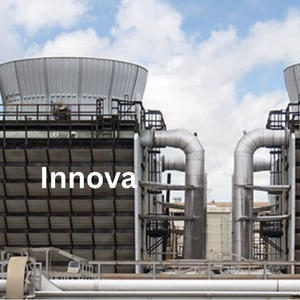
Innovacorp manufactures Cooling Water Treatment Chemicals for industrial circuits in the United States. This page is about the circuit as a whole: chillers, heat exchangers, closed loops and the water that moves through them. It is not a tower-only page. The focus here is on circuit-wide management — cycles of concentration, LSI balance, biocide rotation and the chemistry that keeps heat transfer surfaces clean across the entire loop. For the tower-specific problems (basin algae, fill fouling, drift), see our cooling tower chemicals for US plants.
A cooling circuit is not just a tower and a basin. It includes chillers, condensers, plate heat exchangers, piping, pumps and sometimes a closed secondary loop. Each component has its own materials of construction and its own sensitivity to water chemistry. A treatment programme that works for the tower may not protect the chiller if the chemistry is not matched to the circuit as a whole.
The circuit view changes the treatment logic. In an open circuit, water evaporates and concentrates, so scale and COC management are central. In a closed loop, water does not evaporate, so scale is less of a concern, but corrosion and microbial growth still need control. A plant with both open and closed circuits needs two different chemical approaches, not one generic programme applied to both.
Cycles of concentration (COC) is the ratio of dissolved solids in the circulating water to the dissolved solids in the makeup water. Higher COC means less makeup water is needed, because the same water is reused more times before blowdown. That saves water and reduces discharge volume.
But higher COC has a cost. As water cycles more times, scale-forming minerals concentrate. The treatment difficulty increases exponentially with COC. A typical target range is 3 to 5, depending on makeup water quality and the treatment programme. Pushing COC higher to save water can increase chemical consumption and risk scale failure if the inhibitor programme is not designed for that concentration level.
For US plants, water costs and discharge regulations vary by region. In water-stressed areas, higher COC may be worth the treatment cost. In areas with cheap water and lenient discharge rules, a lower COC may be more economical. The right COC is a site-specific decision, not a universal target.
The Langelier Saturation Index (LSI) is a calculated value that indicates whether water is scale-forming, corrosive, or balanced. A positive LSI suggests a tendency to deposit calcium carbonate scale. A negative LSI suggests a tendency to corrode metal. The target range is typically minus 0.5 to plus 0.5.
LSI is affected by pH, temperature, calcium hardness, alkalinity and dissolved solids. In a cooling circuit, these parameters shift as water concentrates and temperature changes. pH control is therefore a core part of circuit treatment. If pH runs high, scale risk rises. If pH runs low, corrosion risk rises. A pH booster or acid dosing system is used to keep the circuit within the balanced range. For the pH control side of the programme, see our pH booster for cooling water systems.
The distinction matters because the problems are different.
Open recirculating circuits: water is exposed to air in the tower, evaporates, and concentrates. Scale inhibitors, corrosion inhibitors, biocides and dispersants are all part of the programme. COC and blowdown are active control variables. The circuit is dynamic, and the chemistry has to respond to changing concentration and temperature.
Closed loops: the same water circulates without atmospheric exposure. Evaporation and concentration are not the primary issues. The main concerns are corrosion (from dissolved oxygen and galvanic effects) and microbial growth (if the loop is not sterile). Closed-loop treatment typically focuses on corrosion inhibitors and occasionally a biocide, with less emphasis on scale inhibitors unless the makeup water is hard and the loop has a leak or make-up requirement.
A US plant may have both: an open circuit for the main cooling load and a closed loop for a chiller or a critical heat exchanger. The treatment programme has to account for both, with different products at different dosing points.
The US cooling water treatment market is segmented by end use, with power generation, steel and metallurgy, petrochemicals, food and beverage, and textile among the main segments. Each segment has a different operating pattern and a different sensitivity to cooling failure.
Power generation: condensers are the largest cooling load. Scale or biofilm on condenser tubes directly affects vacuum and generation efficiency. Power plants are typically large-volume chemical users with continuous dosing and monitoring.
Petrochemicals and refining: process cooling is critical for reactor and distillation control. Cooling water failure can force a process shutdown. These plants often have both open and closed circuits and require a programme that covers both.
Food and beverage: cooling is used in fermentation, pasteurisation and storage. The treatment programme must be compatible with food safety requirements, and discharge regulations may be stricter than for other industries.
HVAC and commercial buildings: chillers and closed loops serve air conditioning loads. The systems are smaller, but reliability matters because the building is occupied. Closed-loop corrosion control is often the primary concern.
Indicative product types from our cooling water treatment range. Final specification is confirmed against your circuit configuration, water analysis and operating conditions. TDS is shared before order.
| Product Type | Open Circuit | Closed Loop |
|---|---|---|
| Scale Inhibitor | Continuous, based on makeup flow | Occasional, if makeup hardness is high |
| Corrosion Inhibitor | Continuous, matched to metals | Continuous, primary treatment |
| Oxidizing Biocide | Scheduled shock dosing | Rarely used (closed loop) |
| Non-Oxidizing Biocide | Alternating schedule with oxidizer | Periodic, if microbial growth is observed |
| pH Booster / Acid | Continuous, based on pH control | Occasional, for pH adjustment |
TDS on request. Dosage and product selection depend on circuit type, water analysis and operating conditions.
Cooling water treatment is control-based. The programme defines target ranges for COC, LSI, pH, inhibitor residual and microbial counts. The chemical dose is adjusted to keep the circuit within those ranges.
Scale and corrosion inhibitors are dosed continuously, typically proportional to makeup water flow. Biocides are dosed on a schedule, often alternating shock and maintenance doses. pH control is based on online measurement. Blowdown rate is set by the COC target and is adjusted when makeup water quality or operating conditions change.
Monitoring frequency depends on the circuit size and criticality. Large power plant circuits may have online monitoring for pH, conductivity and inhibitor residual. Smaller HVAC circuits may be tested weekly or monthly. The programme is reviewed when water analysis changes, when the circuit is modified, or when monitoring data shows a drift from target.
Standard packing is 35 kg / 50 kg HDPE carboys and 200 litre HDPE drums for liquid products. Bulk supply is available on request. Store in a cool, dry area away from direct sunlight and incompatible chemicals. Keep containers closed until use. Refer to the product SDS for handling and personal protective equipment requirements.
Cooling water treatment depends on the circuit configuration, makeup water quality and operating conditions. A programme that works for one plant may need adjustment for another because the circuit layout, water source or process load is different. We prefer to review your circuit diagram, water analysis and current treatment programme before recommending a product set and dosing approach. Share your system details with our technical team. Call +91-9312871070.
Q. What is cycles of concentration (COC) and why does it matter in cooling water
treatment?
Cycles of concentration is the ratio of dissolved solids in the circulating water to the dissolved solids
in the makeup water. Higher COC means less makeup water is needed, which saves water. But higher COC also
concentrates scale-forming minerals and increases treatment difficulty. A typical target range is 3 to 5,
depending on makeup water quality and treatment programme.
Q. How does the Langelier Saturation Index (LSI) guide cooling water treatment?
LSI indicates whether water is scaling, corrosive, or balanced. A positive LSI suggests scale-forming
tendency; a negative LSI suggests corrosive tendency. The target range is typically minus 0.5 to plus 0.5.
Treatment chemicals and pH control are adjusted to keep the circuit within this balanced range.
Q. What is the difference between an open recirculating circuit and a closed loop?
An open recirculating circuit exchanges heat with the atmosphere through a cooling tower, so water is
exposed to air, evaporation and concentration. A closed loop circulates the same water without atmospheric
exposure, so evaporation and concentration are not the primary concerns. Closed loops focus on corrosion
inhibition and microbial control, while open circuits require scale and COC management alongside corrosion
and biocide treatment.
Q. How are cooling water treatment chemicals dosed in a US plant?
Scale and corrosion inhibitors are typically dosed continuously, proportional to makeup water flow.
Biocides are dosed on a schedule, often alternating shock and maintenance doses. pH control chemicals are
dosed based on online pH measurement. Dosage is confirmed after water analysis and system observation.
Call +91-9312871070 to discuss your cooling circuit and request TDS for the treatment programme that fits your system configuration.
© 2026 Innovacorp India Pvt Ltd. All Rights Reserved. Managed & Developed by Innova Corporate India
 Chat with Us